
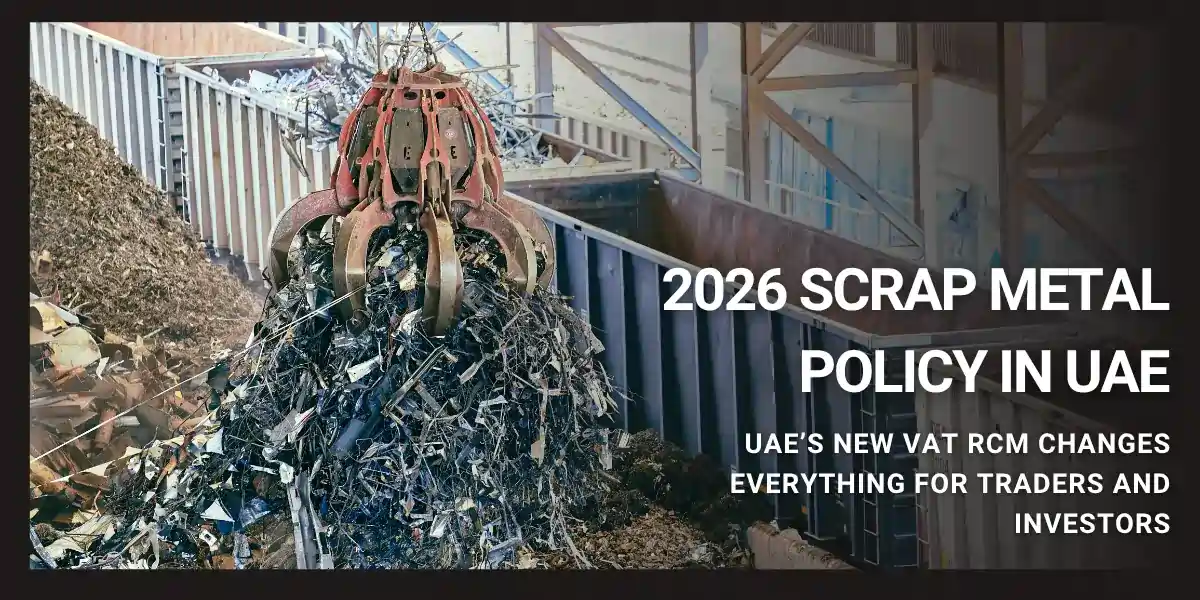
2026 Scrap Metal Policy In UAE
2026 Scrap Metal Policy In UAE: UAE’s New VAT RCM Changes Everything for Traders and Investors
Cabinet Resolution No. (153) of 2025 was announced by the UAE Ministry of Finance (MoF) on December 19, 2025. This is a significant change in the way VAT is managed in the scrap metal sector, not merely a small update.
The UAE will introduce a Reverse Charge Mechanism (RCM) for the exchange of scrap metal (such as iron, copper, and aluminum) on January 14, 2026. For those who are unaware, this implies that the buyer now bears the burden of accounting for VAT instead of the supplier.
This action creates a significant compliance barrier even though it is intended to reduce tax evasion and improve market integrity.
Businesses need to go beyond simple spreadsheets and work with IBR GROUP UAE ADVISORY, the top VAT experts in Dubai, to address this.
Why Is the Reverse Charge Mechanism Important?
In a typical transaction, 5% VAT is collected by the seller and sent to the FTA. Under the new scrap metal RCM:
1. The invoice does not include VAT from the seller.
2. The buyer accounts for the VAT on their own tax return if they are registered for taxes.
3. The buyer must give the seller a written statement attesting to their registration with the Authority and their intention to either process or resell the metal.
Although this seems straightforward, it adds a great deal of difficulty for an accountant in Dubai. Both parties are subject to severe penalties if the buyer does not submit the accurate declaration or if the seller does not confirm the buyer’s tax status.
In this situation, expert accounting services in Dubai can mean the difference between financial success and a legal nightmare.
Goals for the Decision
The UAE isn’t attempting to make traders’ lives more difficult, though. It aims to improve the system’s intelligence.
- Fighting VAT fraud in the metal-scrap industry is the first clear objective. The government seeks to close the gaps in this segment, which has historically been prone to them, without taxing everyone at random.
- It concerns justice and voluntary compliance. Traders who abide by the rules should believe that the system is fair since it erodes trust if everyone witnesses a gap being exploited.
- The action should enhance the management of VAT refunds. The FTA can process refunds more quickly, disagreements are reduced, and everyone is aware of their position when paperwork is straightforward and roles are clearly defined.
- Lastly, and possibly most crucially, it has to do with openness and confidence in the UAE tax system. This might be viewed as fortifying the core and making it more resilient without introducing burdensome elements that undermine legitimate enterprises. It is deliberate and cautious. Though not flawless, this is a step in the direction of a more dependable and clean tax environment.
The Accounting Difficulty: Reporting and Accruals
The trade in scrap metal moves quickly. Both the volume and frequency of transactions are high. Your records must show the tax responsibility at the precise time the “supply” takes place, not only when money exchanges hands, according to the accrual method of accounting.
You will probably have inconsistencies in your financial reporting in Dubai if your current bookkeeping is not configured to handle RCM automation. The FTA initiates a tax audit primarily due to these mistakes.
Many companies are opting to outsource accounting services in Dubai to make sure their books are audit-proof. They obtain access to sophisticated technologies that automatically classify scrap metal transactions in accordance with the new 2026 RCM regulations by doing this.
UAE replicates a global anti-VAT fraud measure
Internationally, scrap-metal dealing has long been recognized as a sector susceptible to VAT fraud, including carousel and missing-trader schemes. The UAE authorities aim to limit potential for exploitation while ensuring neutrality for enterprises who comply by eliminating VAT cash flow from the supply chain.
Similar reverse-charge regulations have already been effectively implemented by the UAE in other higher-risk industries, such as electronics, gold, and precious metals. Expanding the process to include scrap metal is not an individual adjustment, but rather a consistent approach to policy.
UAE Corporate Tax
It is crucial to keep in mind that corporate tax and VAT compliance are now closely related in the United Arab Emirates. The FTA can see every dirham of scrap metal that is traded. Financial mismanagement may be indicated if your VAT returns do not match your 9% Corporate Tax in UAE filings exactly.
A top-tier accounting firm in Dubai makes sure that your bookkeeping services in Dubai provide a “single source of truth” that feeds into both your corporate tax and VAT duties, rather than merely looking at the tax in a vacuum.
Why IBR GROUP UAE ADVISORY Is the Best Tax Advisory Company in UAE
You cannot rely on general guidance in a field as specialized as scrap metal. You need a partner that is regarded as one of the best tax consultancy companies in the United Arab Emirates.
That partner is IBR GROUP UAE ADVISORY. High-stakes regulatory changes are our area of expertise. We create a compliance barrier around your company rather than only “doing the math.”
Included in our Scrap Metal Compliance Strategy are:
- Specialized VAT Advisory: As top VAT advisors in Dubai, we help you make the switch to the Reverse Charge Mechanism and make sure your invoices and declarations are completely compliant by May 2026.
- Modernized Bookkeeping: We provide you with real-time financial reporting in Dubai using an accrual foundation of accounting designed especially for scrap metal volume.
- Integrated Tax Planning: We make sure your 9% tax burden is maximized and compliant by coordinating your VAT strategy with your corporate tax requirements in the United Arab Emirates.
- Cost-Effective Outsourcing: By outsourcing accounting services to IBR Group UAE, you can replace the expense of a whole in-house department with a group of top-notch accountants in Dubai at a much lower cost.