
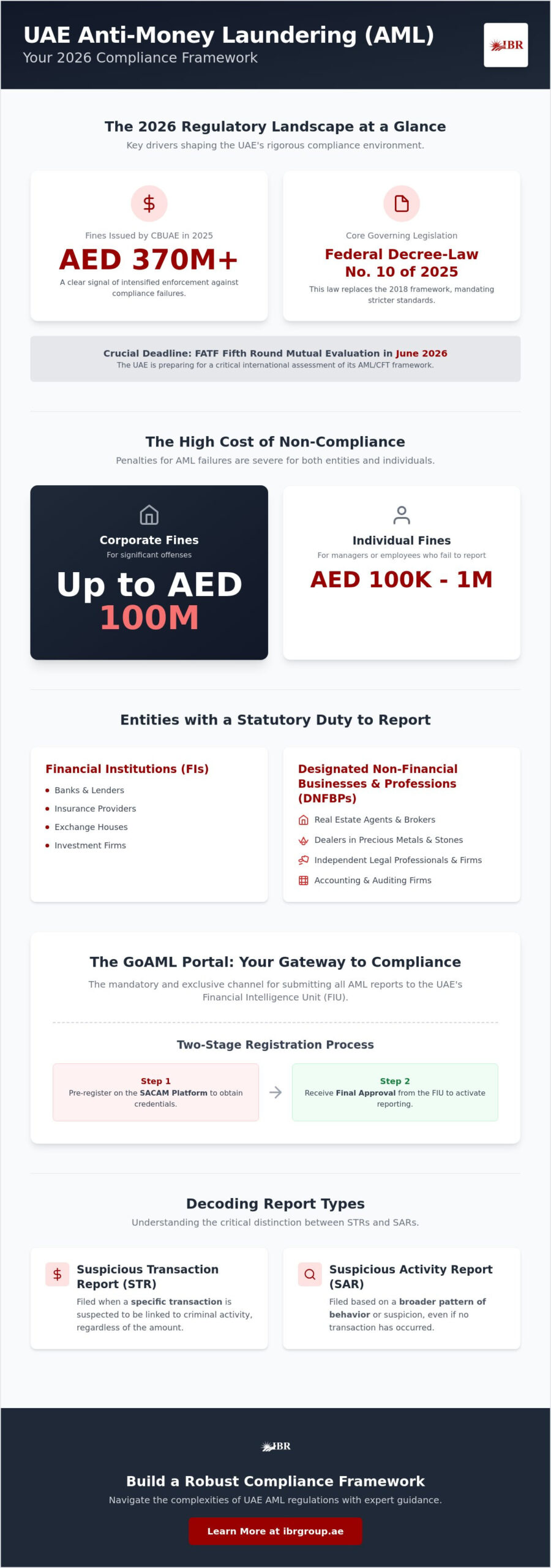
Did you know the Central Bank of the UAE issued over AED 370 million in fines in 2025 alone for compliance failures? As the country prepares for the FATF Fifth Round Mutual Evaluation in June 2026, the regulatory environment has become exceptionally rigorous. It’s natural to feel a sense of urgency regarding anti money laundering reporting uae requirements, particularly with the transition to Federal Decree-Law No. 10 of 2025. You likely recognize that maintaining a flawless compliance record isn’t just a legal necessity; it’s a strategic shield for your company’s longevity and reputation.
We understand that the updated goAML 5.6 portal and the subtle distinctions between Suspicious Transaction Reports and Suspicious Activity Reports can create significant confusion. This guide provides the expert clarity you need to master the 2026 reporting framework and ensure every submission is accurate. We will examine the specific triggers for reporting, the new XML upload capabilities, and the practical steps required to mitigate regulatory risks. This reference offers a structured roadmap to help you achieve seamless compliance and professional excellence in a complex financial landscape.
Key Takeaways
- Identify the core requirements of Federal Decree-Law No. 10 of 2025 to keep your business aligned with the latest regulatory standards.
- Recognize the importance of the goAML portal as your primary tool for mandatory disclosures to the Financial Intelligence Unit.
- Master the nuances of anti money laundering reporting uae by learning the specific triggers for Suspicious Transaction Reports and Suspicious Activity Reports.
- Follow a structured data-gathering protocol that ensures all necessary KYC details are documented before you finalize a submission.
- Understand how external audits act as a vital check, reinforcing your compliance framework and providing long-term peace of mind.
The UAE AML Reporting Landscape: Regulatory Framework in 2026
How can a business stay ahead of shifting regulatory tides while maintaining its focus on growth? In the United Arab Emirates, anti money laundering reporting uae is a statutory obligation that requires specific entities to disclose suspicious financial activities or transactions to the Financial Intelligence Unit (FIU). This process is a fundamental pillar of corporate integrity, designed to protect the nation’s financial ecosystem from illicit exploitation. The current legal foundation rests primarily on Federal Decree-Law No. 10 of 2025, which came into force on October 14, 2025, effectively replacing the 2018 framework to meet more rigorous international standards.
The National Committee for Combating Money Laundering coordinates these efforts, setting the strategic direction for all regulatory bodies. Compliance is no longer a peripheral task; it is a core operational requirement. Under the 2026 enforcement regime, the consequences of negligence are substantial. Legal entities can face administrative fines reaching up to AED 100 million for significant offenses. Individual accountability has also been heightened, with managers or employees who fail to report suspicious activity facing personal fines ranging from AED 100,000 to AED 1,000,000.
The Evolution of UAE Compliance Standards
The UAE has undergone a significant transformation, moving from the FATF grey list in early 2024 to becoming a global benchmark of transparency. This evolution is reflected in the 2026 regulations, which prioritize “substance over form” in all reporting activities. This means the FIU now looks beyond the mere submission of a report, evaluating the depth of the internal investigation and the quality of the data provided. Historical context regarding UAE Anti-Money Laundering Laws shows a consistent trajectory toward this high-pressure, high-transparency environment. Currently, the Ministry of Economy serves as the dedicated supervisor for all Designated Non-Financial Businesses and Professions (DNFBPs), ensuring these diverse sectors adhere to the same stringent standards as traditional banks.
Who is Obligated to Report?
The duty to report extends across two primary categories: Financial Institutions (FIs) and Designated Non-Financial Businesses and Professions (DNFBPs). While FIs include banks and insurance providers, the DNFBP category captures a wide range of professional services that are often targeted for money laundering. Key sectors under this umbrella include:
- Real estate agents and brokers involved in property transactions.
- Dealers in precious metals and stones (DPMS).
- Independent legal professionals and law firms.
- Accounting and auditing firms.
Within these organizations, the appointment of a “Reporting Officer” is mandatory. This individual acts as the primary liaison with the FIU and is responsible for overseeing the anti money laundering reporting uae process. It is their duty to vet internal suspicions and ensure that the firm’s compliance framework remains robust against evolving risks.
Navigating the goAML Portal: The Gateway to Compliance
How does a business bridge the gap between identifying a financial risk and fulfilling its statutory duty? The answer lies within the goAML portal, a sophisticated, integrated platform developed by the United Nations Office on Drugs and Crime (UNODC) specifically for the UAE Financial Intelligence Unit (FIU). This system is the exclusive channel for anti money laundering reporting uae, acting as a secure bridge for data exchange between the private sector and regulatory authorities. Because it is the only recognized medium for submission, completing your goAML registration uae is the first mandatory step for any entity operating within a regulated sector.
The registration process is a deliberate, dual-stage journey designed to verify the legitimacy of the reporting entity. First, businesses must complete a pre-registration on the SACAM (System for Abiding by Commission against Money Laundering) platform to obtain access credentials. Once this initial hurdle is cleared, the application moves to the FIU for final approval. In 2026, the portal operates on version 5.6, which requires specific technical configurations. You’ll need to ensure your systems are compatible with XML upload formats for bulk reporting and that your security protocols include multi-factor authentication to protect sensitive data. Securing professional assistance for AML Compliance can often help businesses navigate these technical hurdles with greater confidence.
Essential Documentation for goAML Access
Precision is vital during the registration phase. The FIU requires a specific set of documents to validate your corporate identity and the authority of your appointed officer. Before you begin the upload process, ensure you have the following items ready in a high-resolution, digital format:
- A valid Trade License issued by the relevant UAE licensing authority.
- The Passport and Emirates ID of the designated Compliance or Reporting Officer.
- A formal Authorization Letter, signed by the owners or directors, officially appointing the officer.
Check that all documents are currently valid; expired licenses are the leading cause of registration rejection in 2026. Other common pitfalls include mismatched names between the trade license and the portal entry or submitting documents that aren’t clearly legible. Taking the time to verify these details prevents avoidable delays in your anti money laundering reporting uae capabilities.
Managing Your goAML Dashboard
Once your account is active, the goAML dashboard becomes your primary compliance hub. It’s essential to monitor the “Message Board” daily, as this is where the FIU publishes critical circulars and regulatory updates that may impact your reporting triggers. Keeping your entity profile updated is equally important. If your office location or senior management changes, these details must be reflected in the portal immediately to avoid account suspension. Finally, the “Reporting History” tab is an invaluable resource. It provides a permanent record of all your submissions, which is vital for internal reviews and during any subsequent regulatory audit.
Decoding Report Types: SAR, STR, and DPM Explained
How do you determine which disclosure is appropriate when a client’s behavior raises concerns? Understanding the nuances of anti money laundering reporting uae requires a clear distinction between the various report types available on the goAML portal. While they all serve the overarching goal of transparency, their triggers and data requirements differ significantly. Selecting the wrong report type can lead to administrative delays or, in some cases, a failure to meet your statutory obligations under Federal Decree-Law No. 10 of 2025.
The primary distinction lies between the Suspicious Transaction Report (STR) and the Suspicious Activity Report (SAR). An STR is filed when a specific transaction, whether completed or merely attempted, appears to have no clear economic purpose or suggests a link to illicit funds. Conversely, a SAR is utilized when a client’s behavior or the circumstances surrounding a potential engagement are suspicious, even if a specific financial transaction hasn’t yet occurred. Additionally, businesses must remain vigilant regarding High-Risk Country Reports (HRC). These are mandatory filings triggered by any business relationship or transaction involving jurisdictions identified by the UAE authorities as having strategic AML deficiencies.
Compliance officers must also adhere to the “No-Tipping Off” rule. This is a critical legal boundary. It’s a criminal offense to disclose to a customer or any third party that a report has been filed or that an investigation is underway. Such an action could compromise an active FIU investigation and lead to severe personal legal consequences for the employee involved. Maintaining total confidentiality is not just a best practice; it’s a legal shield for your firm.
When to File: Identifying Suspicious Triggers
Identifying “Red Flags” is the first step in the reporting chain. Common indicators include clients who are unusually reluctant to provide KYC documentation, transactions that are unnecessarily complex, or sudden changes in a long-standing customer’s financial patterns. Thorough due diligence often involves checking a client’s legal history across various jurisdictions; for example, Verifica Processo is a valuable tool for monitoring judicial proceedings in Brazil. You don’t need absolute certainty of a crime to file a report. The standard is “Reasonable Grounds,” meaning a person with your professional expertise would find the activity suspicious based on the available facts. Suspicious Transaction Reports must be submitted to the FIU without delay once a suspicion is formed, typically interpreted as within 24 hours.
The DPM Report: A Guide for Real Estate and Precious Metals
The Designated Payment Method (DPM) report is a specific requirement for sectors prone to high-value cash movements. For Dealers in Precious Metals and Stones (DPMS), a report is mandatory for any single or linked cash transaction equal to or exceeding AED 55,000. Real estate professionals face similar requirements, particularly when transactions involve cash or Virtual Assets exceeding this same AED 55,000 threshold. Successful DPM submissions require precise data points, including the full identification of the purchaser, the exact source of funds, and a detailed description of the asset being traded. In the digital age, transactions involving Virtual Assets now require the same level of scrutiny as traditional cash payments to ensure no regulatory gaps remain; to understand the investigative side of these crimes, you can check out International Investigative Group.
Step-by-Step Guide to Submitting an AML Report
How does a firm move from a moment of suspicion to a successful regulatory filing? Once a potential risk is identified, the transition from internal concern to a formal disclosure must be methodical and well-documented. Effective anti money laundering reporting uae relies on a structured internal process that transforms raw observations into actionable intelligence for the Financial Intelligence Unit. This sequence ensures that your business doesn’t just meet a filing deadline but provides the high-quality data necessary for national security.
The process begins with a thorough internal investigation. Before accessing the goAML portal, the Reporting Officer must document why the suspicion arose, including the specific dates and the names of employees who flagged the activity. Following this, you must gather all relevant “Know Your Customer” (KYC) details. This includes the subject’s identification documents, corporate structure charts if applicable, and a clear record of their source of wealth. Drafting the report requires you to synthesize this information into a coherent argument. Your “Reason for Suspicion” must be objective and evidence-backed, avoiding personal opinions while focusing on the facts of the transaction or behavior. If you need assistance in structuring these internal workflows, our experts provide comprehensive AML Compliance services to secure your operations.
Drafting a High-Quality Narrative
The narrative section is the most critical component of any STR or SAR. It acts as the primary roadmap for FIU analysts who may not be familiar with your specific industry. A high-quality narrative focuses on the “Who, What, Where, When, and Why” of the suspicious activity. You should be concise but comprehensive, ensuring the chronological flow of events is easy to follow. When you attach supporting documents like bank statements, invoices, or contracts, ensure they are clearly labeled and directly referenced within the goAML text fields. This level of precision facilitates a smoother review process and demonstrates your firm’s commitment to professional excellence.
Post-Submission Protocols
Clicking the “Submit” button is only one phase of the compliance cycle. After a report is filed, the FIU may initiate a feedback loop, requesting further information or specific clarifications. You must respond to these inquiries with the same level of urgency as the initial report. During this period, handling the client relationship is a delicate task. You must maintain business as usual to avoid “tipping off” the subject, which is a serious legal violation. Finally, record-keeping is a mandatory safeguard; UAE regulations require you to store all AML-related records, including internal investigation notes and portal submission receipts, for at least five years to ensure they remain available for future audits.
Building a Robust Compliance Framework with IBR Group
How can a business transform its compliance obligations from a source of anxiety into a pillar of operational strength? While the technical steps of anti money laundering reporting uae are well-defined, the true challenge lies in integrating these requirements into the daily rhythm of your business. A robust framework isn’t merely about reacting to suspicious activity; it’s about building a proactive culture where every team member understands their role in protecting the firm’s reputation. This level of integration ensures that when a reporting trigger occurs, your response is seamless, documented, and fully aligned with the latest 2026 standards.
For organizations looking to implement similar high standards in other jurisdictions, such as Australia, Trancher provides a comprehensive end-to-end AML/CTF program management platform designed to help businesses meet their specific regulatory obligations efficiently.
One of the most effective ways to validate your internal controls is through a rigorous external audit. While many view auditing as a purely financial exercise, it plays a vital role in testing the efficacy of your AML protocols. An independent review can identify gaps in your KYC documentation or weaknesses in your transaction monitoring that might otherwise go unnoticed. At IBR Group, we provide end-to-end support that spans from the initial goAML registration to sophisticated reporting advisory. We also specialize in drafting the “expert report” often required to resolve complex regulatory inquiries or satisfy bank compliance departments during deep-dive reviews.
IBR Group: Your Strategic Compliance Partner
With over 15 years of experience navigating the intricate UAE regulatory environment, we’ve established ourselves as a steady guide for both freezone and mainland enterprises. We don’t believe in one-size-fits-all solutions. Instead, we draft tailored AML policies that reflect the specific risk profile of your industry, whether you’re in real estate, precious metals, or professional services. Our expertise extends beyond compliance; we offer a holistic suite of corporate services, including Golden Visa assistance and Corporate Tax Registration. This comprehensive approach allows us to act as a protective advisor for all your administrative and financial responsibilities.
Next Steps for UAE Business Owners
Adopting a “set and forget” approach to AML is a high-risk strategy that often leads to significant administrative fines. Regulatory expectations evolve rapidly, and your internal systems must keep pace. Regular compliance health checks and continuous staff training are essential to ensure your team remains vigilant against sophisticated financial crimes. Don’t wait for a regulatory inspection to discover vulnerabilities in your reporting chain. We invite you to contact IBR Group today for a comprehensive AML compliance audit to ensure your business remains a model of professional excellence in the UAE’s transparent financial ecosystem.
Securing Your Corporate Future in a Transparent Economy
Mastering the intricacies of the 2026 regulatory framework is no longer optional for businesses looking to thrive in the region. The shift toward more rigorous standards under Federal Decree-Law No. 10 of 2025 demands a deep understanding of reporting triggers and the technical nuances of the goAML portal. Maintaining an accurate anti money laundering reporting uae protocol is the most effective way to safeguard your organization against heavy administrative fines and reputational damage. By prioritizing high-quality data and methodical record-keeping, you position your firm as a leader in corporate integrity.
At IBR Group, we bring over 15 years of UAE financial expertise to help you navigate these complexities with total confidence. Our team provides comprehensive support for FTA and Central Bank compliance, including expert goAML registration and monitoring services tailored to your specific industry. We invite you to Ensure your business is 100% compliant; Book an AML consultation with IBR Group today. Taking proactive steps now ensures you can focus on growth while we provide the professional excellence and peace of mind your business deserves.
Frequently Asked Questions
What is the deadline for filing an STR or SAR in the UAE?
Regulated entities must submit a report to the Financial Intelligence Unit without delay once a reasonable suspicion is formed. In practice, the authorities expect this filing to occur within 24 hours of the suspicion being identified. Prompt anti money laundering reporting uae is essential to prevent the movement of illicit funds and ensures your firm remains compliant with the strict timelines set by Federal Decree-Law No. 10 of 2025.
Can a business be fined if they report a transaction that turns out to be legitimate?
No, businesses and their employees are legally protected when reporting in good faith. UAE law provides specific immunity from administrative, civil, or criminal liability for individuals who disclose suspicious activities to the FIU. This protection applies even if the underlying transaction is eventually found to be lawful. The priority is to encourage transparency and ensure that potential risks are flagged without fear of legal repercussions.
Who is responsible for AML reporting in a small UAE freezone company?
The designated Compliance Officer or Reporting Officer holds the primary responsibility for all filings. Even for small firms in freezones, appointing a qualified individual to oversee the AML framework is a mandatory legal requirement. This officer acts as the official liaison with the FIU and ensures that all internal suspicions are properly vetted and submitted through the goAML portal to maintain corporate integrity.
What is the difference between AML and CFT in the context of UAE reporting?
Anti-Money Laundering (AML) focuses on preventing the integration of funds derived from criminal activities into the legal economy. In contrast, Combating the Financing of Terrorism (CFT) is concerned with the destination of the funds, regardless of whether the source is legal or illegal. Both elements are critical components of your anti money laundering reporting uae obligations and require different risk assessment strategies to identify suspicious patterns correctly.
Do I need to report cash transactions if I have a mainland trade license?
Yes, if your business falls under the category of a Designated Non-Financial Business or Profession (DNFBP). For example, mainland real estate brokers or dealers in precious metals must report cash transactions that meet or exceed the AED 55,000 threshold. These filings are made via the DPMSR (Designated Payment Method) report on the goAML portal to ensure full transparency in high-value sectors prone to cash movements.
What happens if I forget my goAML login credentials?
You must initiate a recovery process through the official Financial Intelligence Unit helpdesk. Because the portal contains highly sensitive data, the reset process involves strict identity verification of the registered Reporting Officer. It’s vital to maintain secure records of your credentials to avoid delays in reporting, as technical issues don’t exempt a firm from its statutory filing deadlines or regulatory expectations.
Is AML reporting required for offshore BVI companies managed from the UAE?
If the offshore entity is managed and controlled within the UAE, or if it conducts regulated activities through a local branch, it must adhere to UAE AML regulations. The authorities focus on where the business activity and decision-making occur. Any entity operating within the UAE’s jurisdiction that meets the criteria of a Financial Institution or DNFBP must register on goAML and fulfill all mandatory reporting duties.
How does the goAML system protect the identity of the reporting officer?
The goAML platform utilizes advanced encryption and secure protocols to ensure that the identity of the person filing the report remains confidential. UAE law strictly prohibits the disclosure of the reporting officer’s identity to the subject of the report or any unauthorized third parties. This confidentiality is a cornerstone of the system, designed to protect professionals while they fulfill their statutory duty to report illicit financial behavior.