
Did you know that 72% of new business ventures in the Emirates are now supported by formal assessments to navigate an increasingly sophisticated economy? In a landscape where the 2026 UAE Corporate Tax framework and stringent AML protocols have redefined the standards for success, a simple business plan is rarely enough. Investing in a professional business feasibility study for the UAE market has become a critical step for entrepreneurs who need to secure bank approvals and avoid the devastating costs associated with market entry errors.
It’s understandable to feel a sense of caution when faced with a 9% corporate tax on income over AED 375,000 and the transition to mandatory e-invoicing. You deserve a strategy that protects your capital while providing a clear, data-driven path to growth. This guide promises to equip you with a professional framework to ensure your project is both financially viable and fully compliant with current regulations. We’ll examine how to build a bankable report that offers precise ROI projections, allowing you to move forward with the confidence and peace of mind that only deep-rooted expertise can provide.
Key Takeaways
- Understand why a comprehensive assessment is essential to navigate the 2026 regulatory landscape, including the 9% corporate tax and evolving AML requirements.
- Learn how to evaluate technical feasibility by assessing UAE-specific infrastructure and logistics to ensure your operational model is sustainable from day one.
- Discover why a professional business feasibility study dubai must serve as the foundation for your business plan to validate your logic before committing capital.
- Identify the specific IFRS standards and “bankable” criteria required to secure financing and regulatory approvals from UAE financial institutions.
- Explore how integrating feasibility data with professional audit and company setup services creates a seamless transition from a concept to an active mainland or freezone entity.
Table of Contents
- Why Feasibility Studies are Vital for UAE Market Entry in 2026
- The Four Pillars of a Professional Feasibility Analysis
- Feasibility Study vs. Business Plan: A Strategic Comparison
- Ensuring Your Study Meets UAE Banking and Investor Standards
- Leveraging IBR Group’s Multi-Disciplinary Expertise for Project Success
Why Feasibility Studies are Vital for UAE Market Entry in 2026
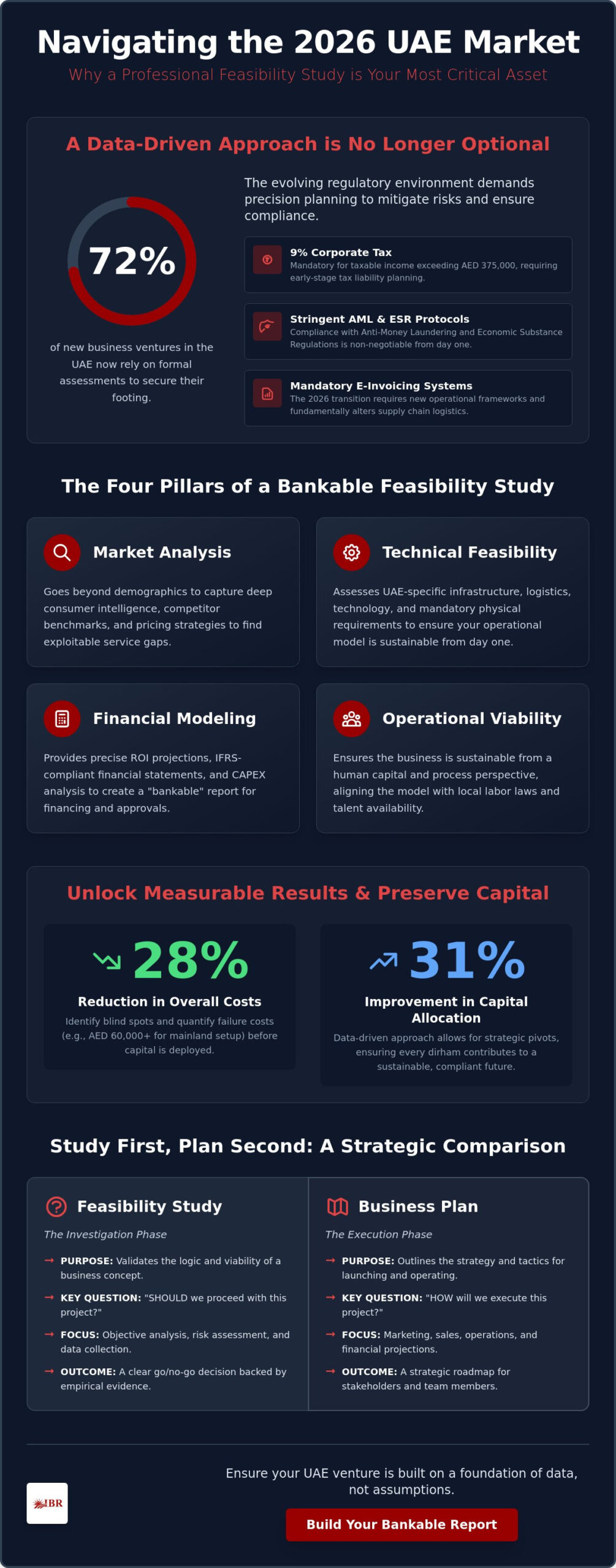
Entering the Dubai market is no longer a matter of intuition; it’s a calculated commitment to a high-growth yet highly regulated ecosystem. As of 2026, approximately 72% of new business ventures in the Emirates rely on formal assessments to secure their footing. This shift from “gut-feeling” entrepreneurship to data-driven corporate strategy reflects the increasing complexity of the regional market. For international investors, the stakes are high, and the cost of entry errors can be prohibitive. A robust business feasibility study dubai provides the necessary clarity to determine if a concept can survive the transition from paper to a competitive reality. It’s the difference between a speculative gamble and a strategic investment.
The Evolving UAE Regulatory Environment
The regulatory landscape in 2026 requires a level of precision that was optional only a few years ago. With the 9% corporate tax now fully integrated for taxable income exceeding AED 375,000, investors must account for tax liabilities from the earliest planning stages. Understanding What is a Feasibility Study? helps entrepreneurs realize that these documents aren’t just for internal use; they’re vital for proving Economic Substance (ESR) and meeting Anti-Money Laundering (AML) requirements. Compliance isn’t a post-launch checklist. It begins with the project planning phase. New ventures must also consider the 2026 mandatory e-invoicing systems and the nationwide ban on single-use plastics, both of which can fundamentally alter operational costs and supply chain logistics.
Risk Mitigation and Capital Preservation
Capital preservation is the cornerstone of any successful market entry. UAE-based companies that rely on structured feasibility assessments report a 28% reduction in overall project and operational costs. These firms also see a 31% improvement in capital allocation efficiency. This data-driven approach identifies “blind spots” that international investors often miss, such as the nuances between mainland and freezone competitive landscapes. Consider these critical factors:
- Quantifying Failure: The cost of professional advisory is a fraction of the potential loss from a failed launch, where mainland setup costs can reach AED 60,000 before a single sale is made.
- Strategic Pivoting: A feasibility study allows you to pivot your model before significant capital expenditure (CAPEX) is deployed.
- Saturation Analysis: We analyze market saturation to ensure your entry is timed with genuine opportunity rather than entering a crowded field.
By utilizing a business feasibility study dubai, you’re not just validating an idea. You’re building a protective shield around your capital and ensuring that every dirham spent contributes to a sustainable, compliant future.
The Four Pillars of a Professional Feasibility Analysis
A professional business feasibility study dubai is built on four distinct yet interconnected pillars. These components provide the structural integrity required for any commercial venture to withstand the unique pressures of the local market. While a business plan focuses on execution, the feasibility study serves as the critical validation phase. It ensures that every dirham allocated to your project is backed by empirical evidence and strategic logic. By examining these four areas, you move from a conceptual idea to a verified investment opportunity.
The first pillar is Market Analysis. This goes beyond simple demographics to capture deep consumer intelligence. You must understand the specific behaviors of the UAE’s diverse population. The second pillar, Technical Feasibility, addresses physical and technological requirements. For instance, a mainland business must account for mandatory office space, where private offices typically range from AED 15,000 to over AED 50,000 annually. The third and fourth pillars, Financial Modeling and Operational Viability, ensure the business is both profitable and sustainable from a human capital perspective.
Market and Competitive Intelligence
Defining the Total Addressable Market (TAM) within the UAE requires a nuanced understanding of national demographics and regional trade flows. Competitor benchmarking is equally vital. You need to identify pricing strategies and service gaps that your venture can exploit. Market validation is achieved through a rigorous synthesis of primary consumer surveys and secondary industry reports. This dual approach ensures your market share projections aren’t just optimistic guesses but are grounded in reality. Understanding When to Do and How to Use a Feasibility Study is essential for timing this research before significant capital is committed.
Financial Projections and ROI
Bankable projections require 3-to-5-year cash flow statements that align strictly with UAE accounting standards and IFRS. We calculate the Break-Even Point (BEP) and Internal Rate of Return (IRR) to provide a transparent view of profitability. A critical component of this pillar is sensitivity analysis. What happens if market conditions shift by 10% or 20%? By stress-testing your financial model, you prepare for fluctuations in the regional economy. For those looking to ensure their financial models meet the highest regulatory standards, engaging with experts in external audit can bridge the gap between theoretical projections and bank-ready reports. This level of precision is what distinguishes a standard report from a truly professional business feasibility study dubai.
Feasibility Study vs. Business Plan: A Strategic Comparison
Why do so many entrepreneurs rush into drafting a business plan before validating their core assumptions? It’s a common mistake that can lead to significant capital loss in a market as competitive as the Emirates. While these two documents are often treated as interchangeable, they serve entirely different purposes in the investment lifecycle. A business feasibility study dubai is designed to answer the question: “Is this venture viable?” In contrast, a business plan focuses on the question: “How will we execute this venture?” Understanding this distinction is the first step toward professional excellence and risk mitigation.
The feasibility study acts as a filter. It identifies technical limitations, financial risks, and regulatory hurdles that could render a project unworkable. If the study reveals that the 9% corporate tax or the high cost of mainland office space-where private offices can exceed AED 50,000 annually-compromises the ROI, the investor can pivot or halt the project. A business plan, however, assumes the project is already a “go.” It outlines marketing strategies, management hierarchies, and daily operations. Without the preceding validation of a feasibility study, a business plan is merely a roadmap built on untested logic.
Validation vs. Roadmap
For institutional investors and venture capitalists, the feasibility study is the ultimate “Go/No-Go” tool. It provides an objective analysis of the Total Addressable Market (TAM) and technical constraints. Once the study confirms viability, the business plan takes over as a tactical manual for post-incorporation operations. At IBR Group, we specialize in bridging this transition. We ensure that the data gathered during your business feasibility study dubai flows seamlessly into your company setup strategy. This integrated approach ensures that your operational roadmap is grounded in verified financial realities.
Decision-Making Frameworks
Investors and banks in the UAE maintain high standards for documentation. They often trust third-party feasibility reports over internal business plans because the former is perceived as more objective and less biased. This is where the role of professional external audit firms becomes invaluable. By having an independent expert validate your feasibility data, you provide a layer of security that internal teams simply cannot offer. This external validation proves that your financial projections, from break-even points to IRR, have been stress-tested against current market volatility and regulatory shifts. It’s this level of thoroughness that secures bank approvals and investor confidence.
Ensuring Your Study Meets UAE Banking and Investor Standards
How do you ensure your project moves from a theoretical concept to a funded reality? In the current financial climate, a business feasibility study dubai must act as a bridge between your vision and the stringent requirements of local lending institutions. Banks in the Emirates have significantly increased their scrutiny, looking for reports that align perfectly with International Financial Reporting Standards (IFRS) and local regulatory mandates. A study that lacks this level of professional depth is often the primary reason for delayed corporate account approvals or rejected credit applications.
One of the most effective tools for resolving complex bank queries is the inclusion of an “expert report.” These specialized documents provide third-party validation that can expedite the opening of corporate accounts and the approval of credit facilities. By presenting an objective analysis of your project’s viability, you provide the reassurance that modern financial institutions demand. Compliance isn’t just a legal obligation; it’s a financial necessity. Your study should demonstrate clear goAML readiness and a robust framework for AML compliance, proving that your venture is built on a foundation of integrity and transparency.
Securing Project Financing
When you present a risk-weighted financial model, you’re showing lenders that you’ve accounted for every possible variable. It’s essential to factor in the 9% corporate tax on income exceeding AED 375,000, as this directly impacts your future debt servicing capacity. Lenders want to see how your cash flow remains resilient under various stress tests. Maintaining professional bookkeeping from day one ensures that your historical data supports the feasibility narrative, making your venture “bankable.” This proactive approach to financial management is what distinguishes a serious investor from a speculative one.
Regulatory and Legal Alignment
Choosing between a Mainland or Freezone structure is a decision with long-term consequences that must be addressed in your feasibility analysis. While Mainland setups offer unrestricted market access, they require careful navigation of the 2026 regulatory updates, including the nationwide ban on single-use plastics and mandatory e-invoicing. Comprehensive VAT and tax residency planning are essential for every new entity to optimize its financial position and ensure long-term sustainability. If you’re ready to secure your project’s future with a compliant and bankable strategy, our team can assist with professional expert report services tailored to the UAE market.
Leveraging IBR Group’s Multi-Disciplinary Expertise for Project Success
How can an investor transform a high-level vision into a sustainable, revenue-generating entity? Success in the UAE’s sophisticated regulatory environment requires more than a standalone report. It demands a partner who understands how a business feasibility study dubai interacts with every subsequent phase of the business lifecycle. At IBR Group, we provide a multi-disciplinary approach that ensures your initial validation is perfectly aligned with the practicalities of company setup and long-term operational compliance.
Our methodology is distinct because it’s informed by active external audit experience. This means your feasibility study isn’t based on theoretical models alone. It’s built on a foundation of real-world financial scrutiny and rigorous IFRS standards. By integrating corporate tax registration into the planning stage, we protect your venture from the risks associated with the 2026 tax landscape. We don’t rely on generic templates. Every strategy is bespoke, designed to empower your specific commercial objectives while simplifying the inherent complexity of the regional market.
From Feasibility to Foundation
The insights gained during the feasibility phase flow directly into a seamless registration process, whether you’re establishing a mainland entity or a freezone presence. Our support extends far beyond the initial study. We guide you through the complexities of VAT return filing and the implementation of robust AML monitoring systems to ensure your business remains in good standing with the authorities. For many international investors, the business feasibility study dubai roadmap also includes strategic guidance on securing a Golden Visa, providing a stable foundation for both your professional and personal future in the Emirates.
Why Investors Trust IBR Group
With over 15 years of experience within the UAE financial sector, IBR Group has established a reputation for delivering bankable results that satisfy the most demanding institutional requirements. We act as a protective and proactive advisor, taking ownership of critical administrative and financial responsibilities so you can focus on growth. Our commitment to professional excellence and strategic empowerment ensures that you aren’t just entering a market; you’re building a legacy. We pride ourselves on being a steady guide through every modern challenge, providing the peace of mind that comes from working with seasoned professionals who value precision above all else.
Securing Strategic Success in the 2026 UAE Market
Securing a business feasibility study dubai is the first step toward commercial stability. We’ve explored how a professional framework mitigates the risks of the 2026 Corporate Tax landscape and ensures your financial projections meet IFRS standards. By distinguishing between simple roadmaps and rigorous validation, you position your entity for long-term viability and seamless bank approvals. Precision matters here.
IBR Group brings over 15 years of UAE financial expertise to your project. We offer specialized support in Bank Query Resolution and comprehensive tax and audit integration. We don’t just provide data; we deliver the peace of mind that comes from professional excellence. If you’re ready to move forward with a bankable strategy, Contact IBR Group for a tailored business feasibility study. Your vision deserves a foundation built on precision and deep-rooted regional wisdom. We look forward to empowering your growth in the Emirates.
Frequently Asked Questions
What is the primary purpose of a business feasibility study in the UAE?
The primary purpose of a business feasibility study dubai is to provide a definitive “go/no-go” decision framework by validating the financial and regulatory viability of a proposed project. It acts as a protective shield for your capital, ensuring that every assumption about market demand and operational costs is tested against the reality of the Emirates’ competitive landscape before you commit to significant investment.
How long does it typically take to complete a comprehensive feasibility study?
A professional feasibility study typically takes between 4 and 8 weeks to complete. This duration is necessary to conduct thorough primary market research, assess technical requirements, and develop the risk-weighted financial models that UAE banks and institutional investors require for project approval.
Can a feasibility study help in securing a bank account in the UAE?
Yes, a professionally prepared feasibility study is often a decisive factor in securing a corporate bank account for a new entity. UAE financial institutions use these reports to evaluate the business model’s legitimacy and risk profile, ensuring the venture complies with current Anti-Money Laundering (AML) standards and possesses a clear path to profitability.
What is the difference between a market research report and a feasibility study?
Market research focuses exclusively on external factors such as consumer behavior, demographics, and competitor pricing. A business feasibility study dubai is much broader, integrating those market insights with internal technical requirements, operational management structures, and 5-year financial projections to determine if the project is holistically sustainable.
Do UAE freezone authorities require a feasibility study for company setup?
Certain freezone authorities and mainland departments mandate a feasibility study for specific activities, particularly in the industrial, healthcare, and education sectors. Even when it isn’t a mandatory filing requirement, having one is essential for obtaining specialized licenses and demonstrating economic substance to regulatory bodies.
How does the new UAE Corporate Tax affect feasibility projections for 2026?
The 2026 Corporate Tax landscape requires all feasibility projections to include a 9% tax on taxable income exceeding AED 375,000. This ensures that your projected Return on Investment (ROI) and payback periods are calculated based on net figures after tax, providing a more accurate and “bankable” reflection of your future cash flows.
Is it possible for a feasibility study to recommend not proceeding with a project?
An objective feasibility study will recommend not proceeding if the data reveals that the project is not financially viable or technically possible. Identifying these “no-go” scenarios early is a vital part of risk mitigation, saving investors from the high costs of failed market entries and preserving capital for more viable opportunities.
What are the essential financial metrics included in a professional study?
A professional study must include the Internal Rate of Return (IRR), Net Present Value (NPV), and a detailed Break-Even Analysis (BEP). These metrics, supported by 3-to-5-year cash flow projections and sensitivity analyses, provide the quantitative evidence needed to satisfy both internal stakeholders and external lending institutions.