
Could your financial records be the only thing standing between your business and its next major expansion? For many entrepreneurs, a financial statement audit in dubai is often viewed as a mandatory regulatory hurdle rather than a strategic asset. We understand that keeping pace with the 9% corporate tax threshold and the varying filing deadlines for the DMCC, JAFZA, or the Dubai Development Authority can feel like a complex burden. It’s natural to feel a sense of anxiety regarding potential financial misstatements or the difficulty of securing vital bank financing without a verified report in hand.
We believe that clarity is the foundation of confidence. In this article, you’ll discover how a financial statement audit serves as a strategic tool for transparency, compliance, and sustainable business growth in the UAE. We’ll explore how precise reporting ensures full compliance with the latest 2026 regulations while identifying internal control weaknesses that could hinder your progress. By the end of this guide, you’ll understand how to transform a standard compliance requirement into a powerful engine for building corporate credibility with investors and financial institutions alike.
Key Takeaways
- Learn how an audit functions as a strategic tool to uncover internal control weaknesses and drive long-term business growth.
- Understand specific audit thresholds for UAE Mainland and Freezone entities to ensure license renewals and regulatory filings remain seamless.
- Discover how a professional financial statement audit dubai builds essential trust with banks and international investors, serving as a financial passport for global trade.
- Identify critical components of a comprehensive audit report that safeguard your corporate transparency and satisfy complex bank queries.
- See how combining external audit services with tax and AML compliance creates a high-standard framework for managing your critical administrative responsibilities.
The Role of Financial Statement Audits in the UAE Economy
The UAE economy is undergoing a profound transformation. As Dubai cements its position as a global financial hub, the need for rigorous oversight has never been more critical. A financial audit is an independent examination of a company’s financial records to ensure they provide a true and fair view of its financial health. While internal reviews are helpful for day-to-day management, an external statutory audit provides the objective validation that stakeholders, from government bodies to international investors, demand. This distinction is vital; an internal review looks inward for efficiency, but an external audit looks outward to build trust.
Transparency acts as the cornerstone of the UAE’s 2026 economic vision. By aligning national auditing standards with international benchmarks, the Emirates has created a stable environment for capital investment. Conducting a financial statement audit dubai isn’t just about checking boxes; it’s about participating in a mature ecosystem where financial integrity is rewarded with easier access to credit and increased market trust. In a landscape where over 90% of businesses are SMEs, having verified data is the only way to stand out in a competitive field.
Understanding the Audit Process
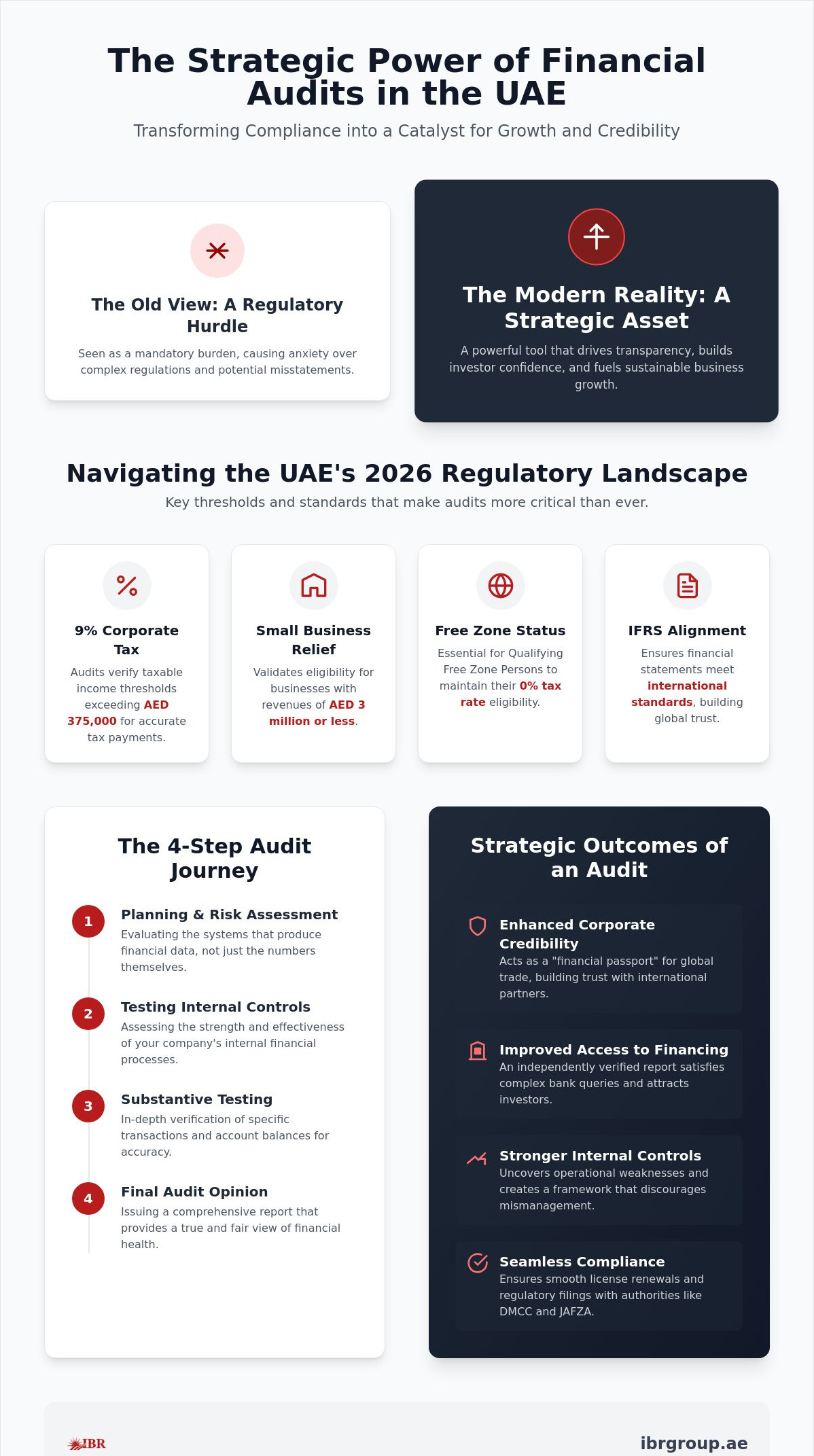
When you engage in a financial statement audit dubai, the journey begins with meticulous planning and risk assessment. Auditors don’t just look at numbers; they evaluate the systems that produce them. This process moves from testing internal controls to substantive testing of transactions, eventually leading to the final audit opinion. In the UAE, this work is guided by International Financial Reporting Standards (IFRS). These standards ensure that local businesses speak the same financial language as their global counterparts. This consistency allows a Dubai-based firm to present its books with confidence to a partner in London or Singapore, knowing the data is recognized and respected.
The 2026 Regulatory Landscape
The regulatory environment in 2026 is more integrated than ever. Under the UAE Federal Commercial Companies Law, specific entities must undergo an annual audit to maintain their legal standing. The introduction of the 9% Corporate Tax has added a new layer of necessity. The Federal Tax Authority (FTA) now utilizes audited financial statements as a primary tool for monitoring tax accuracy. This means your audit is no longer just a corporate requirement; it’s a tax-critical document. Key regulatory focuses include:
- Verification of taxable income thresholds exceeding AED 375,000 to ensure correct tax payments.
- Validation of Small Business Relief eligibility for companies with revenues of AED 3 million or less.
- Compliance checks for Qualifying Free Zone Persons to maintain their 0% tax rate eligibility.
- Adherence to the latest IFRS amendments effective as of January 1, 2026, regarding ESG-linked cash flows and financial asset derecognition.
This synergy between audit and tax makes the role of the auditor more strategic than administrative. It acts as a proactive safeguard for your business’s future, ensuring that your financial disclosures remain beyond reproach in an increasingly scrutinized market.
Why Financial Audits are Essential for Corporate Credibility
Credibility isn’t just a buzzword; it’s the bedrock of any successful enterprise in the UAE. When you commit to a financial statement audit dubai, you’re sending a clear signal that your business values precision over convenience. This independent verification acts as a “financial passport,” allowing your company to cross borders and engage in international trade with partners who require standardized proof of solvency. In a globalized market, a company without audited accounts is often viewed with skepticism, making it difficult to secure contracts with multinational corporations that prioritize risk management.
Beyond external growth, an audit serves as a vital internal shield. By adhering to the UAE’s Commercial Companies Law, businesses establish a framework that actively discourages mismanagement and fraud. It’s about protecting what you’ve built. A “clean” audit report carries significant psychological weight, reassuring the market that your operations are transparent and your leadership is accountable. This reputation for integrity can be your greatest asset during economic shifts, providing a layer of stability that unverified competitors simply lack.
Building Trust with Stakeholders
Trust is hard to earn but easy to lose. For minority shareholders and potential investors, an objective audit provides the assurance they need to keep their capital in your business. It demonstrates a commitment to professional excellence and ethical reporting. Utilizing a professional audit report dubai helps you present a narrative of stability, transforming raw data into a compelling story of transparency. This level of detail doesn’t just satisfy legal requirements; it builds a bridge of confidence between management and those who fuel the company’s growth.
Enhancing Banking and Financing Opportunities
Why do UAE banks insist on audited financials before granting credit? It’s simple: they need to manage their own risk. A verified financial statement audit dubai often leads to more favorable interest rates and flexible loan terms. Banks look for consistency and reliability. If they encounter complex queries regarding stock valuation or asset depreciation, having a verified expert report ready can mean the difference between a swift approval and a lengthy rejection. These reports provide the technical depth banks require to justify lending decisions. It’s often helpful to consult with experienced audit professionals who understand these specific banking requirements and can guide you through the documentation process seamlessly.
Key Components of a Comprehensive Financial Audit Report
What exactly does a financial statement audit dubai produce for your business? It’s much more than a simple stamp of approval. A comprehensive audit report is a structured dossier that provides a microscopic view of your company’s financial integrity. It begins with a detailed analysis of the Statement of Financial Position, commonly known as the Balance Sheet. Here, auditors verify the existence and valuation of your assets, from physical inventory to liquid cash, while ensuring that all liabilities and equity are recorded with precision. This verification process is essential for confirming that your company’s net worth is represented accurately to external stakeholders.
The report also includes a rigorous examination of the Income Statement. Auditors scrutinize revenue recognition patterns and expense categorizations to ensure they align with the IFRS standards discussed earlier. By assessing the Cash Flow Statement and changes in equity, the audit provides a clear narrative of how your business generates and spends its capital. The most critical element, however, is the Auditor’s Opinion. An “Unqualified Opinion” is the gold standard; it signifies that your records are free from material errors. Conversely, a “Qualified Opinion” indicates specific areas where the data may be incomplete or non-compliant, serving as a roadmap for necessary corrections.
Evaluating Internal Controls and Compliance
A thorough audit doesn’t just look at the numbers; it evaluates the systems that create them. This involves testing the robustness of your accounting software and the data entry protocols your team follows daily. Auditors look for weaknesses in financial workflows that could lead to accidental errors or intentional mismanagement. For businesses operating outside free zones, ensuring alignment with auditing services for mainland companies is a vital step in meeting the strict requirements of the UAE Federal Commercial Companies Law. This systemic check provides peace of mind that your internal processes are as strong as your financial results.
Disclosure and Transparency Standards
Transparency is often found in the details that aren’t visible on the main ledger. The “Notes to the Financial Statements” provide essential context for significant accounting policies and subsequent events that occur after the reporting period ends. These notes explain the “why” behind the numbers, offering a deeper level of insight for investors and tax authorities. In the 2026 regulatory environment, comprehensive disclosures act as a primary safeguard by providing the necessary context to prevent any data from being misinterpreted as a material misstatement. This level of detail ensures that your financial statement audit dubai remains a reliable foundation for your corporate reputation.
Navigating Audit Requirements for Mainland and Freezone Entities
Understanding where your business stands within the UAE’s jurisdictional framework is the first step toward seamless compliance. For mainland companies, the requirements are definitive. Under the Federal Decree-Law No. 32 of 2021, all limited liability companies (LLCs) and joint-stock companies are required to have an annual audit. This isn’t just a recommendation; it’s a legal mandate designed to ensure corporate transparency across the Emirates. Without a verified financial statement audit dubai, mainland firms may face significant hurdles during license renewals or when attempting to restructure their corporate setup.
Freezone entities operate under a different set of regulations that vary by authority. While some zones only require audits for specific license types, major hubs like the DMCC, JAFZA, and the Dubai Development Authority (DDA) make it a prerequisite for staying in good standing. For example, DDA-registered companies with a financial year ending December 31, 2025, must submit their audited financial statements by May 30, 2026. JAFZA companies, meanwhile, must submit theirs within 90 days of the year-end. Failing to meet these zone-specific deadlines can lead to heavy penalties or even the suspension of your trade license.
Mandatory vs. Voluntary Audits
Why would a small business choose to undergo an audit if it isn’t strictly mandatory? The introduction of UAE Corporate Tax has changed the calculation for many entrepreneurs. Even if your business qualifies for Small Business Relief with revenues under AED 3 million, a voluntary financial statement audit dubai provides the verified data needed to claim these exemptions with confidence. It’s why leading external audit firms in dubai often recommend early adoption for startups and SMEs. Having an audited history makes you “bank-ready” and simplifies the transition as your revenue grows beyond the AED 375,000 tax threshold.
Preparing Your Business for an External Audit
Preparation is the key to an efficient and stress-free experience. You don’t want to be hunting for missing documents while the auditor is waiting. Start by organizing your financial records and reconciling every bank account to the last Dirham. Ensure that all VAT return filings and tax registrations are current and align with your internal ledgers. A proactive preparation checklist should include:
- Gathering all payment vouchers, receipts, and invoices for the fiscal year.
- Consolidating all legal contracts, lease agreements, and bank facility letters.
- Coordinating with your bookkeeping team to resolve any accounting discrepancies before the audit begins.
- Verifying that your accounting software implementation is correctly capturing all depreciable assets.
This methodical approach reduces the time auditors spend on-site and minimizes the risk of receiving a qualified opinion due to missing information. If you’re concerned about your current state of readiness, you can book a pre-audit consultation to identify and fix potential issues before the formal process begins.
Strategic Assurance and Growth with IBR Group
How do you choose a partner in such a high-stakes environment? With over 15 years of experience in the UAE financial sector, IBR Group acts as a steady guide for businesses facing the complexities of 2026. We don’t just provide a report; we offer a partnership rooted in stability and deep-rooted regional expertise. Whether your entity is based in the UAE Mainland, a specific Freezone, or requires specialized oversight for BVI jurisdictions, our customized solutions ensure your financial statement audit dubai is both accurate and strategically empowering. Our goal is to provide peace of mind, knowing that your financial responsibilities are in the hands of seasoned professionals who understand the local ecosystem.
Integrated Audit and Tax Compliance
In the current regulatory environment, an audit can’t exist in a vacuum. It’s now the foundation for your Corporate Tax filings, particularly with the 9% rate on income above the AED 375,000 threshold. We’ve designed our external audit services to integrate seamlessly with tax and AML compliance, ensuring that your financial disclosures directly support your tax positions. This holistic approach allows us to proactively identify tax-saving opportunities within the law while maintaining compliance across VAT and statutory reporting. By aligning these critical functions, we remove the friction often found when dealing with multiple service providers, giving you a clear, unified view of your financial health.
Expert Reporting for Long-term Growth
Beyond the numbers, we look for the narrative of your business’s potential. Our audits result in comprehensive management letters that highlight operational efficiencies and identify internal control weaknesses before they become liabilities. If you’re looking to expand, our expert reports provide the technical depth needed for feasibility studies or stock valuations that banks and investors trust. We’ve spent years resolving complex bank queries through these verified reports, turning potential roadblocks into opportunities for growth. IBR Group simplifies the audit journey for modern enterprises by providing a protective and proactive framework that values precision and high standards above all else.
Strengthening Your Financial Foundation for 2026
As the UAE’s economic landscape continues to mature, the value of precise financial reporting has never been higher. We’ve explored how a financial statement audit dubai acts as a strategic gateway, unlocking better financing terms and ensuring your business remains fully compliant with the latest Corporate Tax and Mainland regulations. By viewing the audit as a tool for transparency rather than a mere administrative hurdle, you position your company for sustainable growth in a highly competitive global market. Clarity in your accounts is the first step toward building lasting trust with every stakeholder you encounter.
Choosing a partner with deep-rooted regional expertise is the most effective way to navigate these evolving complexities. IBR Group brings over 15 years of UAE financial sector experience to every engagement, offering specialized support for both Mainland and Freezone structures. Our integrated tax and audit solutions are designed to provide the peace of mind you deserve, allowing you to focus on your core business while we manage the intricacies of your financial health. We’re here to act as your steady guide through the regulatory landscape.
Are you ready to elevate your corporate standing? Secure your corporate credibility with a professional financial statement audit from IBR Group today. We look forward to helping you achieve a future of excellence and regulatory clarity.
Frequently Asked Questions
Is a financial statement audit mandatory for all companies in the UAE?
No, an audit isn’t mandatory for every single business, but it’s a legal requirement for most. All mainland limited liability companies and joint-stock companies must undergo an annual audit under the UAE Federal Commercial Companies Law. Many freezone authorities also mandate audited reports for license renewals, and any business seeking to maintain Qualifying Free Zone Person status for corporate tax purposes must have its accounts audited.
Can a financial statement audit help my business secure a bank loan?
Yes, audited financial statements are typically a prerequisite for any corporate credit facility in the UAE. Banks rely on these independent reports to verify your company’s solvency and cash flow health. By providing a verified expert report, you reduce the bank’s perceived risk, which can lead to more favorable interest rates and higher credit limits for your operations.
How long does a typical external audit process take for a UAE company?
A typical audit usually takes between two to four weeks to complete. This timeline depends heavily on the complexity of your transactions and the readiness of your internal documentation. If your bookkeeping is reconciled and all vouchers are organized, the process is much faster. Larger enterprises with multiple subsidiaries or high transaction volumes may require a longer period for thorough substantive testing.
What is the difference between an internal audit and a financial statement audit?
An internal audit is a management tool used to improve internal controls and operational efficiency. In contrast, a financial statement audit dubai is an independent examination conducted by an external firm. Its primary goal is to provide an objective opinion on whether your financial records offer a true and fair view to external parties like investors, banks, and the Federal Tax Authority.
What happens if a company receives a “qualified” audit opinion?
A qualified opinion means the auditor found specific areas where the financial records didn’t fully comply with accounting standards or where evidence was insufficient. While it’s not a complete rejection of your accounts, it acts as a red flag for lenders and investors. It serves as a clear signal that your business needs to address specific accounting weaknesses to regain full reporting credibility.
How often should a UAE company conduct a financial statement audit?
Most companies should conduct a financial statement audit dubai once a year. This cycle aligns with the annual trade license renewal process and the mandatory corporate tax filing deadlines. Regular annual audits ensure that your internal controls remain robust and that any discrepancies are identified and corrected before they become significant regulatory or financial liabilities.
Do freezone companies need to submit their audit reports to the authorities?
Yes, many prominent freezones require the submission of audited reports to keep your trade license active. For instance, DMCC-registered companies must file their reports within 180 days of the financial year-end, while JAFZA entities have a 90-day window. It’s vital to check your specific freezone’s regulations to avoid penalties or the suspension of your business activities.
How much does a financial statement audit cost in the UAE?
The cost of an audit is determined by the size of the company, the volume of its transactions, and the complexity of its legal structure. Fees are typically customized based on whether the business is a mainland LLC, a freezone entity, or a multinational corporation. Since every business has unique reporting requirements, it’s best to seek a tailored proposal that reflects your specific operational scale and jurisdiction.