
Is your current audit partner merely checking boxes, or are they actively shielding your business from the complexities of the UAE’s 2026 tax landscape? With more than 1.4 million registered businesses now navigating the 9% corporate tax rate, the margin for error has effectively vanished. Selecting the right external audit firms in dubai is no longer just a routine task; it’s a critical decision for any leader facing the pressure of maintaining flawless financial records across Mainland and Freezone jurisdictions. It’s a common anxiety for entrepreneurs who value transparency but feel overwhelmed by the intricate requirements of International Financial Reporting Standards (IFRS).
We understand that a clean audit report is more than just a regulatory requirement; it’s a cornerstone of your business’s credibility and long-term stability. This guide provides a strategic roadmap for choosing a partner that ensures your compliance remains ironclad and your operations stay optimized for growth. You’ll learn how to navigate the specific 2026 criteria for Qualifying Free Zone Persons and identify the documentation necessary for seamless license renewals. From resolving bank queries to managing audits across multiple jurisdictions, we’ll outline exactly what you need to secure your financial future.
Key Takeaways
- Understand how the latest UAE Federal Decree-Law on Corporate Tax mandates rigorous financial oversight for businesses exceeding specific revenue thresholds.
- Learn the essential technical criteria for evaluating external audit firms in dubai, including their proficiency in IFRS and their “Approved Auditor” status across various jurisdictions.
- Discover how a strategic audit validates your VAT filings and ensures your financial data aligns perfectly with Corporate Tax registration requirements.
- Identify the critical internal steps, from stock valuation to fixed asset registers, that guarantee a seamless and efficient audit process.
- Explore how specialized expert reporting and fraud analysis can transform a standard audit into a powerful tool for financial transparency and bank credit assessments.
The Evolving Mandate for External Audit Firms in Dubai
The UAE’s financial landscape has undergone a profound transformation. What was once a relatively low-tax environment has matured into a sophisticated regulatory ecosystem where transparency is the primary currency. For businesses operating in this new era, the role of external audit firms in dubai has shifted from an optional best practice to a central pillar of corporate survival. It’s no longer sufficient to simply maintain internal ledgers; the Federal Tax Authority (FTA) now requires a level of independent verification that only a professional audit can provide.
This shift represents a fundamental transition from basic bookkeeping to high-level financial assurance. While bookkeeping records the day-to-day transactions, an external audit validates the integrity of those records for the public and the government. Understanding What is an External Auditor? is essential for any business leader aiming to protect their entity from regulatory friction and ensure long-term stability.
Statutory Compliance and the AED 50 Million Threshold
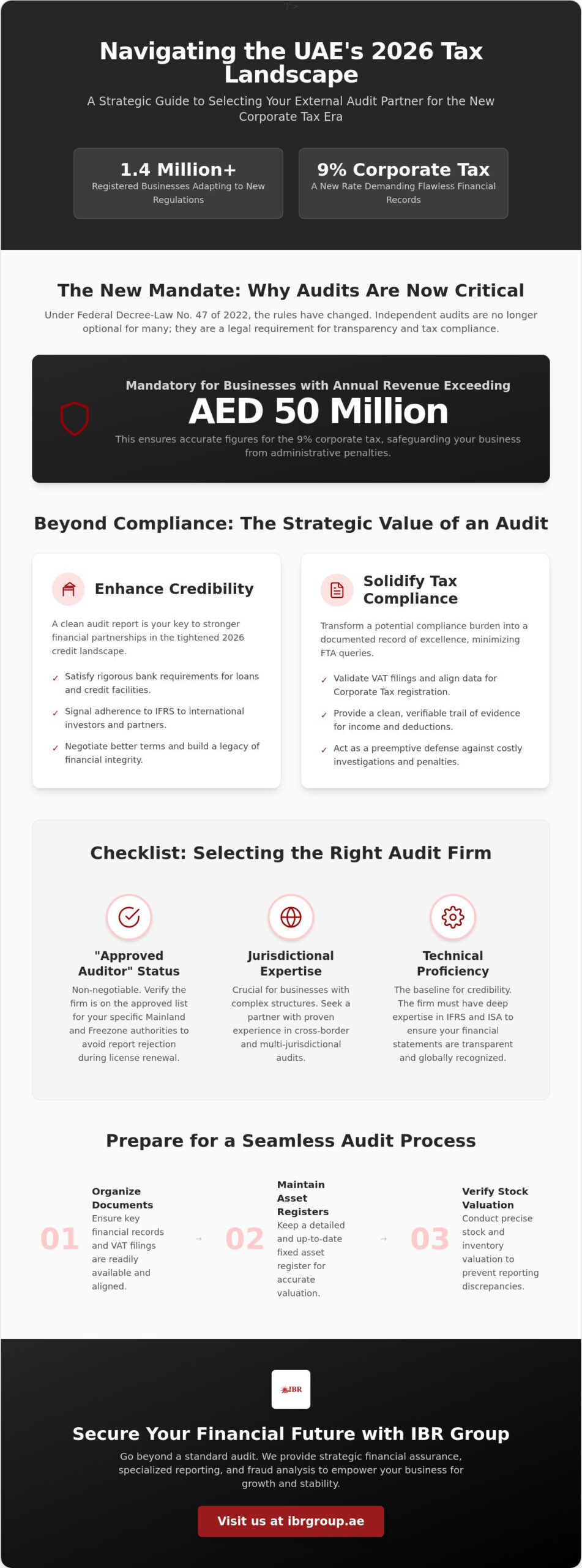
Why is the current year so critical for financial reporting? Under Federal Decree-Law No. 47 of 2022, the UAE government has established clear benchmarks for mandatory independent assurance. Specifically, companies with an annual revenue exceeding AED 50 million are legally required to maintain audited financial statements. This requirement ensures that the 9% corporate tax rate is applied to accurate, verified figures, significantly reducing the risk of administrative penalties.
By engaging professional external audit firms in dubai, businesses can ensure their corporate tax filings are beyond reproach. These audits act as a preemptive strike against FTA queries; similarly, for businesses looking to mitigate broader operational risks, including those in specialized sectors, Britton Insurance offers expert brokerage to safeguard commercial interests. They provide a clean trail of evidence that supports every deduction and income claim, turning a potential compliance burden into a documented record of excellence. For many, this process is the difference between a seamless filing and a costly investigation.
To ensure your internal records are fully prepared for such scrutiny, AccouConsult provides comprehensive accounting and tax advisory services tailored to the UAE’s regulatory environment.
Enhancing Stakeholder and Banking Credibility
Beyond the legal requirements, how does an audit impact your day-to-day operations? UAE banks have significantly tightened their credit assessment protocols for the 2026 fiscal year. Whether you’re applying for a new loan or renewing existing credit facilities, financial institutions demand audited reports to gauge your risk profile. A clean audit report signals to lenders and international investors that your business is managed with precision and adheres to International Financial Reporting Standards (IFRS).
In the 2026 fiscal year, the external audit mandate serves as the definitive bridge between internal accounting accuracy and the rigorous external compliance standards demanded by the Federal Tax Authority and financial institutions alike. This independent assurance doesn’t just satisfy a checklist; it empowers your business to negotiate better terms and attract higher-quality partnerships. It’s a proactive step toward building a legacy of financial integrity, often validated by global auditing and certification bodies such as International Associates Limited.
Maintaining a professional corporate image is an extension of this integrity; for instance, ensuring your office or commercial space is impeccably maintained with the help of NovoTech can reinforce the high standards your audit report demonstrates to visiting stakeholders.
Key Criteria for Selecting Professional Audit Services
Selecting among the many external audit firms in dubai requires a discerning eye for technical rigor. It isn’t just about finding a firm that can sign a document; it’s about finding one that understands the specific nuances of your industry. A firm’s proficiency in International Financial Reporting Standards (IFRS) and International Standards on Auditing (ISA) is the baseline for credibility. These frameworks ensure that your financial statements are comparable, transparent, and globally recognized across the regional and international markets.
Verification of “Approved Auditor” status is non-negotiable. Different UAE freezones and mainland authorities maintain specific lists of registered auditors. If your firm isn’t approved by your specific jurisdiction, your report might be rejected during license renewal. This is especially vital for businesses with complex structures that span across multiple zones. When evaluating external audit firms in dubai, verify their track record with your specific Freezone authority, as each zone has unique reporting deadlines and formats that require precise attention.
Cross-Border and Multi-Jurisdictional Expertise
Many Dubai-based groups manage entities across Mainland UAE, various Freezones, and offshore locations like the British Virgin Islands (BVI). Does your auditor have the reach to consolidate these accounts efficiently? Utilizing auditing services for mainland companies that also understand offshore compliance creates a unified financial narrative. This synergy prevents discrepancies that often trigger queries from the FTA or international tax authorities. It’s about ensuring that your BVI holding company and your Dubai LLC speak the same financial language, providing a seamless view of your corporate health.
Look for a partner that provides more than just a balance sheet review. In 2026, the intersection of audit, AML compliance, and tax residency is where the real value lies. A firm that can support your goAML filings while verifying your financial health provides a protective shield for your operations. This integrated approach saves time and reduces the risk of conflicting data across different government portals.
Technological Integration and Accounting Software
The speed of an audit often depends on the quality of your digital records. Firms that advocate for modern accounting software implementation can access real-time data, reducing the time spent on manual reconciliations. This digital-first approach ensures that data security remains a priority while increasing the accuracy of the final report. It allows for a more collaborative review process where queries are resolved instantly rather than weeks after the site visit.
Choosing a partner with this level of depth ensures your business remains agile. If you’re looking for a steady hand to guide you, exploring a partnership for an external audit can simplify even the most complex regulatory challenges.
The Strategic Synergy Between Audit and Tax Compliance
How do financial statements become a shield against tax scrutiny? In the current fiscal climate, the alignment between your ledger and your tax filings is the primary focus of the Federal Tax Authority (FTA). Leading external audit firms in dubai provide the necessary validation to ensure that VAT return filing accuracy isn’t just a goal, but a documented reality. As the UAE moves toward the full implementation of the 2026 e-invoicing roadmap, the role of the auditor in verifying digital transaction data has never been more critical. This verification ensures that refund claims are supported by irrefutable evidence, preventing the delays that often plague unverified submissions.
The synergy extends directly into Corporate Tax registration data. If your audited accounts don’t mirror the figures provided during tax filing, you risk triggering a comprehensive FTA audit. A professional review ensures that every deduction is compliant with Federal Decree-Law No. 47 of 2022. This precision is also vital for businesses seeking a Tax Residency Certificate (TRC) or managing Indian Tax Residency requirements, where the integrity of UAE-sourced income must be clearly demonstrated to international authorities. It’s about creating a single, cohesive financial narrative that satisfies both local and global regulators.
AML Compliance and goAML Integration
Why is the audit process increasingly focused on anti-money laundering? For high-risk sectors, the auditor’s review serves as a secondary check on your internal controls. Professionals will verify your goaml registration uae status to ensure your business isn’t inadvertently facilitating illicit flows. This is where professional bookkeeping becomes a strategic asset; clean records allow auditors to spot anomalies before they become regulatory liabilities. In 2026, an external review acts as a safeguard, protecting your management from the heavy penalties associated with AML non-compliance. It’s a proactive measure that reinforces your reputation as a transparent and reliable market participant.
Corporate Tax Readiness and Expert Reports
Can your business withstand a sudden query from a local bank or the FTA? Often, a standard set of accounts isn’t enough to resolve complex disputes or clarify specific transactions. This is where an expert report becomes indispensable. These specialized documents, prepared by external audit firms in dubai, provide the deep-dive analysis required to satisfy bank credit committees or regulatory investigators. By using audit insights for strategic tax planning, you don’t just react to changes; you anticipate them. For entities with UK-UAE cross-border interests, partnering with Davis & Co LLP ensures that your tax planning is both globally compliant and strategically sound. This methodical approach ensures your financial performance remains robust while your tax liabilities are managed with absolute precision.
Preparing for a Seamless External Audit Process
How can you transform the audit from a seasonal hurdle into a strategic milestone? The key lies in proactive internal preparation. When you engage external audit firms in dubai, the efficiency of their review depends heavily on the organization of your underlying data. A well-prepared business doesn’t just pass an audit; it uses the process to reinforce its financial foundation. This preparation begins with a thorough cleanup of your bookkeeping records and ensuring that all transactions are backed by verifiable evidence.
Particular attention must be paid to stock valuation and fixed asset registers. For trading companies, an inaccurate inventory count can lead to significant discrepancies in the cost of goods sold, potentially skewing your taxable income. To ensure your operations are as efficient as your reporting, you can discover Global Exclusive Trading (GET) to help facilitate your connection between domestic and international markets. Similarly, a robust fixed asset register ensures that depreciation is calculated correctly, providing a clear trail for the auditor to follow. Before the official review begins, conducting a pre-audit check of your accountant’s work can help identify gaps in documentation or ledger entries that might otherwise cause delays. Remember that for corporate tax purposes, records must be retained for at least 7 years, making an organized digital archive essential.
Documentation and Evidence Collection
The success of the audit often hinges on the availability of a comprehensive document trail. External audit firms in dubai typically require a standardized set of records to begin their fieldwork. You should have the following items ready for review:
- Monthly bank reconciliations and year-end statements for all corporate accounts.
- VAT return records and corresponding receipts from the Federal Tax Authority.
- Detailed payroll records and evidence of end-of-service benefit calculations.
- Documentation of any international tax consultations or cross-border transaction agreements.
Auditors also perform fraud analysis by testing the strength of your internal financial controls. By documenting your approval processes and segregation of duties, you provide the assurance that your financial statements are free from material misstatement.
The Audit Execution and Final Reporting
What happens once the auditor arrives? The fieldwork phase involves management inquiries and substantive testing of transactions. This is a collaborative period where your team must be available to clarify specific entries. Once the testing is complete, the firm will issue an opinion. An “unqualified opinion” is the gold standard, indicating that your records are a fair and accurate representation of your finances. Conversely, a “qualified opinion” suggests there were areas where the auditor couldn’t find sufficient evidence. Don’t overlook the management letter provided at the end of the process; this document offers professional advice on improving your internal controls for the following year.
If you’re looking to ensure your next review is handled with precision, you can request a consultation for an external audit to begin your preparation early.
Strategic Financial Assurance with IBR Group
How do you choose a partner that views your financial health as a strategic asset rather than a mere compliance requirement? IBR Group stands apart among external audit firms in dubai by offering a sophisticated blend of technical precision and strategic foresight. Our approach isn’t limited to the balance sheet; we provide comprehensive auditing solutions that encompass Mainland, Freezone, and BVI entities. By integrating specialized services like fraud analysis and detailed stock valuation, we ensure your financial narrative is both accurate and resilient against the pressures of a maturing regulatory environment. This commitment to professional excellence ensures that your business remains a leader in its field while adhering to the highest global standards; to reflect this same level of excellence at your corporate galas, you can explore Close-up Magic for world-class entertainment.
Expertise in Complex Regulatory Resolutions
Can a standard audit report always resolve a complex bank query? Often, financial institutions require a deeper level of evidence to satisfy their credit committees. IBR Group specializes in producing the “Expert Report,” a detailed analytical document designed specifically to address complex regulatory or banking concerns. As we align with the 2026 UAE e-invoicing roadmap, having this level of professional guidance is indispensable. We ensure that your business feasibility study dubai isn’t just a theoretical exercise but is fully aligned with the audited realities of your current operations. This precision protects your reputation and facilitates smoother credit assessments during facility renewals.
Future-Proofing Your Business Financials in 2026
The evolution of the UAE’s fiscal landscape has made the selection of external audit firms in dubai a defining factor for corporate longevity. We’ve explored how a robust audit process does more than satisfy the Federal Tax Authority; it builds the credibility necessary for bank credit assessments and seamless license renewals. By aligning your internal bookkeeping with IFRS standards and maintaining a clear trail for cross-border transactions, you turn a mandatory requirement into a competitive advantage. This strategic approach ensures your business is not just compliant but is actively positioned for growth; to help scale your operations through data-driven solutions, you can visit EmirAds.
IBR Group brings over 15 years of deep-rooted experience in the UAE financial sector to protect your interests. Whether you need an expert report to resolve an FTA query or comprehensive support for Mainland, Freezone, and BVI entities, our team provides the precision your business deserves. We bridge the gap between complex regulatory demands and your long-term growth objectives. Our proactive guidance helps you stay ahead of the e-invoicing roadmap while ensuring your financial statements remain beyond reproach.
Take the first step toward total financial transparency and peace of mind. Secure your business compliance with IBR Group’s expert auditing services. We’re here to guide you through every regulatory challenge with confidence and clarity.
Frequently Asked Questions
Why is an external audit mandatory for businesses in the UAE in 2026?
An external audit is mandatory for businesses that exceed the AED 50 million annual revenue threshold as specified under Federal Decree-Law No. 47 of 2022. Additionally, many Freezone authorities require audited financial statements for license renewals. In the context of the 2026 tax landscape, this requirement ensures that taxable income is calculated accurately, providing the Federal Tax Authority with verified data that supports your corporate tax filings.
How do external audit firms in Dubai help with Corporate Tax compliance?
Professional external audit firms in dubai ensure that your financial statements are fully aligned with the requirements of the Federal Tax Authority. They verify that your reported income and expenses comply with International Financial Reporting Standards (IFRS), which is the benchmark for calculating taxable income. This verification process significantly reduces the risk of administrative penalties and ensures that your Corporate Tax registration data is beyond reproach.
What is the difference between an internal and an external audit?
The primary difference lies in the objective and the audience of the report. An internal audit is conducted by employees or consultants to improve internal controls and operational efficiency for management’s benefit. Conversely, an external audit is performed by an independent third party to provide assurance to external stakeholders, such as banks and government authorities, that the financial statements are a fair and accurate representation of the business’s health.
Can an external audit report help in securing bank loans in the UAE?
Yes, a clean audit report is a fundamental requirement for securing bank loans or renewing credit facilities in the UAE. Financial institutions rely on these independent assessments to evaluate your company’s risk profile and repayment capacity. An unqualified opinion from a reputable firm provides the transparency banks need to approve higher credit limits and offer more favorable interest rates for your business.
What documents are required for a Mainland company audit?
Mainland companies must provide a comprehensive set of records, including bank reconciliations, VAT return filings, and detailed sales and purchase invoices. You’ll also need to present your payroll data, fixed asset register, and evidence of end-of-service benefit calculations. Having these documents organized according to IFRS standards ensures that the audit team can complete their fieldwork efficiently without unnecessary delays.
How long does the typical external audit process take for a Freezone entity?
The typical external audit process for a Freezone entity ranges from two to four weeks, depending on the complexity of the business structure and the quality of the bookkeeping. If your internal records are well-organized and your accounting software implementation is up to date, the timeline can be significantly shortened. It’s best to start the preparation at least one month before your license renewal deadline to allow for thorough review.
What happens if a company fails to provide an audited financial report?
Failing to provide an audited financial report can lead to heavy administrative penalties from the Federal Tax Authority and may result in the rejection of your trade license renewal. For Freezone entities, this failure could lead to the loss of “Qualifying Free Zone Person” status, subjecting the business to the standard 9% corporate tax rate. It also negatively impacts your ability to resolve bank queries or secure future financing.
How often should a UAE-based company conduct an external audit?
Most UAE-based companies should conduct an external audit annually to coincide with their financial year-end. This frequency is standard for maintaining compliance with the UAE Commercial Companies Law and meeting the reporting requirements of various Freezone authorities. Regular annual audits also help management identify internal control weaknesses early, allowing for strategic adjustments that support long-term financial stability and transparency.