
Could your residency in a tax-free jurisdiction like the UAE actually trigger an unexpected tax liability in India under the new 2026 regulations? For many expatriates, the implementation of the Income Tax Act 2025 brings a justified fear of double taxation on Indian rental income and dividends. You likely feel the weight of changing residency laws and the burdensome administrative processes required to stay compliant. Obtaining an indian tax residency certificate for nris is no longer just a bureaucratic step; it’s a strategic necessity to protect your global income and lower your withholding tax rates.
In this comprehensive guide, we’ll master the complexities of the new 120-day residency threshold and the mandatory electronic filing of Form 41. You’ll learn exactly how to leverage international tax treaties to ensure your financial growth remains uninterrupted. We provide a clear roadmap through the latest Indian and UAE regulations, allowing you to secure the documentation needed for Indian banks and authorities with professional precision. By understanding these shifts, you can transform a complex regulatory hurdle into a shield for your international wealth.
Key Takeaways
- Understand how the indian tax residency certificate for nris serves as a vital shield against double taxation under the updated 2026 regulatory framework.
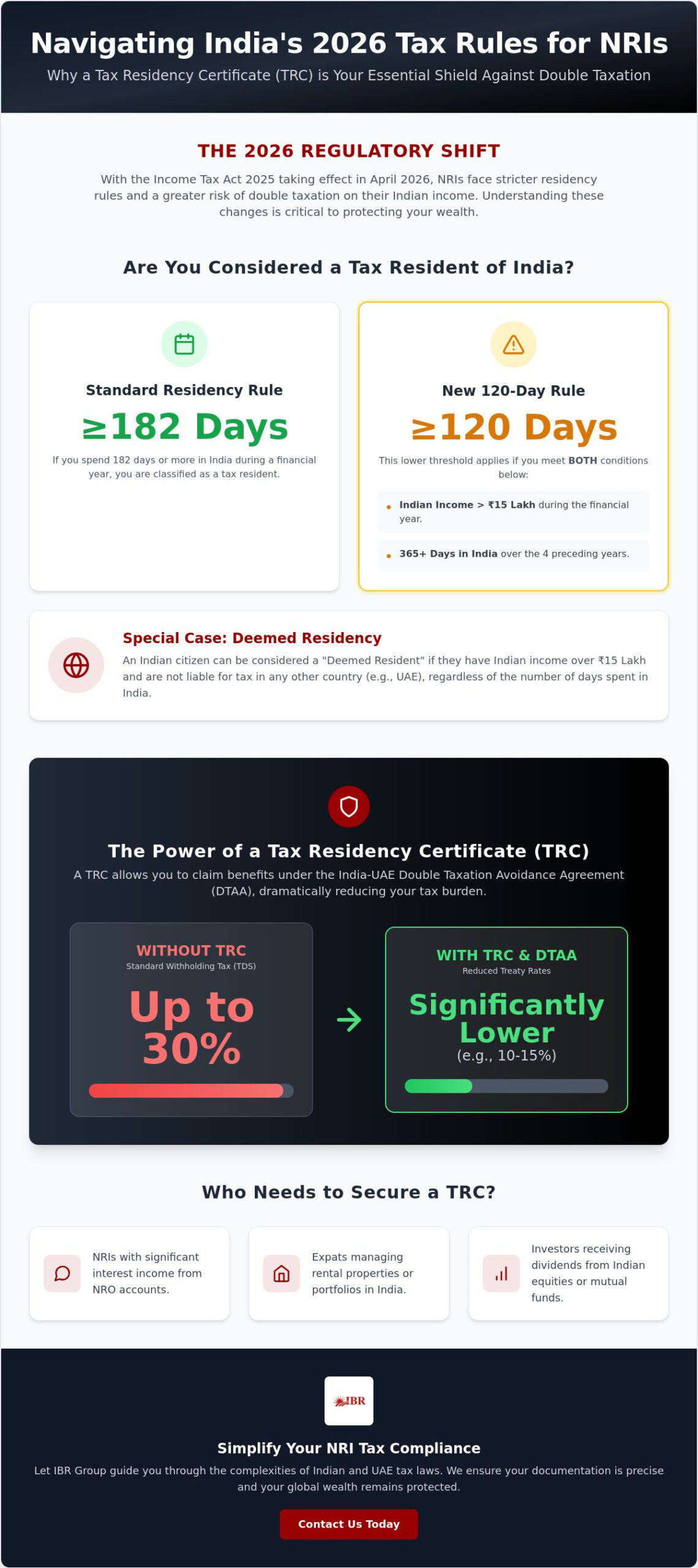
- Identify the critical shifts in residency status, including the standard 182-day rule and the new 120-day threshold for those with Indian income exceeding 15 lakhs.
- Learn how to leverage the India-UAE DTAA to significantly reduce your withholding tax rates from 30% to treaty-specific levels.
- Master the essential documentation requirements, from gathering foundational records like your PAN and Passport to the precise preparation of Form 10FA.
- Discover how professional compliance oversight simplifies the intersection of UAE and Indian tax laws to ensure your global wealth remains protected.
Table of Contents
- Understanding the Indian Tax Residency Certificate (TRC) for NRIs in 2026
- Determining Residency Status: Navigating the 182-Day Rule and Deemed Residency
- Maximizing DTAA Benefits: Why Every UAE-Based NRI Needs a TRC
- Step-by-Step Guide: Documentation and Application Process for TRC
- Strategic Tax Compliance: How IBR Group Simplifies NRI Residency Certification
Understanding the Indian Tax Residency Certificate (TRC) for NRIs in 2026
A Tax Residency Certificate (TRC) is a formal document issued by a government authority that certifies an individual’s tax residence in a specific country for a given financial year. For those managing assets across borders, the indian tax residency certificate for nris acts as the definitive proof required to access benefits under various international treaties. In India, the Central Board of Direct Taxes (CBDT) oversees the issuance of these certificates through the income tax department. As we approach the implementation of the Income Tax Act 2025 in April 2026, maintaining valid documentation has become a critical priority for expatriates. The 2026 regulatory environment introduces stricter scrutiny for high-income earners, making a TRC the primary shield against being incorrectly classified as a resident for tax purposes.
It’s vital to distinguish between a TRC issued by the Indian authorities and one issued by the UAE. While a UAE TRC proves you’re a resident of the Emirates to the Indian tax department, an Indian TRC is often required by UAE banks or international entities to prove you aren’t a tax resident of India for specific high-value transactions. This distinction ensures that you aren’t caught in a cycle of double taxation due to administrative misunderstandings between two different jurisdictions.
The Legal Foundation: Income Tax Act of 1961
The legal framework for avoiding double taxation is rooted in Section 90 and 90A of the Income Tax Act. These sections empower the Indian government to enter into bilateral agreements with other nations to provide relief to taxpayers. Understanding Double Taxation Avoidance Agreements is essential because these treaties dictate which country has the primary right to tax specific types of income. The Indian tax ecosystem is rapidly shifting toward digital verification, requiring NRIs to provide electronic proof of their status to claim any treaty-based exemptions. A Tax Residency Certificate is the primary instrument for invoking treaty rights and ensuring that your income isn’t taxed twice.
Who Needs an Indian TRC While Living Abroad?
Not every expat requires this document, but it becomes indispensable for those with active financial footprints in India. You’ll likely need to secure an indian tax residency certificate for nris if you fall into these categories:
- NRIs earning significant interest income from NRO (Non-Resident Ordinary) accounts, where tax is usually deducted at the highest slab.
- Expats managing ancestral property or rental portfolios in India who wish to apply for lower withholding tax certificates.
- Investors receiving dividends from Indian equities or mutual funds, where treaty rates are often significantly lower than standard domestic rates.
Ensuring compliance in these areas requires a proactive approach. Our Tax and Compliance Services help bridge the gap between your life in the UAE and your obligations in India, providing the stability you need to grow your wealth. We act as your knowledgeable guide, ensuring that every document is precise and every filing is timely.
Determining Residency Status: Navigating the 182-Day Rule and Deemed Residency
How do you ensure your status remains “Non-Resident” when the regulatory goalposts are shifting? The primary metric for determining your tax status in India remains the 182-day rule. If you spend 182 days or more in the country during a financial year, you’re classified as a resident. However, the 2026 landscape introduces a significant pivot for high-income individuals. If your Indian-sourced income exceeds ₹15 lakh, the threshold for being considered a “Resident but Not Ordinarily Resident” (RNOR) drops to just 120 days. This applies if you’ve also been in India for 365 days or more over the preceding four years. Understanding these nuances is the first step in successfully applying for an indian tax residency certificate for nris.
Deemed residency is another critical concept to grasp, particularly for those residing in the UAE. Under the Income Tax Act 2025, which takes effect in April 2026, an Indian citizen with Indian income over ₹15 lakh who isn’t liable to pay tax in any other country is “deemed” to be an Indian tax resident. This rule can apply even if you don’t spend a single day in India during the year. It’s a provision designed to bring high earners in zero-tax jurisdictions into the tax net, making it vital to prove your actual residence through proper documentation. Following OECD guidelines on tax residency, the Indian authorities now look closer at where your “center of vital interests” truly lies.
ROR vs. RNOR: Why the Distinction Matters for Your TRC
The distinction between Resident and Ordinarily Resident (ROR) and Resident but Not Ordinarily Resident (RNOR) is fundamental to your tax liability. An ROR is taxed on their global income, while an RNOR is generally only taxed on income sourced within India. This transitional status acts as a vital buffer for returning expats. To protect your status, you must track your travel days with absolute precision for audit purposes. These records serve as the evidentiary backbone when you seek an indian tax residency certificate for nris to clarify your obligations to the CBDT.
The Impact of UAE Residency on Indian Tax Obligations
Holding a valid tax residency in the UAE significantly strengthens your legal standing. By obtaining a UAE TRC, you provide the Indian tax department with tangible proof of your foreign residence. This documentation is the most effective way to avoid the “deemed resident” trap. It demonstrates that your presence in the Emirates is legitimate and recognized by local authorities. Strategically aligning your physical stay in both nations ensures you don’t inadvertently trigger residency. If you’re unsure how your travel patterns affect your status, our experts can provide a tailored company Tax residency review to ensure your global wealth remains protected.
Maximizing DTAA Benefits: Why Every UAE-Based NRI Needs a TRC
Why settle for a 30% tax deduction when a single document could cut that liability in half? For UAE-based expats, the Double Taxation Avoidance Agreement (DTAA) between India and the UAE is the most potent tool for capital preservation. Without a valid indian tax residency certificate for nris, the Indian Income Tax Department defaults to domestic tax rates, which are often significantly higher than treaty-negotiated figures. By presenting this certificate, you effectively invoke your rights under international law, ensuring that your hard-earned wealth isn’t eroded by redundant taxation across two jurisdictions.
The strategic value of a TRC extends beyond mere savings; it’s about dispute prevention. The Indian tax authorities have increased their scrutiny of high-value transactions involving non-residents. Having your documentation pre-emptively filed through the Indian Income Tax e-Filing Portal establishes a clear, verifiable record of your jurisdictional status. This proactive approach minimizes the risk of long-term litigation or complex tax audits that often arise when residency status is left ambiguous. It’s a hallmark of professional excellence to have these documents ready before the tax department initiates an inquiry.
Optimizing Interest and Dividend Income
Interest earned on NRO Fixed Deposits is typically subject to a Tax Deducted at Source (TDS) of 30% plus applicable surcharges. However, under the DTAA, this rate can be reduced to 12.5% or 15%, depending on the specific treaty articles invoked. Similarly, dividends from Indian-listed companies, which are now taxable in the hands of the shareholder, can benefit from reduced treaty rates. For a broader perspective on how these rules integrate with your life in the Emirates, refer to our guide on Tax Residency for Indian Expats in the UAE. Securing an indian tax residency certificate for nris ensures your liquid investments continue to grow at an optimal pace.
Capital Gains and Rental Income Protection
Managing immovable property in India presents unique tax challenges for those living abroad. When you sell a property, the buyer is required to deduct TDS at the highest rates unless you provide a lower withholding certificate backed by a TRC. Treaty relief can also be applied to rental income, providing a more favorable tax outcome than standard non-resident filings. Furthermore, having a TRC is often a prerequisite for the seamless repatriation of funds through NRO channels or the Liberalised Remittance Scheme (LRS). It provides the necessary compliance framework that Indian banks require to process large foreign exchange transfers without administrative delays.
Step-by-Step Guide: Documentation and Application Process for TRC
How do you convert the theoretical benefits of treaty relief into tangible tax savings? The transition from understanding the law to active compliance requires a methodical approach to documentation. Precision is paramount. To obtain an indian tax residency certificate for nris, you must first gather foundational records that prove your identity and travel history. This includes your PAN card, a complete copy of your passport to verify every entry and exit stamp, and valid visa documentation. These records serve as the evidentiary basis for your residency claim during the 2026 financial year.
While many resources focus solely on Indian requirements, proving your UAE residence is equally vital to satisfy Indian tax authorities. You’ll need to provide robust evidence of your life in the Emirates. This typically involves submitting utility bills, Ejari tenancy contracts, or a UAE-issued Tax Residency Certificate. Once these are compiled, the application is moved forward by preparing Form 10FA. This specific form is the formal request for a certificate of residence, which you must submit through the Indian e-filing portal. After the authorities process your request and issue the TRC, the final step involves providing Form 10F to your Indian deductors or banks to officially trigger the reduced TDS rates.
Decoding Form 10FA and Form 10F
It’s common to confuse Form 10FA with Form 10F, but they serve distinct purposes in your compliance journey. Form 10FA is the application you send to the Indian tax department to receive your TRC. In contrast, Form 10F is a self-declaration used to provide details not explicitly mentioned in a foreign-issued TRC. Common errors, such as mismatched dates or incomplete address history, often lead to immediate application rejection. Form 10F is now a mandatory electronic filing for NRIs. Ensuring these forms are synchronized is essential for a seamless experience. If you require professional oversight to avoid these pitfalls, our team provides expert Indian Tax Residency support to ensure your submission is flawless.
Timeline and Validity of the Certificate
In the 2026 digital-first tax era, expected processing times have become more streamlined, yet you should still allow several weeks for administrative review. It’s a standard rule that a TRC is typically valid for only one financial year. Because tax residency is determined annually based on your physical stay, you must commit to timely annual renewals. Allowing your certificate to lapse can result in a sudden jump in withholding tax rates on your Indian income. Maintaining a consistent cycle of renewal ensures that your tax relief remains uninterrupted and your financial planning stays on track.
Strategic Tax Compliance: How IBR Group Simplifies NRI Residency Certification
Why struggle with the administrative friction between two distinct regulatory bodies when you can leverage a unified strategy? Successfully managing cross-border obligations requires more than just filling out forms; it demands a deep-rooted understanding of both the Federal Tax Authority (FTA) in the UAE and the Central Board of Direct Taxes (CBDT) in India. Our Tax and Compliance Services are specifically designed to bridge this geographical and administrative gap. We provide a methodical path for those seeking an indian tax residency certificate for nris, ensuring that every detail of your application aligns with the 2026 standards of both jurisdictions.
Our approach is rooted in precision and professional authority. We don’t just facilitate filings. Instead, we curate a comprehensive documentation package that anticipates potential inquiries from tax inspectors before they arise. By integrating your TRC procurement with your broader freezone company setup or regional investment strategy, we create a cohesive financial structure. This level of strategic empowerment ensures that your business interests in the Emirates and your personal assets in India work in harmony, protecting your wealth from unnecessary erosion.
Expert Advisory for Complex Residency Scenarios
Complex residency scenarios, such as split-year tax obligations or cases of potential dual residency, require a level of expertise that standard digital portals simply cannot provide. High-net-worth individuals and Golden Visa holders often face unique challenges that necessitate a professional review of their global tax footprint to ensure maximum efficiency. We act as a protective advisor, analyzing your travel patterns and income sources to prevent the “deemed residency” traps discussed earlier. This specialized guidance provides a sense of security for entrepreneurs who need to maintain high standards of compliance while focusing on their professional growth.
Seamless Implementation and Peace of Mind
Busy professionals and business owners shouldn’t be bogged down by burdensome administrative processes. We take the lead in ensuring all filings are fully compliant with the latest regulations, reducing the risk of rejection or audit. Our steady and informative communication rhythm keeps you supported throughout the entire narrative of your compliance journey. We prioritize your peace of mind by maintaining the highest standards in every submission for an indian tax residency certificate for nris, allowing you to navigate the 2026 tax year with total confidence.
Ensure your global income is protected. Consult with IBR Group for your Indian Tax Residency Certificate today.
Strategic Compliance for the 2026 Tax Landscape
How will you adapt your financial strategy as India’s tax laws modernize? The transition to the Income Tax Act 2025 requires NRIs to be more vigilant than ever. By mastering the 120-day rule and ensuring your documentation is filed electronically, you protect your assets from excessive withholding. Obtaining an indian tax residency certificate for nris isn’t just about following rules; it’s about active wealth preservation. This proactive approach ensures you leverage treaty benefits to their fullest extent while maintaining total transparency with the authorities.
IBR Group brings over 15 years of UAE financial sector experience to your compliance journey. We offer specialized cross-border tax expertise and comprehensive AML and goAML compliance support to ensure every filing is seamless. Our team acts as your steady guide through these intricate regulatory shifts, prioritizing your peace of mind at every step. Secure your Indian Tax Residency Certificate with IBR Group to ensure your international success remains uninterrupted. It’s time to move forward with the confidence that your global income and local investments are fully protected.
Frequently Asked Questions
Is an Indian Tax Residency Certificate mandatory for all NRIs?
An Indian Tax Residency Certificate isn’t mandatory for every NRI, but it’s essential if you intend to claim benefits under the Double Taxation Avoidance Agreement (DTAA). Without this document, the Indian Income Tax Department defaults to domestic tax rates on your Indian-sourced income, such as interest and dividends. This often results in a 30% withholding tax plus applicable surcharges, whereas a valid certificate allows you to access much lower treaty rates.
How long does it take to obtain a TRC from the Indian authorities?
The processing time typically ranges from two to four weeks in the 2026 digital-first tax ecosystem. While the submission of Form 10FA through the e-filing portal is instantaneous, the jurisdictional Assessing Officer must verify your travel history and documentation before issuance. It’s a methodical process, so we recommend applying well in advance of any major financial transactions or tax filing deadlines to avoid administrative delays.
Can I apply for an Indian TRC online while staying in the UAE?
Yes, you can complete the entire application for an indian tax residency certificate for nris through the official Indian Income Tax e-Filing Portal from anywhere in the world. Since the process is fully digitized, there’s no requirement for you to be physically present in India. You’ll simply need to upload digital copies of your passport, PAN card, and evidence of your UAE residency, such as utility bills or an Ejari contract, to support your application.
What is the difference between Form 10F and a Tax Residency Certificate?
A Tax Residency Certificate is a formal document issued by a government authority to prove your jurisdictional tax status, whereas Form 10F is a self-declaration required by Indian law. You use Form 10F to provide specific information that may be missing from a foreign-issued TRC, such as your Tax Identification Number or nationality. From the 2026-27 financial year, electronic filing of Form 10F is a mandatory requirement for any NRI seeking treaty relief.
Does a UAE Golden Visa exempt me from needing an Indian TRC?
No, holding a UAE Golden Visa doesn’t exempt you from Indian tax residency regulations or the need for a certificate. While the Golden Visa provides long-term immigration status in the UAE, the Indian tax authorities determine your residency based on your physical stay in India and your income levels. You still require an indian tax residency certificate for nris to prove your non-resident status and protect your Indian-sourced income from higher domestic tax rates.
What happens if I fail to provide a TRC to my Indian bank?
If you don’t provide a valid TRC, your Indian bank is legally required to deduct Tax Deducted at Source (TDS) at the highest applicable domestic rates. For interest earned on NRO accounts, this typically means a deduction of 30% plus surcharges instead of the 12.5% or 15% rates available under the India-UAE treaty. While you can claim a refund by filing an Indian tax return later, it creates significant cash flow delays and increases your administrative burden.
Can I use a UAE-issued TRC to claim benefits in India?
Yes, a UAE-issued TRC is the primary document used to demonstrate to Indian authorities that you’re a tax resident of the Emirates. This certificate is vital for invoking the protections of the Double Taxation Avoidance Agreement. However, it must be accompanied by an electronically filed Form 10F if the UAE document doesn’t explicitly contain all the details required under Section 90 of the Indian Income Tax Act.
How often do I need to renew my Indian Tax Residency Certificate?
You must renew your certificate every financial year. Because tax residency is a status determined annually based on your physical presence in a country during that specific year, a certificate issued for one period isn’t valid for the next. Establishing a steady rhythm for annual renewals ensures that your tax relief remains uninterrupted and that your Indian deductors continue to apply the lower treaty-based withholding rates to your income.