
Are you certain that your NRI status alone protects your global income from the reach of the Indian Income Tax Department? Many Indian expats in the Emirates believe that holding a residence visa is a sufficient shield against tax liabilities back home. However, as global tax authorities increase their scrutiny in 2026, the distinction between being a resident for immigration and a resident for tax purposes is vital. Securing a corporate tax residency certificate uae, or an individual equivalent, is the only definitive way to invoke the protections of the India-UAE Double Taxation Avoidance Agreement (DTAA).
We understand that navigating the technical hurdles of the EmaraTax portal can feel overwhelming, especially when your financial peace of mind is at stake. This resource provides a comprehensive roadmap to securing your certificate and leveraging the DTAA for maximum fiscal efficiency. You’ll gain clarity on the 183-day and 90-day residency rules, learn how to manage the FTA application process seamlessly, and discover how to legally exempt your income from double taxation.
Key Takeaways
- Understand how a Tax Residency Certificate acts as a vital legal instrument to access specific tax exemptions under the India-UAE Double Taxation Avoidance Agreement.
- Learn the precise physical presence and management requirements needed to successfully secure a corporate tax residency certificate uae or an individual TRC via the EmaraTax portal.
- Discover the step-by-step application process, including how to select the correct certificate type to satisfy the rigorous documentation standards of Indian tax authorities.
- Master the “Tie-Breaker” rule to resolve dual residency conflicts and shield your global income from redundant tax liabilities in India.
- Identify why aligning your UAE operational substance with 2026 regulatory standards is essential for maintaining long-term fiscal compliance and peace of mind.
Understanding the UAE Tax Residency Certificate (TRC) in 2026
The landscape of taxation in the Emirates has undergone a profound transformation, making 2026 a watershed year for both individual expats and business owners. A Tax Residency Certificate (TRC) is a formal document issued by the Federal Tax Authority (FTA) that confirms an applicant’s status as a resident of the UAE for tax purposes. While it might seem like a simple administrative requirement, it serves as a critical bridge to international treaties. Its primary function is to enable residents to claim specific benefits under the numerous Double Taxation Avoidance Agreements (DTAA) that the UAE has signed with global partners, including India.
Why is this particularly urgent in 2026? With the first major corporate tax filing deadline set for September 30, 2026, for many businesses, the need for a corporate tax residency certificate uae has shifted from a luxury to a legal necessity. It’s vital to distinguish this document from the Commercial Activities Certificate. While the latter is often used by companies to claim VAT refunds on business expenses incurred abroad, the TRC is specifically designed to address income tax liabilities and treaty protections.
The Role of the Federal Tax Authority (FTA)
The FTA serves as the sole regulatory body responsible for managing tax residency for both natural persons and juridical entities. Since the transition to the EmaraTax portal, the process has become more structured and digital-centric. The authority doesn’t just issue certificates; it validates residency status against rigorous international standards. This ensures that the UAE remains compliant with global frameworks while providing a secure platform for taxpayers to demonstrate their legitimate presence in the country. This validation is essential for maintaining the integrity of the UAE’s tax system as it integrates more deeply with the OECD’s global tax initiatives.
Benefits of Holding a UAE TRC
Securing a TRC offers more than just compliance; it provides a strategic advantage for Indian expats. By Understanding Double Taxation, one can see how this certificate prevents the same income from being taxed by both the FTA and the Indian Income Tax Department. For professionals, this means facilitating the repatriation of funds to India with significantly reduced tax friction. For businesses, holding a corporate tax residency certificate uae strengthens corporate credibility and ensures that management and control are clearly established within the Emirates, protecting the entity from aggressive cross-border tax claims.
Eligibility Criteria and Regulatory Updates for 2026
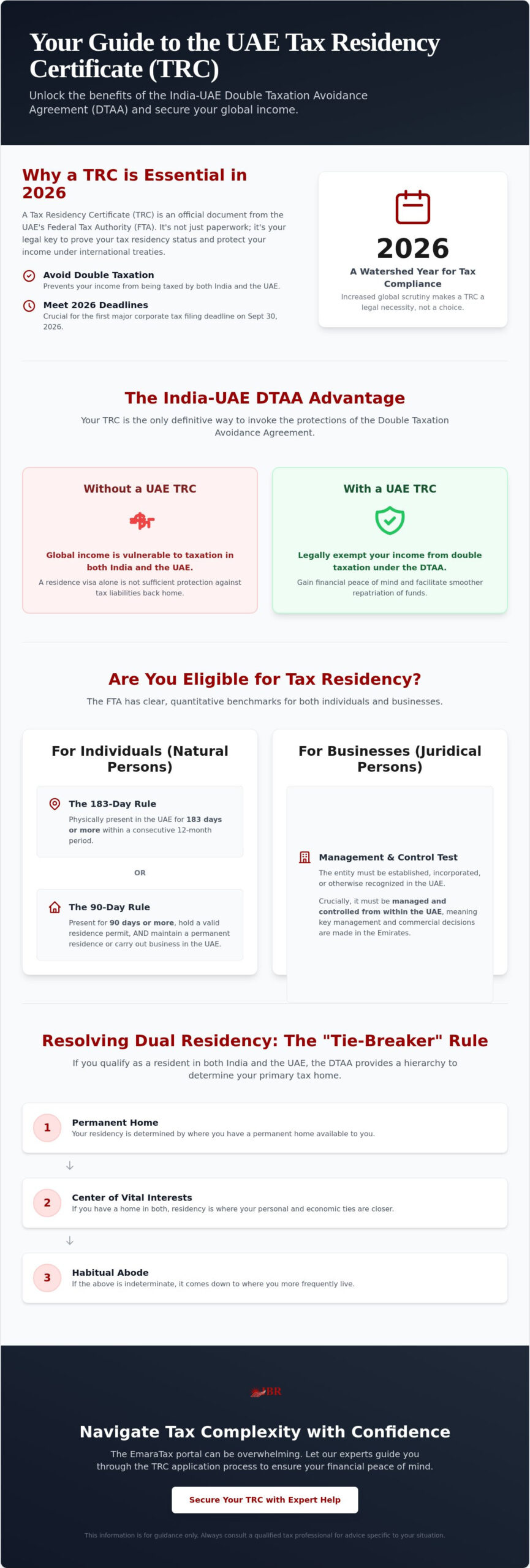
How do you determine if you qualify for tax residency in a year of significant regulatory shifts? The Federal Tax Authority (FTA) defines residency through clear, quantitative benchmarks that align with international best practices. For natural persons, the standard remains the 183-day physical presence rule within a consecutive 12-month period. This is the most straightforward path to residency, but it isn’t the only one. The “90-day rule” offers a strategic alternative for residents who hold a valid permit and maintain a permanent place of residence or carry out business in the UAE. Applying for a UAE Tax Residency Certificate requires meeting these specific thresholds to ensure your status is indisputable under international law.
For juridical persons, the criteria focus on where the entity is managed and controlled. It’s not enough to simply have a trade license; the FTA expects to see that key management decisions are made within the Emirates. Special provisions also exist for government-controlled entities and international organisations, which often follow streamlined paths to residency due to their unique legal standing. Establishing these facts is the first step toward securing a corporate tax residency certificate uae and protecting your business from external tax claims.
New Timing Rules for Applications
2026 introduces more precise windows for submission that every expat entrepreneur should know. Juridical persons can now apply for a certificate as early as three months after the start of their tax year, provided they can demonstrate sufficient operational substance. However, newly incorporated companies must often wait for a full 12-month cycle if they haven’t yet filed a tax return. This rule ensures that only businesses with a genuine, ongoing presence can claim treaty benefits. These timing nuances make proactive planning essential for maintaining compliance throughout the fiscal year.
Documentation Requirements for Indian NRIs
Documentation for Indian NRIs has become more focused on substance rather than just paperwork. You’ll need your Emirates ID, a valid residence visa, and an official entry and exit report from the Federal Authority for Identity and Citizenship (ICP). While the FTA has moved away from making individual bank statements a mandatory requirement for everyone, they now place a higher weight on salary certificates and registered lease agreements. An Ejari is vital as it serves as primary proof of a permanent home in the UAE. If you find these requirements complex, seeking expert tax residency guidance can ensure your application is processed without unnecessary delays or technical hurdles.
Step-by-Step TRC Application Guide for Expats and Businesses
How do you transition from understanding eligibility to actually holding the certificate in your hand? The process begins with a methodical setup on the EmaraTax portal. You’ll first need to create a functional user profile and verify it through your registered email and mobile number. Once the account is active, the system requires you to choose between a certificate for a specific treaty (DTAA) or for general purposes (non-DTAA). For Indian expats, selecting the DTAA option is essential to access the protections of the India-UAE agreement. This choice defines the legal weight your document carries when presented to the Indian Income Tax Department.
Your documentation must be digitised according to strict FTA specifications. This includes clear, high-resolution scans of your Emirates ID, passport, and proof of residence. After uploading these files, you’ll pay the non-refundable AED 50 submission fee. If your application for a corporate tax residency certificate uae is linked to an existing Tax Registration Number (TRN), the processing fee is AED 500. For those without a TRN, individuals pay AED 1,000, while legal persons pay AED 1,750. Once payment is confirmed, the digital certificate is typically issued within 5 to 7 business days, though you can request a physical hard copy for an additional fee of AED 250.
Comparing UAE and Indian Tax Residency Certificates
Expats often ask when they need a UAE TRC versus an Indian TRC. While the UAE version proves your residency to the Indian government, the Indian TRC is sometimes required for specific domestic compliance or when managing inherited assets back home. IBR Group facilitates both Indian Tax Residency and company Tax residency services to ensure total cross-border compliance. This dual-layered framework is vital for avoiding NRI tax pitfalls where Indian authorities might challenge your non-resident status without comprehensive documentation from both jurisdictions.
Common Pitfalls in the Application Process
Even minor administrative errors can lead to application rejection or lengthy delays. A frequent issue is a mismatch between visa issuance dates and the actual physical presence recorded in your ICP entry and exit report. If you haven’t completed the 183-day requirement within the requested 12-month period, the FTA will likely issue a query. Freezone-based juridical persons often struggle with incomplete documentation regarding their physical office space or proof of management and control. If you receive a query through the EmaraTax dashboard, you must respond promptly with the specific evidence requested to avoid a total application cancellation.
Navigating the India-UAE Double Taxation Avoidance Agreement (DTAA)
Why do many Indian expats believe that simply living in the UAE grants them a total tax holiday back home? One of the most persistent misconceptions is that UAE residence automatically equates to an exemption from Indian tax liabilities. In reality, without a formal corporate tax residency certificate uae, the Indian Income Tax Department may still classify you as a resident if you don’t strictly adhere to their physical presence thresholds. The India-UAE DTAA provides a ‘Tie-Breaker’ rule to resolve such dual residency conflicts, looking at factors like your permanent home, your center of vital interests, and where you maintain your habitual abode.
This agreement is a powerful tool for fiscal efficiency, provided it’s invoked correctly. It establishes specific capped withholding rates for various income types. For instance, dividends and royalties are generally taxed at 10%, while interest on bank loans carries a reduced 5% rate. All other interest cases are capped at 12.5%. These protections are particularly vital in 2026 as business owners manage the UAE’s 9% corporate tax on income exceeding AED 375,000. Aligning your UAE tax filings with these treaty benefits ensures that you aren’t paying more than your fair share across two jurisdictions.
Taxation of NRIs: The Indian Perspective
The Indian government has tightened residency definitions, specifically through the 120-day rule. If your Indian-sourced income exceeds approximately AED 66,000 (equivalent to 15 Lakh INR), you could be deemed a resident in India if you spend 120 days or more in the country. A UAE TRC serves as the primary evidence to counter such claims. You’ll also need to submit Form 10F electronically on the Indian tax portal to claim treaty benefits, a process that requires a valid certificate from the FTA to be legally sound.
Strategic Planning for High-Net-Worth Individuals (HNWIs)
HNWIs managing global asset portfolios must be deliberate in how they structure their UAE presence. While capital gains on Indian shares remain taxable in India, gains from Indian mutual funds may often be taxable only in the country of residence. This makes the UAE an attractive hub for wealth management. For those seeking long-term stability, the UAE Golden Visa provides an excellent foundation. For tax residency purposes, a Golden Visa holder must still meet the physical presence or primary residence criteria established by the FTA to qualify for a certificate. If you’re looking to optimize your cross-border tax position, it’s time to consult with our DTAA specialists at IBR Group to secure your financial future.
Strategic Tax Residency Management with IBR Group
Why do some businesses face rejection despite meeting the physical presence requirements? Often, the failure lies in the lack of documented substance or management control. Professional advisory is no longer optional for those navigating complex cross-border tax structures in 2026. A single administrative oversight can jeopardize your eligibility for treaty benefits and expose your global income to unnecessary risk. IBR Group provides a sophisticated, integrated approach that simplifies this complexity, guiding you from initial goAML registration and AML compliance through to the successful issuance of your corporate tax residency certificate uae.
Our team delivers customized solutions tailored to your specific legal framework, whether you operate on the UAE mainland, within a specialized freezone, or manage entities in jurisdictions like the BVI. We recognize that tax residency is a continuous state of compliance rather than a one-time filing. When financial institutions or the Federal Tax Authority raise technical queries regarding your operational presence, our expert reports provide the necessary evidentiary weight to resolve these friction points. This proactive documentation acts as a strategic shield, ensuring your residency status remains indisputable under international scrutiny.
Comprehensive Compliance Beyond the TRC
Maintaining your status involves more than just holding a digital certificate. It requires a holistic alignment of your residency with other mandatory obligations like Corporate Tax Registration and VAT return filing. We assist with accounting software implementation to ensure your financial records are audit-ready and clearly demonstrate that management and control are exercised within the Emirates. Regular internal reviews are essential to ensure that your physical presence and corporate governance continue to meet the rigorous 2026 standards, protecting you from aggressive tax claims in India.
Partnering with IBR Group for Seamless Residency
With over 15 years of deep-rooted experience in the UAE regulatory landscape, IBR Group acts as a steady and knowledgeable guide for business owners. We offer specialized support for Indian expats who must navigate the intricate dual-residency challenges posed by evolving Indian tax laws. Our commitment to precision and professional excellence ensures that your cross-border interests are protected and your fiscal efficiency is maximized. You don’t have to manage these intricate financial responsibilities alone. Secure your UAE Tax Residency Certificate with IBR Group today.
Securing Your Financial Future in the Emirates
How will you ensure your global income remains protected as the 2026 tax deadlines approach? Securing a corporate tax residency certificate uae is no longer just a recommendation; it’s a fundamental requirement for Indian expats seeking to leverage the India-UAE DTAA. By understanding the physical presence rules and maintaining meticulous documentation, you can transition from uncertainty to total fiscal clarity. It’s essential to recognize that residency is a continuous state of compliance that demands proactive management and strategic foresight.
Managing these intricate regulatory requirements requires a partner with deep-rooted expertise in the regional ecosystem. IBR Group brings over 15 years of UAE financial sector experience to every engagement, offering specialized Indian Tax Residency support and comprehensive AML and FTA compliance expertise. We empower you to navigate the EmaraTax portal and resolve dual-residency challenges with absolute confidence. Our integrated approach ensures that your transition to the new tax regime is both efficient and legally sound.
Contact IBR Group for Expert Tax Residency Assistance and take the first step toward a seamless, compliant financial future. Your peace of mind is our priority as we simplify the path to your long-term prosperity.
Frequently Asked Questions
What is the minimum stay in the UAE to qualify for a Tax Residency Certificate?
You must be physically present in the UAE for at least 183 days within a consecutive 12-month period to meet the standard residency threshold. Alternatively, a 90-day rule exists for residents who hold a valid permit and maintain a permanent home or carry out business in the Emirates. These quantitative benchmarks ensure that your residency status is recognized under both domestic law and international tax treaties.
Can a UAE Freezone company apply for a Corporate Tax Residency Certificate?
Yes, a UAE Freezone entity is fully eligible to apply for a corporate tax residency certificate uae. The Federal Tax Authority requires the company to demonstrate that it’s managed and controlled within the UAE, which involves showing that strategic decisions are made locally. You’ll also need to provide a valid lease agreement for a physical office space to satisfy the FTA’s substance requirements.
Does the UAE TRC exempt me from all taxes in India?
No, the certificate doesn’t provide a blanket exemption from all Indian taxes. It serves as a vital tool to claim benefits under the India-UAE DTAA, preventing you from being taxed twice on the same income. While it protects dividends and professional fees, income generated from assets located in India, such as rental income from Indian property, remains taxable under India’s domestic tax laws.
How much does it cost to get a Tax Residency Certificate in the UAE in 2026?
The total cost depends on your registration status and applicant type. Every application requires a non-refundable AED 50 submission fee. If you have a Corporate Tax TRN, the processing fee is AED 500. Individuals without a TRN pay AED 1,000, while legal persons without a TRN pay AED 1,750. If you require a physical hard copy, an additional fee of AED 250 applies per certificate.
How long is a UAE Tax Residency Certificate valid for?
A UAE Tax Residency Certificate is valid for exactly one 12-month period specified in the application. This period can cover a previous calendar year or the current financial year. Since tax residency is determined by your annual physical presence and business activities, you must renew the certificate every year to continue claiming treaty benefits and maintain compliance with foreign tax authorities.
What happens if the FTA rejects my TRC application?
If your application is rejected, the FTA typically issues a query through the EmaraTax portal requesting further clarification or additional documentation. This often stems from mismatches in your entry and exit reports or insufficient proof of a permanent residence. You’ll have a specific window to re-submit the corrected files. Professional advisory is often essential at this stage to resolve technical hurdles and avoid a final cancellation.
Can I apply for a TRC if I hold a UAE Golden Visa?
Yes, Golden Visa holders are eligible to apply, but the visa itself doesn’t automatically confer tax residency. You must still meet the FTA’s physical presence requirements or demonstrate that the UAE is your primary place of residence and center of financial interests. The Golden Visa provides long-term immigration stability, but tax residency is a separate status verified through your actual presence and substance in the country.
Is a bank statement mandatory for a TRC application for Indian expats?
Bank statements are no longer a mandatory requirement for all individual TRC applications in 2026. Instead, the FTA has shifted its focus toward other forms of proof, such as certified salary certificates and registered lease agreements. Providing an Ejari is now the primary way to prove you have a permanent home in the UAE. This change simplifies the process for expats while maintaining rigorous standards for residency verification.