
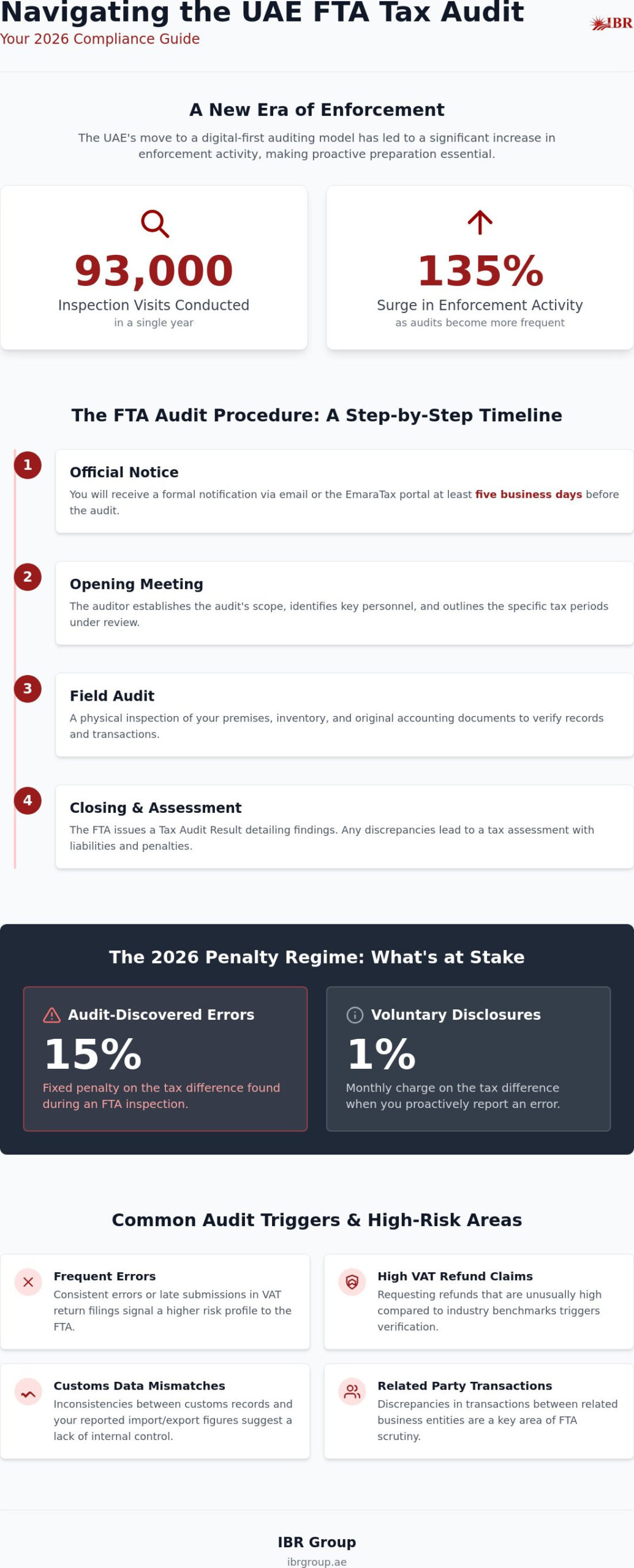
Did you know the Federal Tax Authority conducted 93,000 inspection visits in a single year, representing a 135% surge in enforcement activity? As the UAE moves toward a digital-first auditing model, proactive fta tax audit preparation has become the only reliable way to protect your business from the latest, stringent penalty regimes. For many business owners, the prospect of a formal inspection feels like a looming threat to operational stability. You’ve likely felt the pressure of organizing historical records or deciphering how the 2026 Corporate Tax and VAT synergy affects your compliance standing.
We understand that maintaining a continuous state of financial integrity is a significant undertaking. This guide serves as your comprehensive manual for navigating these complexities, promising a clear roadmap to master regulations and secure a zero-penalty outcome. We’ll examine critical 2026 updates, such as the 15% fixed penalty for audit-discovered errors and the 1% monthly charge for voluntary disclosures. By the end of this article, you’ll have a streamlined strategy to reorganize your internal processes and a firm grasp of your legal rights during an FTA inspection.
Key Takeaways
- Understand the formal procedural steps of an inspection, from the receipt of an official notice to the critical opening meeting that defines the audit’s scope.
- Master a systematic fta tax audit preparation checklist that focuses on reconciling VAT returns and verifying that all tax invoices meet strict statutory requirements.
- Address common audit triggers, such as inconsistencies in Related Party Transactions, by utilizing a professional second review to ensure total compliance.
- Leverage professional representation and detailed expert reports to navigate complex queries and maintain clear communication with the Federal Tax Authority.
- Learn how to align your internal bookkeeping with the 2026 digital-first auditing model to achieve seamless tax readiness and long-term peace of mind.
Understanding the FTA Tax Audit Landscape in 2026
What exactly does an FTA tax audit entail in the current regulatory environment? An audit is a formal examination conducted by the Federal Tax Authority to inspect a taxable person’s commercial records and financial data. The primary objective is to verify tax liabilities and ensure absolute compliance with the UAE Decree-Laws. In 2026, this process has evolved. The FTA now employs sophisticated data analytics to identify discrepancies across VAT and Corporate Tax filings. This digital-first approach means that mismatches between different tax types are flagged automatically. While most audits are scheduled with at least five business days’ notice, the authority maintains the right to conduct unannounced visits in specific circumstances. Thorough fta tax audit preparation isn’t just about filing papers; it’s about ensuring your digital footprint matches your physical records.
Why Your Business Might Be Selected for Audit
The FTA’s selection process is increasingly driven by risk-based indicators. If your business demonstrates frequent errors or late submissions in VAT return filing uae, you’re statistically more likely to face an inspection. Another high-risk area involves VAT refund claims. When a business requests refunds that are unusually high relative to industry benchmarks, the FTA may step in to verify the legitimacy of the input tax recovered. We also see increased scrutiny on customs data. The FTA cross-references these records with your reported import and export figures. Any inconsistency here suggests a lack of internal control, which often prompts a deeper dive into your financial history.
The Legal Framework: Rights and Responsibilities
Navigating the broader framework of Taxation in the United Arab Emirates requires a clear understanding of your legal standing. As a taxable person, you have the right to request the tax auditor’s professional identification credentials before the inspection begins. This step ensures that you’re dealing with authorized personnel and protects your sensitive commercial data. Your responsibilities are equally clear. You must provide all requested records in either Arabic or English. If your primary accounting is kept in another language, you’re expected to provide translated versions that meet FTA standards. Additionally, audits should generally occur during official working hours. Unless the FTA provides a specific authorization for an alternative time, the inspection must respect your standard operational schedule. Maintaining this balance of rights and responsibilities is a core component of effective fta tax audit preparation.
The FTA Audit Procedure: A Step-by-Step Timeline
How does the Federal Tax Authority (FTA) manage the inspection process from start to finish? Understanding the chronological flow of an audit is the cornerstone of effective fta tax audit preparation. The procedure begins with the receipt of an official notice, typically delivered via email or through the EmaraTax portal. By law, this notification is issued at least five business days before the scheduled audit date. This brief window is your final opportunity to ensure all documentation is organized and accessible. Once the auditor arrives, the process initiates with an opening meeting. This session is designed to establish the scope of the audit, identify key personnel, and outline the specific tax periods under review. It’s a critical moment for setting a professional tone and demonstrating your commitment to transparency.
The core of the process is the field audit. During this stage, the auditor performs a physical inspection of your premises, inventory, and original accounting documents. They’ll verify that your physical stock matches your digital ledgers and that all transactions are backed by valid tax invoices. Finally, the audit concludes with the closing and assessment phase. The FTA issues a Tax Audit Result, which details their findings. If discrepancies are found, you’ll receive a tax assessment outlining any additional liabilities and penalties. Under the 2026 regime, errors discovered during an audit incur a fixed penalty of 15% of the tax difference, plus a 1% monthly charge. Ensuring your records are flawless before this stage is vital to protecting your bottom line. If you’re concerned about your current readiness, engaging a professional for expert auditing support can provide the necessary security.
Phase 1: The Pre-Audit Notification
When you receive an audit notice, your first task is to identify exactly what is being scrutinized. The notice will specify the tax period and the specific taxes involved, whether it’s VAT, Excise Tax, or Corporate Tax. You’ll need to cross-reference these requirements with the latest standards found on the UAE Government Corporate Tax Portal to ensure full alignment. The notice also identifies the “Place of Audit,” which is usually your business premises but could occasionally be the FTA office. You should prepare a dedicated, quiet space for the auditors and ensure that all digital records are readily accessible on a secure terminal to facilitate a smooth review process.
Phase 2: On-Site Inspection Dynamics
During the on-site visit, auditors may take samples of goods or assets for verification purposes. This is a standard procedure to ensure that your reported inventory values are accurate. A Tax Agent plays a pivotal role here, acting as a bridge between your business and the auditor to clarify complex transactions and manage document requests. It’s important to know when to provide copies versus allowing the inspection of original documents. While auditors have the right to view originals, providing well-organized digital copies can often speed up the process. This level of detail in your fta tax audit preparation ensures that the inspection remains focused and efficient, reducing the risk of administrative friction.
A Comprehensive Checklist for FTA Tax Audit Preparation
How can your business transition from a state of uncertainty to one of total compliance? The answer lies in a methodical internal review. Effective fta tax audit preparation begins with Step 1: a rigorous reconciliation of all VAT returns against your general ledger and audited financial statements. Discrepancies here are often the first thing an auditor flags. Step 2 involves a granular review of your Tax Invoices. You must ensure they meet every specific requirement of the UAE Executive Regulations, including the clear display of Tax Registration Numbers (TRNs), correct dates, and precise VAT calculations. For deeper insights into specific requirements, you can consult the FTA Tax Audit Guides and Clarifications.
Step 3 focuses on verifying the validity of your VAT refund process uae documentation. If you’ve claimed significant refunds, you’ll need the supporting evidence ready for inspection. Step 4 requires a technical “Health Check” on your accounting software. In 2026, the authority expects your system to generate the FTA Audit File (FAF) accurately and without delay. Finally, Step 5 involves reviewing zero-rated and exempt supplies. You must have the proper classification and documentation, such as official and commercial evidence of export, to justify why no tax was charged on these transactions. This structured approach ensures no detail is overlooked.
Essential Document Categories to Organise
Organising your records by category helps auditors navigate your data quickly, which often works in your favour. We recommend categorising your files as follows:
- Annual accounts and ledgers: Keep your general ledgers, purchase daybooks, and sales daybooks in a chronological and searchable format.
- Inventory and stock: Maintain detailed records of stock valuation, including logs for wastage or damaged goods that affect your tax liability.
- Customs and shipping: Organise all customs declarations and shipping documents to reconcile your import/export data with your tax filings.
Digital Record-Keeping Standards in 2026
The landscape of data retention has shifted. You’re now required to keep records for a statutory period that typically ranges from 5 to 15 years, depending on your sector and registration status. It’s no longer enough to have paper files; you need a secure, searchable digital archive for all tax invoices to meet the FTA’s digital-first expectations. Many businesses find that having external audit firms in dubai review their digital compliance provides an extra layer of security. This proactive step ensures your fta tax audit preparation is robust enough to withstand the scrutiny of advanced data analytics used by the authority today. It’s about building a foundation of transparency that lasts.
Mitigating Risks: Common Triggers and High-Risk Areas
Many business owners believe their internal accounting team has everything under control. While your staff may be highly competent, the complexity of the 2026 regulatory environment makes a second set of professional eyes vital. Internal teams often become accustomed to routine processes, which can lead to oversight in high-scrutiny areas. Robust fta tax audit preparation requires an objective perspective to identify subtle discrepancies before the authority does. This proactive review acts as a strategic safeguard, ensuring that your records aren’t just complete, but also technically accurate according to the latest Decree-Laws.
One of the most scrutinised areas in 2026 involves “Related Party Transactions” and the associated complexities of transfer pricing. Under current Corporate Tax rules, the FTA pays close attention to whether these transactions follow the arm’s length principle. If your prices don’t reflect market standards, it could trigger an immediate audit. Similarly, “Input Tax Apportionment” remains a significant risk for businesses providing both taxable and exempt supplies. If your method of calculating recoverable tax is flawed, the resulting errors can accumulate into substantial liabilities. We also frequently see internal teams overlook “Deemed Supplies,” such as business gifts or the personal use of corporate assets, which must be accounted for to maintain total compliance.
The Synergy Between VAT and Corporate Tax
Under the current framework, your VAT turnover must align perfectly with your Corporate Tax revenue declarations. The FTA’s digital tools are specifically designed to flag inconsistencies between these two filings. For multi-national groups, managing “Permanent Establishments” is equally critical, as any ambiguity in where tax is actually due can lead to cross-border disputes. Tax Synergy is the alignment of indirect and direct tax records to prevent audit triggers. Ensuring this harmony is a fundamental part of modern fta tax audit preparation.
Handling Voluntary Disclosures
If you discover an error before receiving an audit notice, submitting a Voluntary Disclosure (Form 211) is often the wisest course of action. This proactive step can significantly reduce your exposure to heavy administrative penalties. By disclosing errors early, you demonstrate a commitment to transparency, which the FTA views favourably. This culture of integrity is often supported by proper goaml registration uae, which ensures your business meets broader anti-money laundering standards. If you suspect your records contain inaccuracies, our team can provide a comprehensive tax audit health check to secure your standing before an inspection is announced.
The Value of Professional Representation in Tax Compliance
How does a business owner transition from the stress of reactive compliance to a position of strategic empowerment? While the previous sections of this manual have detailed the technicalities of fta tax audit preparation, the final piece of the puzzle is professional representation. IBR Group acts as your authoritative guide, navigating the UAE’s intricate regulatory environment with a blend of regional wisdom and modern agility. Having a certified Tax Agent present during an inspection isn’t just about answering questions. It’s about providing a layer of stability and professional depth that ensures the authority’s inquiries are met with precise, technically sound responses. This partnership allows you to focus on your core business growth while we manage the complexities of administrative and financial responsibilities.
The long-term benefit of professional support extends far beyond a single inspection. It’s about moving from a state of “survival” to one where your tax strategy actively supports your commercial goals. When you have a seasoned partner at your side, you’re no longer guessing at the interpretation of new Decree-Laws. Instead, you’re operating with a sense of security that comes from long-standing experience. This strategic empowerment ensures that your internal processes are streamlined, your legal rights are protected, and your business remains a reliable participant in the UAE’s growing economy.
Expert Reports and Query Resolution
What happens when the FTA raises a complex query regarding your specific accounting treatment? In these instances, a standard ledger entry might not suffice. IBR Group specializes in preparing detailed expert reports that provide clear, evidence-based justifications for your financial positions. These reports are also vital for meeting stringent bank requirements or as part of specialized services related to company accounts. With over 15 years of experience in the regional ecosystem, our team possesses the foresight to anticipate auditor concerns before they’re even voiced. This proactive approach transforms a potentially confrontational audit into a methodical verification process where every figure is supported by expert analysis.
Continuous Compliance Beyond the Audit
The ultimate goal of fta tax audit preparation is to reach a state where your business is “audit-ready” every day of the year. This requires the implementation of robust bookkeeping practices and advanced accounting software that simplifies data retrieval. Beyond the immediate inspection, strategic tax planning ensures that your business structure remains compliant as the UAE’s tax laws continue to evolve. We help you move beyond the mindset of simply avoiding penalties toward a future of financial excellence. By maintaining high standards of integrity, you build a foundation of trust with the authorities and stakeholders alike. If you’re ready to protect your enterprise, you should consult with IBR Group to secure your business’s financial future.
Securing Your Enterprise for a Digital-First Future
Mastering the intricacies of the UAE’s evolving tax landscape is no longer a seasonal task; it’s a year-round commitment to financial integrity. We’ve explored how the synergy between VAT and Corporate Tax requires absolute precision in your record-keeping and how a digital-first approach from the authorities makes automated flagging a daily reality. Effective fta tax audit preparation transforms these regulatory challenges into opportunities for operational excellence. By aligning your internal processes with the latest Decree-Laws, you don’t just avoid penalties; you build a foundation of trust with regional stakeholders.
IBR Group brings over 15 years of deep-rooted experience in the UAE financial sector to protect your interests. As your partner, we provide the expertise of a Certified FTA Tax Agent alongside comprehensive AML and goAML compliance support to ensure your business remains beyond reproach. Don’t leave your compliance status to chance. Ensure your business is audit-ready with IBR Group’s expert tax services. We’re here to provide the peace of mind you need to lead your business with confidence and clarity.
Frequently Asked Questions
How long does an FTA tax audit typically last?
An FTA tax audit typically lasts between five and ten business days for the on-site inspection, though the total duration depends on your business’s complexity. Larger enterprises with multi-faceted transactions might see the process extend as auditors require additional time to verify specific ledgers. Once the field audit concludes, the authority may take several weeks to issue the final Tax Audit Result after reviewing all gathered data.
Can I request a postponement of a scheduled FTA audit?
You can request a postponement of a scheduled audit, but the FTA grants these only under exceptional circumstances. Valid reasons typically include the documented illness or unavoidable absence of key financial personnel who are essential to the inspection process. It’s best to submit such requests immediately upon receiving the audit notice, as the authority maintains full discretion over the final schedule.
What are the most common penalties resulting from an FTA audit?
The most common penalties include a fixed 15% charge on any tax difference discovered during the audit, supplemented by a 1% monthly penalty on the outstanding amount. Under the regime effective from April 14, 2026, administrative fines for failing to maintain proper records or failing to provide documents in Arabic or English can also apply. These costs highlight why thorough fta tax audit preparation is a financial necessity for modern businesses.
Is it mandatory to have a certified Tax Agent for an audit?
It isn’t mandatory to have a certified Tax Agent present during an audit, but it’s a strategic advantage that provides significant peace of mind. A Tax Agent acts as a professional bridge, ensuring that the auditor’s queries are answered with technical precision and that your legal rights are fully respected. This representation often prevents simple misunderstandings from escalating into costly administrative penalties.
What is an FTA Audit File (FAF) and how do I generate it?
An FTA Audit File (FAF) is a standardized digital document that contains your business’s accounting data in a format the authority’s software can analyze. You generate this file directly from your FTA-compliant accounting software, usually as a .csv or .txt file. Ensuring your system can produce an accurate FAF without errors is a critical step in modern fta tax audit preparation.
How far back can the FTA look into my business records?
The FTA can typically look back five years into your business records for standard compliance checks. However, under the 2026 amendments to the Tax Procedures Law, this limitation period extends to fifteen years in cases involving tax evasion or a failure to register for tax. Maintaining a secure, long-term digital archive is essential for protecting your historical standing against future scrutiny.
What happens if the FTA finds an error in my previous VAT returns?
If the FTA identifies an error in your previous VAT returns, they’ll issue a formal tax assessment for the outstanding amount. In addition to the unpaid tax, you’ll face the 15% fixed penalty and the 1% monthly interest charge calculated from the original due date. Resolving these discrepancies through a Voluntary Disclosure before an audit notice is received can help mitigate these significant costs.
Does a tax audit cover both VAT and Corporate Tax simultaneously?
Yes, a tax audit in 2026 frequently covers both VAT and Corporate Tax simultaneously due to the authority’s integrated digital-first model. Auditors cross-reference your turnover and expense declarations across both tax types to ensure total consistency in your reporting. This synergy means that a discrepancy in one filing often triggers a deeper investigation into the other, requiring a holistic approach to compliance.