
Could a minor oversight in your Emirate-level reporting be the catalyst for an exhaustive Federal Tax Authority audit? With the UAE implementing stricter compliance measures and a new 14% annual interest rate on late payments as of April 14, 2026, the margin for error in your vat return filing uae has never been thinner. We understand that keeping pace with the 2026 e-invoicing mandates and the intricacies of the EmaraTax portal can feel like a daunting task for even the most seasoned entrepreneur. It’s stressful to manage these shifting regulations while trying to maintain your focus on core business growth and operational excellence.
Our definitive guide is designed to transform your compliance process from a monthly burden into a strategic advantage. You’ll learn how to navigate the complexities of the updated administrative penalty framework and the specific requirements for the VAT201 form with absolute precision. We’ll preview the essential steps for accurate reporting, the latest voluntary disclosure rules, and how to safeguard your business against the AED 10,000 late registration penalty. By the end of this article, you’ll have a clear, actionable roadmap to achieve zero-error filing and optimized VAT recovery for the year ahead, providing the peace of mind you need to lead with confidence.
Key Takeaways
- Understand the fundamental relationship between Output VAT and Input VAT to ensure your net tax liability is calculated accurately during every tax period.
- Determine your specific reporting obligations by evaluating your annual turnover against the AED 150 million threshold for vat return filing uae.
- Navigate the VAT201 form with precision by providing the mandatory Emirate-level sales breakdowns required within the EmaraTax portal.
- Safeguard your enterprise against administrative penalties by replacing manual data entry with structured reporting systems and professional oversight.
- Leverage the synergy between professional bookkeeping and tax reporting to build a robust, audit-ready financial foundation for your business.
Table of Contents
- Understanding VAT Return Filing in the UAE: A 2026 Compliance Overview
- Tax Periods and Filing Thresholds: When is Your Return Due?
- Navigating the FTA Portal: A Breakdown of the VAT Return Form (VAT201)
- Avoiding Common Filing Errors and FTA Penalties
- Strategic VAT Management: How Professional Advisory Ensures Compliance
Understanding VAT Return Filing in the UAE: A 2026 Compliance Overview
What does it mean to be truly compliant in the current fiscal environment? At its core, vat return filing uae is the formal summary of all taxable supplies and purchases made by a registered person during a specific tax period. It’s the mechanism through which your business reports its financial activities to the Federal Tax Authority (FTA). This process isn’t merely an administrative chore; it’s a critical declaration of your business’s integrity and its adherence to the national economic framework.
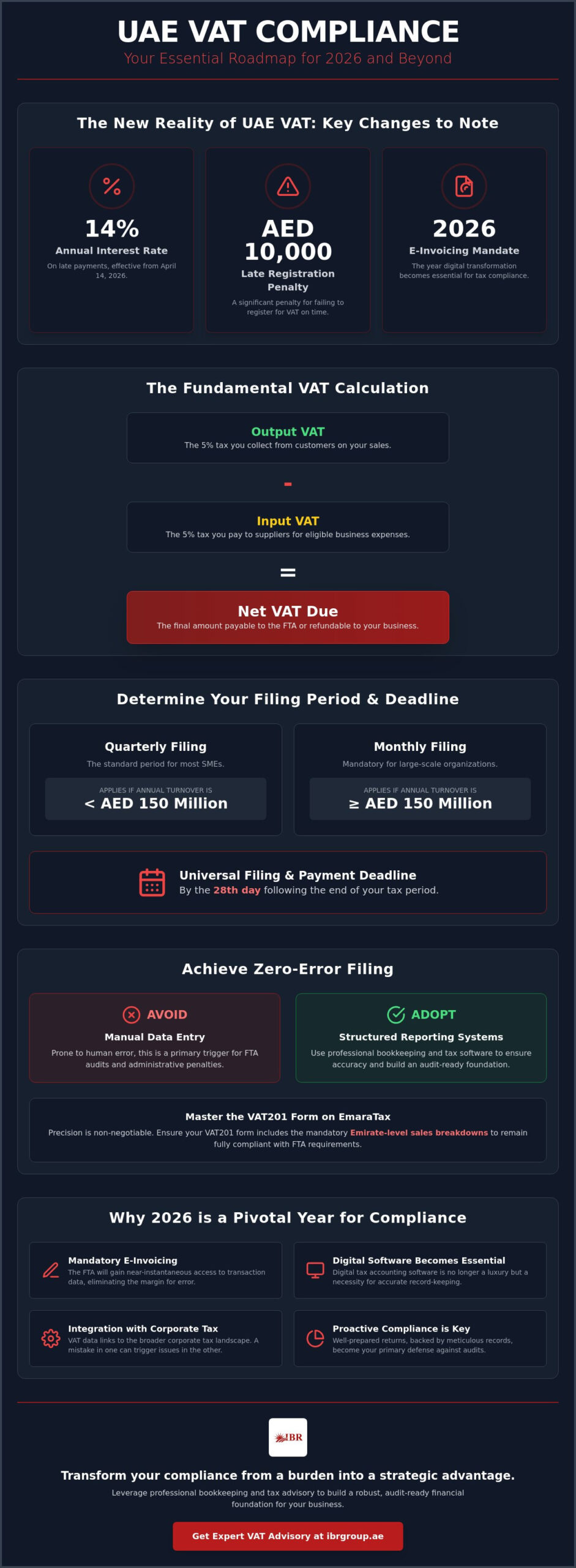
The filing process relies on the fundamental relationship between Output VAT and Input VAT. Output VAT is the 5% tax you collect from your customers on taxable sales. Conversely, Input VAT is the tax you’ve paid to your suppliers for business expenses. For a broader context on the regional tax structure, you can review this Overview of Taxation in the UAE, which details the historical implementation of these laws. By subtracting your eligible Input VAT from your Output VAT, you determine the net tax payable to the FTA or the refund you’re entitled to claim.
As we move through 2026, the regulatory environment is shifting toward unprecedented digital transparency. The FTA is increasingly utilizing real-time reporting tools to monitor transactions. This evolution means that accurate filing has become your primary defense against exhaustive audits. A well-prepared return, backed by meticulous records, demonstrates to the authority that your business is proactive and transparent. It provides a sense of security, ensuring that you can focus on growth without the looming fear of regulatory scrutiny.
The Legal Framework and FTA Authority
The foundation of the current system lies in the Executive Regulations of Federal Decree-Law No. 8 of 2017. These regulations empower the FTA to monitor and enforce compliance across all seven Emirates, ensuring a unified tax environment. The authority acts as a steady guide, providing the rules that maintain market stability and fair competition. The VAT201 form serves as the standard electronic document for tax declaration in the UAE.
Why 2026 is a Pivotal Year for Taxable Persons
The introduction of the UAE e-Invoicing roadmap has fundamentally changed how businesses approach data accuracy. Because the FTA will soon have access to transaction data almost instantaneously, the margin for error in your vat return filing uae has effectively vanished. Digital tax accounting software is no longer a luxury; it’s a necessity for ensuring that your records align perfectly with your filings. Additionally, the integration of VAT data with the broader Corporate Tax landscape means that a mistake in one area can trigger complications in another. Precision in your VAT reporting is now the cornerstone of your entire corporate tax strategy.
Tax Periods and Filing Thresholds: When is Your Return Due?
Timing is a critical component of tax compliance that is often overshadowed by the technicalities of data entry. In the UAE, your tax period is the specific timeframe for which you must report your financial activities. For the majority of small-to-medium enterprises, the standard tax period is quarterly. This structure allows businesses to manage their cash flow while maintaining a regular cadence of reporting. However, for large-scale organizations with an annual turnover exceeding AED 150 million, the FTA mandates a monthly filing cycle to ensure closer monitoring of high-volume transactions.
The deadline for both submission and payment is fixed: everything must reach the authority by the 28th day following the end of your tax period. Missing this window, even by a few hours, can trigger administrative penalties that disrupt your financial stability. To stay ahead of these dates, it’s highly recommended to utilize the “Tax Calendar” feature within the UAE Federal Tax Authority (FTA) portal. This digital tool provides a personalized view of your upcoming obligations, acting as a reliable safeguard against oversight.
Determining Your Specific Filing Frequency
How does the FTA decide your reporting schedule? This is typically determined during your initial registration based on your projected or historical turnover. While the AED 150 million threshold is a standard benchmark, the authority possesses the discretion to assign different periods based on a business’s specific risk profile or industry. For new entities, understanding these VAT registration requirements is the first step in establishing a compliant foundation. If your business circumstances change significantly, you may submit a formal request through the EmaraTax portal to adjust your filing frequency, provided you can justify the shift with accurate financial documentation.
Critical Deadlines and Public Holiday Adjustments
What happens if the 28th falls on a weekend or a public holiday? In such instances, the deadline is generally extended to the next business day. However, relying on this extension requires caution. There is a distinct difference between the “submission date” of your digital form and the “payment clearance date” within the banking system. While a return can be uploaded instantly, bank transfers may take several days to process. The FTA considers the date funds are received, not the date they were sent. To ensure your vat return filing uae remains flawless, we suggest initiating payments at least three business days in advance. Partnering with a professional advisor for your VAT return filing can help you navigate these logistical nuances with ease, providing the peace of mind that comes from knowing your payments are always on time.
Navigating the FTA Portal: A Breakdown of the VAT Return Form (VAT201)
Completing your digital declaration requires more than just entering figures into a spreadsheet. Once you log into the EmaraTax portal, you’ll find the “VAT Returns” tab, which serves as the gateway to the VAT201 form. This electronic document is the definitive record of your tax obligations for the period. While the 2026 e-invoicing roadmap is moving toward automated data population, the responsibility for verifying every entry remains with the taxable person. Accuracy at this stage is what differentiates a compliant business from one at risk of an audit.
The form begins with Box 1, which covers sales and all other outputs. This section is particularly critical because it requires a granular, Emirate-level breakdown of your standard-rated supplies. The FTA uses this data to track economic activity across the country, making it essential to attribute sales correctly based on the place of supply. Moving further down the form, Box 9 addresses your expenses and input tax. Here, you must distinguish between recoverable tax, such as standard business purchases, and non-recoverable tax, such as certain entertainment expenses. Finally, Boxes 12 and 13 aggregate these figures to calculate your Net VAT due or identify a refund position.
Emirate-Level Reporting for Mainland and Freezone Firms
How do you determine which Emirate should receive credit for a sale? For mainland businesses, this usually depends on where the fixed establishment most closely connected to the supply is located. However, for those who have navigated a Freezone company setup, the rules can vary depending on whether the goods are moved into the mainland or remain within a designated zone. Operating across multiple jurisdictions requires a robust accounting system to ensure your vat return filing uae reflects the exact geographical origin of your revenue, as mismatches here are a common red flag for FTA reviewers.
Recoverable Input Tax: What You Can and Cannot Claim
One of the most frequent errors in vat return filing uae involves claiming Input VAT on blocked items. You cannot claim tax back on personal motor vehicles used for non-business purposes or on most forms of business entertainment. To justify any recovery claim in Box 9, you must hold a valid Tax Invoice that meets all FTA requirements. Additionally, Box 10 is used for adjustments related to the reverse charge mechanism. This is often used for services imported from abroad where the recipient is responsible for accounting for the VAT. Ensuring these adjustments are mirrored correctly in both the output and input sections is vital for maintaining a balanced and compliant tax return.
Avoiding Common Filing Errors and FTA Penalties
Can a business successfully manage its tax obligations through manual spreadsheets alone? While many entrepreneurs believe manual entry is a cost-effective solution, the risk of data mismatch in the current digital ecosystem is significant. As the FTA moves toward real-time monitoring through the 2026 e-invoicing roadmap, even a small clerical error can trigger an automated query or a full-scale audit. Relying on manual processes often leads to inconsistencies between your internal records and what is reported on the EmaraTax portal, creating a vulnerability that is easily avoided with structured systems.
The penalty framework in the UAE is designed to encourage timely and accurate reporting. For a late submission of your vat return filing uae, the initial fine is AED 1,000, which increases to AED 2,000 for repeated offenses within 24 months. However, the financial implications don’t stop there. As of April 14, 2026, late payments incur a 14% annual interest rate, calculated monthly on the outstanding balance. If you discover an error after submission that results in a tax difference of more than AED 10,000, you must submit a Voluntary Disclosure via Form 211 within 20 business days. This process involves a monthly penalty of 1% on the tax difference. It’s vital to distinguish these administrative penalties from tax evasion, which involves intentional deception and carries much more severe, potentially criminal, consequences.
The Most Frequent Mistakes in UAE VAT Returns
One frequent error involves the misclassification of supplies. There’s a vital legal distinction between zero-rated supplies and exempt supplies; misapplying these statuses leads to incorrect tax calculations and potential underpayments. Another common oversight is the failure to account for the Reverse Charge Mechanism (RCM) on imported services. Many businesses forget they must act as both the supplier and the recipient for VAT purposes when dealing with international vendors. Additionally, clerical errors in the Emirate-level breakdown remain a top reason for FTA inquiries, as the authority cross-references this data with other regional economic indicators.
A Pre-Submission Audit Checklist
Before you click the final submit button, a structured review process is essential for maintaining your peace of mind. We recommend a thorough reconciliation of your VAT account against your general ledger to ensure every transaction is accounted for. You should also verify that every dirham of claimed Input VAT is supported by a valid Tax Invoice featuring the correct TRN of both parties. Finally, ensure that the individual submitting the return is a registered Tax Agent or an Authorized Signatory recognized by the FTA. If you find these requirements overwhelming, our team provides expert VAT return filing services to ensure your business remains on the right side of the law and avoids unnecessary financial strain.
Strategic VAT Management: How Professional Advisory Ensures Compliance
Managing tax obligations isn’t a standalone task; it’s the final output of a well-maintained financial ecosystem. At IBR Group, we act as a strategic partner to ensure that your vat return filing uae is a seamless reflection of your business’s health. By integrating our professional advisory services with your daily operations, we transform compliance from a source of stress into a structured, predictable process. This holistic approach ensures that every transaction is captured correctly at the source, leaving no room for the discrepancies that often trigger FTA reviews.
The strength of your tax reporting depends entirely on the quality of your in-house accounting and bookkeeping. When these records are managed with precision, they feed directly into accurate tax declarations, reducing the risk of clerical errors. There’s also a powerful synergy between external auditing and tax compliance. An audit provides an objective verification of your financial statements, which in turn reinforces the credibility of your VAT filings. Additionally, maintaining a high regulatory standing through goAML registration demonstrates your commitment to transparency, a trait that the authorities value highly in the current fiscal climate.
Beyond Filing: The Value of Tax Advisory
Why settle for simple data entry when professional review can unlock hidden value? Our experts often identify missed opportunities for Input VAT recovery that internal teams might overlook, ensuring you don’t leave money on the table. We also focus on preparing your business for future FTA tax audits by implementing rigorous record-keeping standards today. This proactive stance is invaluable when navigating complex bank queries, as having an expert accounting report ready can significantly expedite financial approvals and maintain your business’s momentum.
Your Path to Seamless Compliance
The journey from daily bookkeeping to a finalized VAT declaration doesn’t have to be complex. By centralizing your financial responsibilities with a trusted advisor, you create a clear path toward long-term stability and growth. We invite you to experience the peace of mind that comes with knowing every detail of your vat return filing uae is handled with the highest standards of professional excellence. Our team is ready to guide you through the intricacies of the 2026 landscape, protecting your interests while you focus on leading your enterprise.
Take the first step toward a worry-free tax season. Consult with IBR Group for Expert VAT Return Filing Services and secure your business’s future today.
Securing Your Business’s Future in a Digital Tax Era
The landscape of taxation in the Emirates is evolving rapidly. As we have explored, mastering the complexities of the VAT201 form and maintaining precise Emirate-level reporting are no longer optional for those seeking long-term stability. The 2026 shift toward real-time digital transparency means that your vat return filing uae must be backed by a robust, audit-ready financial ecosystem. By prioritizing accuracy and timely submissions, you protect your enterprise from the rising interest rates on late payments and the scrutiny of formal reviews.
IBR Group offers the deep-rooted expertise you need to navigate these intricate financial waters. With over 15 years of experience in the UAE financial sector, we provide an FTA-compliant tax and audit methodology that serves both Mainland and Freezone entities with absolute precision. Our commitment to high standards ensures that your administrative responsibilities are handled with the care they deserve, allowing you to focus on your core mission. Ensure Accurate VAT Filing with IBR Group Today and lead your business toward a future of growth and professional excellence. You don’t have to manage these challenges alone; a reliable partner is ready to support your journey.
Frequently Asked Questions
What is the deadline for filing a VAT return in the UAE?
The deadline for filing is the 28th day of the month following the end of your designated tax period. It’s vital to ensure that both your digital submission and the full tax payment reach the authority by this date. Relying on the EmaraTax portal’s personalized calendar will help you track these dates with precision, ensuring your business remains in good standing with the Federal Tax Authority.
Can I file my VAT return manually through a paper form?
No, you cannot file your return using paper forms as the FTA requires all declarations to be submitted electronically. Every registered business must use the EmaraTax portal to complete the VAT201 form and settle any outstanding tax liabilities. This digital-first approach ensures greater transparency and allows for the real-time monitoring of transactions, which is a cornerstone of the UAE’s modern fiscal infrastructure.
What happens if I make a mistake on a submitted VAT return?
If you discover an error that results in a tax difference of more than AED 10,000, you must submit a Voluntary Disclosure via Form 211. This submission should be made within 20 business days of identifying the mistake to avoid more severe penalties. For smaller errors, you may be permitted to make the correction in your next return, provided the tax impact doesn’t exceed the established threshold.
Is every business in the UAE required to file a VAT return?
Only businesses that are registered for VAT are required to file returns on a regular basis. Once your business is registered, you must submit a return for every tax period, even if you haven’t made any sales or purchases during that time. Filing a “nil return” is a mandatory requirement that demonstrates your ongoing compliance and prevents the authority from issuing late-filing fines against your TRN.
How long should I keep my VAT-related records and invoices?
Standard regulations require you to maintain all tax-related records, including invoices and credit notes, for a minimum of five years. For businesses involved in real estate, this retention period is extended to 15 years to account for the long-term nature of property transactions. Keeping organized, digital copies of these documents is a proactive step that provides a sense of security during any potential FTA audit or review.
Can I claim a VAT refund if my Input Tax exceeds my Output Tax?
Yes, you can claim a refund if your recoverable Input Tax is greater than the Output Tax you’ve collected from customers. You have a five-year deadline to submit a request for any excess refundable VAT through the EmaraTax portal. Many businesses choose to carry forward their credit to offset future tax liabilities, but a formal refund request is always an option for maintaining healthy cash flow.
What is the penalty for late VAT return filing in 2026?
The administrative penalty for late vat return filing uae is AED 1,000 for the first instance and AED 2,000 for any repeated offense within 24 months. Beyond these fixed fines, a 14% annual interest rate is applied to any outstanding tax balance as of April 14, 2026. This interest is calculated monthly, making it essential to prioritize timely submissions to protect your business from accumulating significant financial liabilities.
Do I need an FTA-registered tax agent to file my returns?
While it’s not a legal requirement to use a registered tax agent, many businesses find it strategically beneficial to do so. A professional advisor ensures that your vat return filing uae is accurate and fully compliant with the latest Executive Regulations. This expert oversight reduces the risk of costly errors and provides you with the peace of mind needed to focus on your core business growth and operational excellence.