
Could your cross-border expansion actually be eroding your bottom line through hidden tax leakages you haven’t yet identified? It’s natural to feel a sense of trepidation when facing the shifting landscape of global compliance, especially with the 2026 implementation of mandatory e-invoicing and the complexities of BEPS 2.0 Pillar Two. You want to grow your enterprise without the constant shadow of double taxation or the stress of missing a critical FTA filing. Finding a reliable partner for international tax consultation uae is no longer just about meeting basic requirements; it’s about securing your firm’s future in a transparent global market.
We understand that the intricacies of Transfer Pricing and the specific physical presence rules for Tax Residency Certificates can feel overwhelming. This strategic framework will empower you to master these complexities through tailored strategies that turn regulatory hurdles into competitive advantages. We’ll explore how to optimize your cross-border profit structures, ensure full compliance with the latest AML standards, and leverage the UAE’s extensive network of over 140 Double Taxation Avoidance Agreements to protect your global interests. By the end of this guide, you’ll have a clear path to achieving a seamless, compliant, and tax-efficient international operation.
Key Takeaways
- Learn how to navigate the UAE’s shift toward global transparency by leveraging over 140 Double Taxation Avoidance Agreements to protect your foreign dividends and interest.
- Secure your enterprise’s growth with expert international tax consultation uae that bridges the gap between local corporate tax registration and complex international compliance.
- Understand the specific documentation required to obtain Tax Residency Certificates, ensuring your business demonstrates the necessary substance to claim treaty benefits.
- Identify the vital connection between tax transparency and AML oversight, including the role of goAML registration in maintaining a compliant and reputable corporate profile.
- Shift from basic filing to a strategic framework that prepares your UAE operations for global standards like BEPS 2.0 Pillar Two and mandatory e-invoicing.
Table of Contents
The Evolving Landscape of International Tax Consultation in the UAE
Has your business model adapted to the reality that the UAE is now a fully integrated player in the global tax arena? The days of viewing the Emirates solely as a “low-tax” jurisdiction have passed. Since the introduction of the federal corporate tax in 2023, the region has matured into a globally compliant financial hub that balances domestic revenue needs with international obligations. This evolution means that international tax consultation uae is no longer a luxury reserved for the world’s largest firms; it’s a fundamental requirement for any business operating across borders. The Federal Tax Authority (FTA) has significantly increased its oversight, utilizing advanced data analytics to monitor cross-border activities and ensuring that all transactions align with international standards.
Why should a medium-sized enterprise care about these high-level global shifts? The reality is that the threshold for regulatory scrutiny has lowered. Even smaller entities are finding that their international dealings trigger inquiries that require professional resolution. A robust tax framework ensures that your growth isn’t hampered by compliance failures or the fear of double taxation. As we move through 2026, the interaction between local laws and international treaties has become more complex, requiring a sophisticated approach to maintain both compliance and profitability.
OECD BEPS 2.0 and the UAE Impact
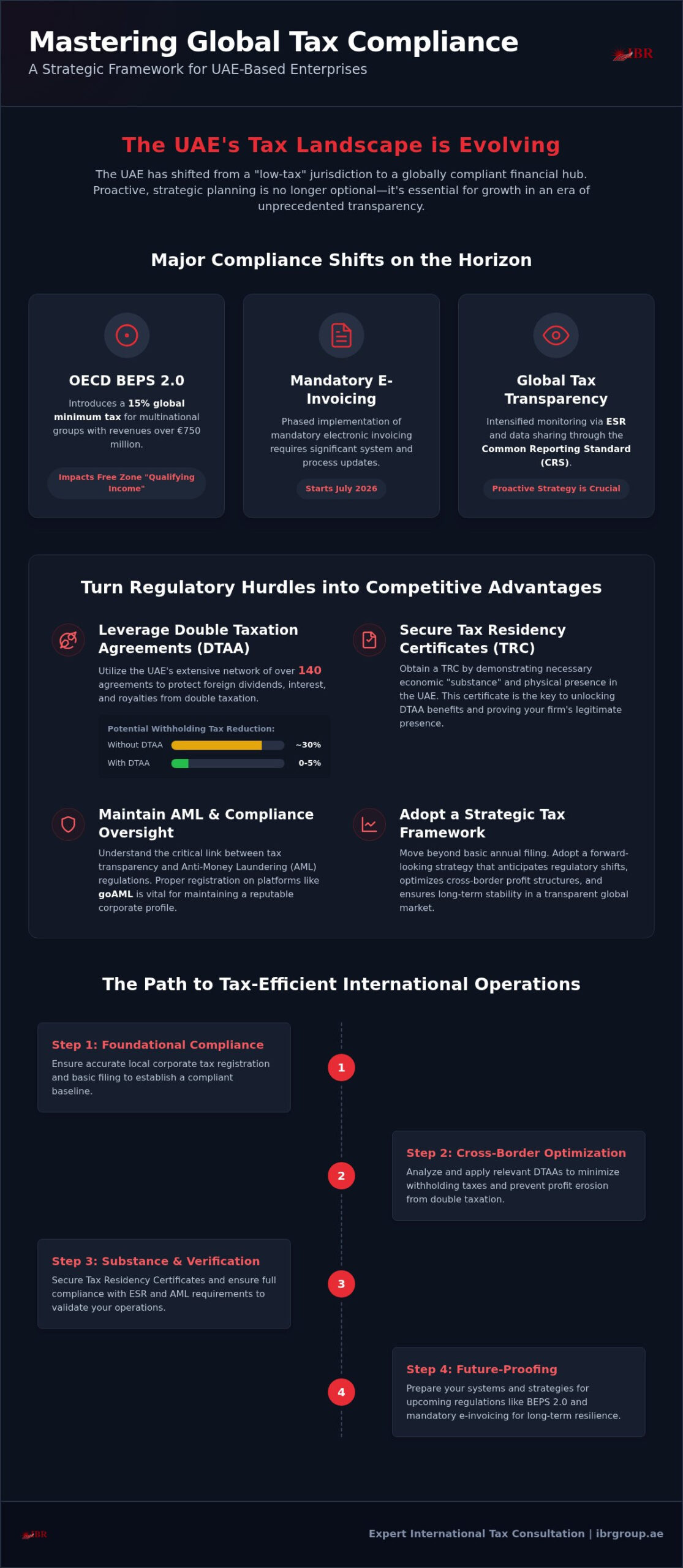
The OECD’s Base Erosion and Profit Shifting (BEPS) 2.0 framework represents the most significant change to international tax in decades. For multinational groups operating in the Emirates, Pillar Two introduces a 15% global minimum tax rate for those with consolidated revenues exceeding €750 million. While this primarily targets large enterprises, the ripple effects influence how UAE freezone company setup is structured in 2026. Qualifying Free Zone Persons must now navigate strict “qualifying income” rules to maintain their 0% status, making expert international tax consultation uae essential to avoid unexpected tax liabilities. Key considerations for 2026 include:
- Evaluating the impact of the 15% global minimum tax on subsidiary profits.
- Ensuring that freezone operations meet the revised “substance” requirements to qualify for preferential rates.
- Preparing for the phased implementation of mandatory e-invoicing starting in July 2026.
The Shift Toward Global Tax Transparency
Transparency is the new standard. The FTA has intensified its monitoring of cross-border transactions to ensure they align with Economic Substance Regulations (ESR). Additionally, the robust implementation of the Common Reporting Standard (CRS) ensures that financial data flows seamlessly between jurisdictions. Understanding the history of Taxation in the UAE helps one appreciate how quickly the landscape has shifted from a reactive filing environment to one that demands proactive, strategic planning. Businesses must move beyond simple compliance and adopt a forward-looking strategy that anticipates regulatory shifts before they impact the balance sheet. This proactive stance is the only way to ensure long-term stability in an increasingly transparent global market.
Navigating Double Taxation Avoidance Agreements (DTAA)
How much of your global profit is being lost to unnecessary withholding taxes? For many UAE-based enterprises, the answer is often more than it should be. The UAE’s extensive network of over 140 Double Taxation Avoidance Agreements (DTAAs) serves as a protective shield, designed to ensure that income earned across borders isn’t taxed twice. These treaties are foundational to international tax consultation uae, as they provide clear rules on which country has the right to tax specific types of income, such as dividends, interest, and royalties. By leveraging these agreements, businesses can significantly reduce the tax burden on their foreign operations, often lowering withholding rates from 30% to as little as 0% or 5% depending on the specific treaty partner.
It’s vital to recognize that treaty benefits aren’t automatic. To claim relief, your business must meet specific criteria, primarily avoiding the creation of a “Permanent Establishment” (PE) in the source country. A PE is generally triggered when a business has a fixed place of operations or a dependent agent abroad for a specific duration. In 2026, updates to major treaties with European and Asian partners have introduced stricter anti-abuse clauses. These changes require companies to demonstrate that their UAE operations have genuine economic substance rather than being mere conduits for tax routing. Reviewing the UAE’s official corporate tax guidelines can provide additional clarity on how these international obligations align with local legislation.
Strategic Use of Tax Treaties for Global Expansion
Identifying the most beneficial jurisdictions for your holding company can define your long-term scalability. Proper documentation, including the acquisition of Tax Residency Certificates, is the only way to validate your claim for treaty benefits. This strategic alignment also influences other areas of compliance, such as VAT return filing in the UAE, where cross-border services must be correctly categorized to avoid penalties. If your structure involves multiple jurisdictions, seeking a professional expert report can help clarify your status to international tax authorities and financial institutions.
Transfer Pricing Compliance and Documentation
Your inter-company pricing must reflect the “Arm’s Length Principle,” meaning transactions between related parties should mirror market-aligned rates. In 2026, the FTA requires robust documentation, including a Master File and a Local File for businesses exceeding specified revenue thresholds. These files provide a transparent audit trail of your global value chain. Failing to maintain these records can lead to significant adjustments and fines during an audit. Proactive transfer pricing risk assessments are now a standard component of international tax consultation uae, ensuring that your internal pricing doesn’t become a liability during global expansion.
Securing Tax Residency Certificates for Cross-Border Operations
Have you considered how your business proves its tax residency to foreign authorities? While a UAE trade license establishes your legal presence, it’s the Tax Residency Certificate (TRC) that serves as the definitive evidence of your tax status. For enterprises engaged in cross-border trade, the TRC is the “golden ticket” required to unlock the benefits of Double Taxation Avoidance Agreements. Without this document, your foreign-sourced income could be subject to full withholding taxes in the source country, significantly impacting your liquidity. Engaging in professional international tax consultation uae ensures that your application is built on a foundation of verifiable substance, protecting your profits from redundant taxation.
It’s important to distinguish between corporate and individual certificates. Corporate TRCs require proof of management and control within the UAE, often evidenced by physical office space and local board meetings. Individual TRCs, frequently sought by entrepreneurs and NRIs, hinge on physical presence rules. In 2026, while the bank statement requirement for DTAA purposes has been removed for many TRC applications, the Federal Tax Authority (FTA) remains vigilant regarding entry and exit logs. Proving you meet the 183-day or conditional 90-day physical presence rule is essential for maintaining your status as a resident for tax purposes.
The Application Process for UAE TRCs
The path to FTA approval requires meticulous preparation. Common pitfalls, such as submitting expired lease agreements or inconsistent audited accounts, often lead to avoidable rejections. In 2026, timeline expectations for approval generally range from two to four weeks; however, this depends entirely on the accuracy of your documentation. You’ll need to provide:
- A valid Ejari or commercial lease agreement.
- Audited financial statements for the relevant tax period.
- A detailed report of entry and exit dates from the UAE.
- Proof of functional substance, such as local utility bills or salary records.
Dual Residency Management: The UAE-India Corridor
Managing tax liabilities for Indian expats with significant business interests in the Emirates requires a specialized approach. The UAE-India corridor is one of the most active financial lanes in the region, and dual residency can lead to complex tax inquiries from the Indian Income Tax Department. This is where the support of external audit firms in Dubai becomes invaluable. These professionals help validate your residency claims by ensuring your financial records are transparent and fully compliant with both UAE and Indian standards. Furthermore, for those holding a UAE Golden Visa, the interaction between your long-term residency status and your tax obligations must be carefully managed through proactive international tax consultation uae to ensure you aren’t inadvertently classified as a resident in multiple jurisdictions for the same income.
Managing Cross-Border Risk and AML Compliance
Why has the boundary between tax compliance and financial crime prevention become so blurred? In 2026, comprehensive international tax consultation uae must encompass Anti-Money Laundering (AML) oversight to be truly effective. The UAE’s regulatory framework, specifically Federal Decree-Law No. (10) of 2025, has expanded the definition of “predicate offenses” to explicitly include tax evasion. This means that a significant error in your cross-border tax filing isn’t just a fiscal oversight; it can be flagged as a potential money laundering risk. Central to this integrated approach is goAML registration in the UAE, which ensures that your business is equipped to report suspicious transactions and maintain its standing with the Financial Intelligence Unit.
FTA audits are frequently triggered by specific red flags that suggest a lack of transparency. Large, unexplained transfers to jurisdictions with low tax transparency or inconsistent Know Your Customer (KYC) documentation for international partners are high-priority targets for regulators. Maintaining a robust KYC framework within your tax structure is no longer optional. It’s a protective measure that proves your business isn’t being used as a conduit for illicit funds. When your international tax strategy is aligned with AML standards, you build a layer of corporate resilience that satisfies both tax authorities and global banking partners.
A Compliance Roadmap for Global Transactions
Establishing a clear path for international compliance helps mitigate the risk of sudden regulatory intervention. We recommend following these three structured steps:
- Step 1: Conduct a comprehensive tax and AML risk audit of all foreign subsidiaries to identify potential exposure points.
- Step 2: Implement accounting software that tracks cross-border jurisdictional data, ensuring every transaction is mapped to its tax origin.
- Step 3: Establish a regular reporting cycle for both FTA filings and AML authorities to ensure no deadline or disclosure is missed.
Resolving Bank Queries and Expert Reports
Financial institutions have become the frontline of tax enforcement. Banks often initiate queries or freeze accounts if they detect a lack of economic substance or suspect tax non-compliance in foreign income streams. Resolving these disputes requires more than just a simple explanation; it demands an expert report for UAE bank queries. These reports provide an independent, professional verification of your tax status and transaction legitimacy, offering the clarity banks need to resume normal operations. Maintaining corporate credibility through audited financial transparency is the most effective way to prevent these interruptions. If you are currently facing scrutiny from financial institutions, our team provides the specialized AML compliance support necessary to restore your operational freedom.
Why Strategic Advisory is the Key to International Success
Are you simply checking boxes, or are you building a tax-efficient fortress for your global operations? In 2026, the value of international tax consultation uae lies not in the act of filing, but in the strategic foresight that precedes it. A long-term partner doesn’t just react to current regulations; they anticipate the fiscal shifts of the next decade. Whether your structure involves a mainland entity, a specialized freezone setup, or offshore jurisdictions like the BVI, a customized framework is essential to navigate the specific compliance demands of each. We’ve seen that businesses attempting to manage these varied requirements in isolation often face fragmented data and increased audit risk. At IBR Group, we integrate bookkeeping, external audit, and tax filing into a single, cohesive strategic flow, ensuring that every data point serves your broader international goals.
The UAE’s fiscal policy is no longer static. As the region continues to harmonize its laws with global standards, the “set and forget” mentality of the past has become a liability. Moving beyond simple filing means establishing a resilient corporate architecture that remains compliant even as thresholds for BEPS 2.0 or e-invoicing evolve. This proactive approach ensures that your cross-border profit structures are optimized for both local 9% corporate tax rates and international withholding expectations, providing a level of stability that “instant quote” providers simply cannot offer.
Integrated Professional Services
The synergy between professional bookkeeping and international tax readiness is often underestimated. While in-house accounting teams are excellent for daily operations, they frequently lack the specialized depth required to capture global tax nuances or complex transfer pricing adjustments. By leveraging our 15 years of UAE financial sector experience, your business gains access to a level of sophistication that transforms financial records into strategic assets. We bridge the gap between local accounting and global empowerment, ensuring your records are always “audit-ready” for both the FTA and international partners. This integration is particularly vital for firms managing the UAE-India corridor, where Indian Tax Residency requirements must be mirrored perfectly in your local books to avoid dual-taxation disputes.
Securing Your Corporate Future
Achieving a fully compliant international structure provides more than just legal safety; it offers the peace of mind necessary to focus on core business growth. As the UAE continues to align its fiscal policy with global transparency standards, the complexity of managing cross-border profits will only increase. Your next step should be a proactive move toward clarity. Scheduling a comprehensive tax residency and compliance review today prevents the regulatory surprises of tomorrow. It’s time to move beyond the basics and embrace a framework designed for excellence. Contact IBR Group for expert international tax consultation to secure your enterprise’s future in the global marketplace.
Empowering Your International Growth
Success in the global market now requires a sophisticated balance between cross-border expansion and meticulous regulatory adherence. We’ve explored how leveraging the UAE’s network of over 140 tax treaties and securing precise Tax Residency Certificates can protect your foreign-sourced income from unnecessary leakage. By integrating your tax strategy with robust AML oversight and goAML registration, you don’t just meet the standards of the FTA; you build a foundation of corporate credibility that satisfies international banking partners and global tax authorities alike. The transition to a transparent fiscal framework in 2026 isn’t a hurdle, but an opportunity to demonstrate your business’s maturity and resilience.
Choosing the right partner for international tax consultation uae is the most critical step in this journey. With over 15 years of UAE financial expertise, IBR Group provides the specialized support needed for Indian and UAE TRC applications and comprehensive goAML compliance integration. Our integrated approach ensures that your bookkeeping, audits, and tax filings work in harmony to support your long-term scalability. Secure your global growth with expert international tax consultation from IBR Group. Your path to a resilient, tax-optimized future starts with a single strategic decision. We’re ready to guide you toward sustained excellence in the Emirates and beyond.
Frequently Asked Questions
What is the difference between UAE Corporate Tax and international tax?
UAE Corporate Tax is a domestic regulation that applies a 9% rate on taxable income exceeding AED 375,000 within the Emirates. International tax focuses on the interaction between the UAE and other jurisdictions. It involves managing Double Taxation Avoidance Agreements and ensuring that cross-border profits aren’t taxed twice. While corporate tax is about your local liability, international tax strategies manage your global footprint and compliance with foreign authorities.
Does a UAE freezone company have to pay tax on foreign income in 2026?
A freezone company may benefit from a 0% rate if the foreign income is considered “Qualifying Income” under specific FTA rules. However, income from “Excluded Activities” or transactions that lack sufficient economic substance is subject to the standard 9% rate. Professional international tax consultation uae is essential to categorize these income streams correctly and avoid unexpected domestic tax liabilities on your global earnings.
How do I apply for a Tax Residency Certificate in the UAE?
You can apply for a Tax Residency Certificate through the Federal Tax Authority’s EmaraTax portal. The process requires submitting a valid lease agreement, audited financial statements, and a detailed report of your entry and exit logs. For individuals, you must generally prove physical presence for at least 183 days within a 12-month period to qualify under most international treaty purposes.
What are the penalties for non-compliance with UAE Transfer Pricing rules?
Non-compliance with Transfer Pricing documentation requirements can lead to significant administrative penalties and unfavorable tax adjustments. If a business fails to provide the required Master File or Local File upon request, the FTA may re-estimate the taxable income based on market rates. These adjustments often result in higher tax burdens and interest on late payments, making proactive documentation a necessity for cross-border operations.
Can IBR Group help with Indian Tax Residency Certificates for NRIs?
Yes, IBR Group offers specialized support for obtaining Indian Tax Residency Certificates specifically for NRIs. Our team understands the unique documentation requirements of the Indian Income Tax Department and how they interact with UAE residency status. We provide a seamless path for individuals to prove their tax status, ensuring they can claim treaty benefits and avoid dual taxation on their global assets.
How does the UAE-India DTAA benefit my business?
The UAE-India Double Taxation Avoidance Agreement protects your business by capping or eliminating withholding taxes on dividends, interest, and royalties. It provides a clear legal framework to ensure that the same income isn’t taxed in both countries. By utilizing this treaty, businesses can significantly improve their cash flow and reinvest foreign profits more efficiently without the burden of redundant tax levies.
What is the impact of BEPS 2.0 on small businesses in the UAE?
While the 15% global minimum tax primarily targets multinational groups with revenue over €750 million, small businesses face indirect impacts. These include stricter reporting standards and an increased focus on economic substance. Even smaller enterprises must now maintain transparent records to prove they aren’t being used for tax avoidance, as the global trend moves toward total fiscal transparency for all entities.
Do I need an external audit for my international tax filing?
An external audit is mandatory for UAE businesses with annual revenue exceeding AED 50 million. Even if your revenue is lower, audited financial statements are frequently required to obtain a Tax Residency Certificate or to satisfy foreign tax authorities during a DTAA relief application. Maintaining audited records is a standard part of international tax consultation uae to ensure your corporate credibility remains high during cross-border transactions.