
What if the decision between a mainland vs freezone company setup in 2026 has almost nothing to do with ownership and everything to do with your specific tax footprint? You likely recognize that the UAE has fundamentally shifted its regulatory landscape, making 100% foreign ownership a reality for most mainland activities. However, this newfound freedom brings a different kind of pressure: the need to manage a 9% corporate tax rate and complex VAT requirements while avoiding hidden renewal costs. It’s natural to feel concerned about how these financial layers will impact your long-term bottom line as you scale.
This strategic comparison will clarify the critical differences between these two structures, ensuring you choose a foundation that is both compliant and future-proof. You’ll gain a clear decision-making framework to navigate the nuances of the current market. We will explore the latest visa regulations, physical office mandates, and the specific criteria for the 0% Qualifying Free Zone Person tax regime to provide you with total confidence in your financial compliance.
Key Takeaways
- Understand why 100% foreign ownership is no longer the primary differentiator and how tax residency now leads your structural decisions.
- Evaluate your operational reach to determine if a mainland vs freezone company setup offers the best access to local markets or international trade corridors.
- Identify the strict financial compliance standards needed to secure a 0% tax rate as a Qualifying Free Zone Person under current corporate tax regulations.
- Learn how physical office requirements and registration types like Ejari directly dictate your total visa quotas and human capital planning.
- Access a side-by-side comparison framework to ensure your chosen foundation supports your five-year expansion goals without the burden of hidden renewal costs.
Table of Contents
- Defining the 2026 UAE Business Landscape: Mainland vs Free Zone
- Operational Reach and Trading Restrictions: Where Can You Grow?
- Financial Compliance: Corporate Tax, VAT, and Auditing in 2026
- Visa Quotas and Residency: Planning for Your Human Capital
- Strategic Comparison Framework: Which Structure Fits Your 2026 Goals?
Defining the 2026 UAE Business Landscape: Mainland vs Free Zone
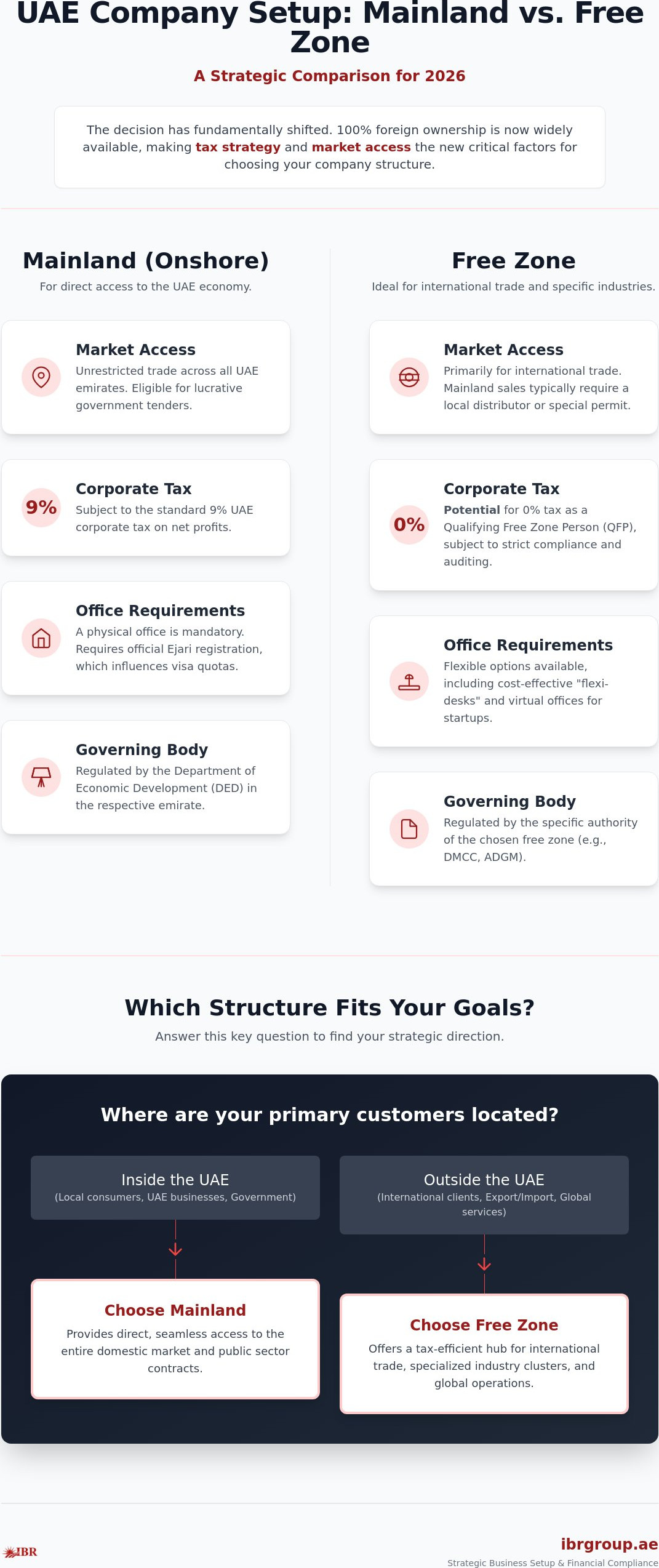
How has the UAE business environment transformed as we move through 2026? The traditional boundaries that once dictated your choice have evolved into a more sophisticated, dual-tier system. Choosing between a mainland vs freezone company setup is no longer a matter of simply securing 100% ownership, as this privilege now extends across both jurisdictions for the vast majority of commercial activities. Instead, your decision must align with your long-term operational reach and specific tax strategy.
The regulatory framework is split between federal oversight and localized authority. While the Ministry of Economy sets the broad national agenda, mainland entities are governed by the Department of Economic Development (DED) in their respective emirates. Conversely, the diverse landscape of UAE Free Zones operates under individual authorities, each offering specialized regulations tailored to specific industries. This distinction determines not just how you register, but who you can serve and how you’re taxed in the current fiscal environment. With the UAE’s non-oil economy reaching AED 981 billion in 2024, the stakes for making the correct structural choice have never been higher.
What is a Mainland (Onshore) Company?
A mainland company is an onshore entity registered with the national Department of Economic Development. Its primary advantage lies in its unrestricted access to the local market. You can trade freely across all seven emirates and bid directly for lucrative government tenders without needing a local distributor or agent. This structure is essential if your growth strategy involves physical retail, local services, or public sector partnerships within the UAE. It also requires a physical office space registered with the official tenancy system, known as Ejari, which provides a tangible foundation for your operations.
What is a Free Zone (Offshore/Designated) Company?
Free zone entities are established within specialized economic jurisdictions designed to foster international trade and industry-specific innovation. These zones are often “designated” areas for VAT purposes and offer unique incentives for exporters. While they provide a streamlined setup process, their operational scope is generally limited to international markets or trade within the zone itself. If you intend to sell goods directly to the UAE mainland, you’ll typically require a local distributor or a specific mainland permit. This structure is ideal for founders who prioritize industry clusters, such as technology or media hubs, and whose primary client base resides outside the UAE.
Ultimately, the “best” structure depends on where your target customers are located. A mainland vs freezone company setup decision should be viewed through the lens of market access. If your revenue flows from local government contracts or UAE-based consumers, the mainland offers the most seamless path. If your focus is global, a free zone provides a tailored environment to scale internationally while maintaining a presence in a premier financial hub.
Operational Reach and Trading Restrictions: Where Can You Grow?
Where do you intend to sell your products or services? This fundamental question often dictates the outcome of the mainland vs freezone company setup debate. While both options offer significant growth potential, their geographic reach differs substantially. Mainland companies enjoy the freedom to operate anywhere within the UAE, including direct sales to consumers and other businesses. In contrast, free zone entities are generally restricted to trading within their specific zone or internationally. To access the mainland market, a free zone company must typically engage a local distributor or obtain a specific permit, such as those enabled by Dubai Executive Council Resolution No. 11 of 2025.
Office space requirements further distinguish these paths. Mainland entities must secure a physical office space, typically requiring a minimum of 200 square feet registered with Ejari. This physical footprint is often a prerequisite for certain activities and visa quotas. Free zones offer more flexibility, providing “flexi-desk” or “virtual office” solutions that are cost-effective for startups. However, if your business falls into regulated sectors like banking, insurance, or oil and gas, a mainland license is usually mandatory. For a broader perspective on these structural nuances, you might find this Forbes guide to UAE company formation particularly insightful.
Market Access and Government Tenders
Mainland companies hold a distinct advantage when it comes to national infrastructure projects. If your goal is to bid on government tenders or work with public sector entities, a mainland license is effectively a necessity. This structure allows you to build direct B2B relationships without the administrative hurdle of a middleman. For free zone entities, navigating the “Designated Zones” for VAT purposes is a critical compliance step, as these areas are treated as being outside the UAE for certain tax applications. Understanding these jurisdictional boundaries is essential for maintaining smooth operations; our team can assist with Mainland Company Setup to ensure you’re positioned for local success.
International Trade and Industry Specialization
Free zones are designed to empower businesses focusing on global markets. By clustering similar industries together, such as logistics in JAFZA or media in Dubai Media City, these zones create high-efficiency ecosystems. They simplify the process of re-exporting goods, as many zones are strategically located near major ports and airports. Free zones function as industry-specific hubs that provide specialized infrastructure and networking opportunities for niche markets. This specialization allows founders to scale rapidly within a supportive environment while minimizing the complexities of domestic retail logistics.
Financial Compliance: Corporate Tax, VAT, and Auditing in 2026
How does the 2026 fiscal regime alter your bottom line? The introduction of corporate tax has fundamentally changed the math behind a mainland vs freezone company setup. Mainland entities now face a standard 9% corporate tax on taxable income exceeding AED 375,000. This shift makes meticulous tax planning a necessity rather than a luxury. While free zone entities can potentially maintain a 0% tax rate, this benefit isn’t automatic. You must qualify as a Qualifying Free Zone Person (QFZP), which involves maintaining adequate economic substance and ensuring your revenue qualifies under specific FTA guidelines. If your free zone company earns non-qualifying income, that portion is still subject to the standard 9% rate.
VAT obligations add another layer of responsibility. Both structures must register for VAT once taxable supplies and imports exceed the mandatory threshold of AED 375,000. Professional bookkeeping ensures your filings are accurate and that you remain eligible for any available reliefs. Without transparent records, you risk losing your QFZP status or facing significant penalties during a tax audit. Maintaining high standards of financial reporting is the only way to secure long-term stability in this complex regulatory environment.
External Audit Requirements
Many founders overlook that most free zones mandate an external audit for annual license renewals. While mainland requirements vary depending on the specific activity and emirate, banks almost always demand audited financials before granting credit facilities or corporate loans. These reports do more than satisfy regulators; they build institutional credibility with international partners. An audit provides an objective verification of your financial health, which is essential for scaling a business in a global hub like the UAE.
AML and goAML Compliance
Compliance extends well beyond tax and accounting. High-risk sectors, such as real estate and precious metals, must complete their goAML registration to monitor and report suspicious transactions. The UAE’s commitment to international standards means the FTA and Ministry of Economy are increasingly vigilant. Every business must adhere to Anti-Money Laundering (AML) reporting obligations to avoid heavy administrative fines. Professional compliance monitoring is your best defense, ensuring your operations remain beyond reproach while you focus on growth.
Visa Quotas and Residency: Planning for Your Human Capital
How many team members does your five-year growth plan require? When evaluating a mainland vs freezone company setup, your talent acquisition strategy is directly constrained by your choice of jurisdiction. In the UAE, residency visas are tied to the physical capacity of your office space. While the mainland offers virtually unlimited scalability for large teams, it requires a proportional investment in real estate. Conversely, free zones provide excellent entry points for solo founders but often impose strict caps on visa quotas for smaller, flexible workspaces. Choosing the wrong path early on can lead to administrative bottlenecks when you’re ready to scale your workforce.
Processing times and administrative costs also vary between these two paths. Mainland visas are processed through the General Directorate of Residency and Foreigners Affairs (GDRFA) and the Ministry of Human Resources and Emiratisation (MOHRE). Free zone visas are handled by the specific zone authority, which can sometimes offer a more streamlined, “one-stop-shop” experience. For international founders, the long-term value of UAE residency extends beyond simple operational needs; it provides a stable base for family sponsorship and global mobility. Understanding the cost of setting up a business involves factoring in these recurring residency expenses alongside your initial license fees.
Office Space vs. Visa Eligibility
In a mainland environment, the Department of Economic Development typically allocates visa quotas based on the square footage of your premises, often requiring roughly 80 to 100 square feet per employee. This makes a physical Ejari contract a cornerstone of your human capital planning. Free zones cater to more agile models, offering “e-desk” or “flexi-desk” packages that usually grant between two and five visas without the need for a dedicated private office. This flexibility is ideal for tech startups or consultancy firms that don’t require a large physical presence immediately. You should always verify if your chosen zone allows for quota increases as your team expands, as some zones have rigid limits for their entry-level packages.
Golden Visa Assistance for Investors
Have you considered how your company formation can lead to a 10-year residency? A significant advantage in the current 2026 landscape is the ability to integrate Golden Visa applications into your setup strategy. This long-term residency is available to investors and highly skilled professionals who meet specific capital or professional criteria. Unlike standard two-year or three-year visas, the Golden Visa offers unparalleled stability and the freedom to stay outside the UAE for extended periods without losing residency status. Our team provides specialized Golden Visa Assistance to ensure your application is handled with the precision and professional authority required for a successful outcome.
Strategic Comparison Framework: Which Structure Fits Your 2026 Goals?
How do you finalize your choice after weighing the operational and fiscal variables? A mainland vs freezone company setup decision requires looking far beyond the immediate license fee. You must evaluate your five-year trajectory to ensure your foundation doesn’t become a structural constraint as you scale. For instance, while a free zone might offer lower initial overhead, the long-term expense of engaging third-party distributors to reach local UAE customers could eventually outweigh those savings. Conversely, a mainland setup involves a higher commitment to physical real estate but provides the direct market access needed for retail and government-facing enterprises.
Before committing capital, conducting a business feasibility study is a critical prerequisite for 2026 investors. This analysis helps you anticipate tax liabilities and operational costs specific to your industry cluster. It ensures that your chosen structure aligns with the reality of the UAE’s economic substance requirements and your specific revenue projections. In a landscape where compliance is as vital as commerciality, a well-researched entry strategy is your best protection against future regulatory friction.
Key Selection Criteria for Founders
To determine the most effective path, founders should answer three fundamental questions regarding their business model:
- Is your primary market local, regional, or international? Mainland licenses are superior for domestic trade, while free zones excel in global re-exports and digital services.
- Do you require a physical retail presence or a corporate office? Mainland entities can open storefronts anywhere, whereas free zone companies are restricted to their designated areas.
- What is your projected annual revenue relative to tax thresholds? If you expect to exceed AED 375,000, your ability to meet Qualifying Free Zone Person status becomes a primary financial driver.
Partnering with Business Setup Consultants
The complexity of the 2026 legal landscape means that small errors in the application phase can lead to significant delays in bank account opening or VAT registration. Professional consultants act as a steady guide, helping you avoid common pitfalls such as incorrect activity mapping or insufficient documentation for AML compliance. They ensure that your corporate structure is optimized for both current operations and future expansion. For those seeking a seamless transition into the market, we invite you to Consult with IBR Group for tailored corporate advisory and professional setup services that prioritize your peace of mind and long-term success.
Securing Your Corporate Future in the UAE
Selecting the ideal foundation for your business is a sophisticated process that requires balancing immediate market access with long-term fiscal efficiency. As we’ve explored, the choice between a mainland vs freezone company setup in 2026 is defined by your tax footprint and operational scope rather than simple ownership rules. Whether you’re navigating the 9% corporate tax regime on the mainland or securing a 0% rate as a Qualifying Free Zone Person, your decision must be supported by rigorous financial planning and a clear five-year growth strategy.
At IBR Group, we bring over 15 years of deep-seated experience in the UAE financial sector to guide you through these complexities. Our team provides comprehensive support across Tax, Audit, and AML compliance, with specialized expertise spanning Mainland, Freezone, and BVI jurisdictions. We ensure your setup is seamless, compliant, and perfectly aligned with your professional excellence. Schedule a Consultation with IBR Group for Expert Business Setup today to begin your journey. Your vision for growth deserves a stable and scalable foundation, and we’re here to help you build it with confidence.
Frequently Asked Questions
Can a free zone company operate in the UAE mainland?
A free zone company can operate on the mainland by obtaining a specific permit or working through a local distributor. While traditionally restricted to their zones, recent regulations like those in Dubai now allow certain entities to expand their reach without establishing a separate mainland license. This hybrid approach is increasingly popular for businesses that need to maintain their free zone tax advantages while accessing local customers.
Do I still need a UAE national partner for a mainland company in 2026?
You no longer require a UAE national partner for the majority of commercial and industrial activities on the mainland. Since the regulatory reforms implemented in 2021, 100% foreign ownership has become the standard for international investors. This change has fundamentally shifted the mainland vs freezone company setup debate, as founders can now maintain full control while enjoying unrestricted access to the domestic market.
Which structure is more cost-effective for a small startup?
Free zones are typically more cost-effective for small startups because they offer flexible workspace solutions like virtual offices and flexi-desks. These options significantly reduce the initial capital required for physical real estate. In contrast, a mainland vs freezone company setup comparison shows that mainland entities often involve higher first-year expenses due to the mandatory requirement for a physical office space registered with Ejari.
Are free zone companies exempt from UAE Corporate Tax?
Free zone companies aren’t automatically exempt from the 9% corporate tax. To maintain a 0% rate, an entity must qualify as a Qualifying Free Zone Person by meeting strict economic substance requirements and earning qualifying income. Any income that doesn’t meet these specific criteria is subject to the standard national tax rate, making professional compliance monitoring essential for preserving your tax benefits.
How many visas can I get with a virtual office in a free zone?
A virtual office or flexi-desk in a free zone typically grants you between two and five residency visas. This allocation is designed to support solo entrepreneurs and small management teams. If your human capital requirements exceed this quota, you’ll likely need to upgrade to a physical private office, as visa eligibility is strictly tied to the square footage of your premises.
Can I switch my company from a free zone to the mainland later?
You can’t directly convert a free zone license into a mainland one; instead, you must establish a new mainland entity or open a branch. This process involves a fresh registration with the Department of Economic Development and the fulfillment of all mainland-specific requirements. It’s often more strategic to maintain both structures if you have significant international and local operations that require different regulatory environments.
What are the auditing requirements for a mainland company?
Auditing requirements for mainland companies vary based on the specific emirate’s regulations and the nature of your business activities. While not every mainland license requires an annual audit for renewal, most UAE banks demand audited financial statements to maintain corporate accounts or approve credit facilities. These reports are also vital for demonstrating financial transparency during VAT or corporate tax assessments by the FTA.
Is a physical office mandatory for all UAE business setups?
Every UAE business setup requires some form of physical address, though the definition of “physical” depends on your jurisdiction. Mainland companies must have a dedicated office space with a valid Ejari contract. Free zones offer more lenient alternatives, such as shared desks or virtual offices, which fulfill the legal requirement for a registered address without the high overhead of a traditional lease.