
What if the most significant administrative challenge your company faces in 2026 isn’t the tax itself, but the digital transformation it demands? Many business owners feel the weight of increased administrative burdens and the persistent complexity of distinguishing between freezone and mainland tax treatments. It’s natural to feel apprehension regarding the potential for non-compliance penalties as the Federal Tax Authority moves toward stricter enforcement and tighter deadlines. Understanding the corporate tax impact on uae businesses is no longer just about meeting a filing deadline. It’s about evolving your entire financial architecture to thrive in a mature, transparent market.
In this strategic analysis, you’ll discover how the UAE corporate tax regime is reshaping business operations, financial transparency, and long-term growth strategies for 2026 and beyond. We’ll examine the upcoming transition toward mandatory e-invoicing and the strategic advantages of proactive tax optimization. Our goal is to provide a clear path toward seamless compliance integration and more precise financial reporting. This guide offers the insights needed to turn regulatory requirements into a foundation for better decision-making and enduring professional excellence.
Key Takeaways
- Understand how the transition to a global tax hub demands a shift from traditional models toward high-transparency financial structures.
- Analyze the corporate tax impact on uae businesses through the lens of IFRS-compliant bookkeeping and mandatory digital transformation.
- Decipher the complex eligibility criteria for Qualifying Free Zone Persons to protect your competitive 0% tax advantage in 2026.
- Learn to integrate tax implications into long-term feasibility studies and strategic roadmaps for sustained corporate growth.
- Discover the strategic value of a multidisciplinary advisory approach that aligns tax registration, external audits, and corporate setup for seamless compliance.
The Evolution of the UAE Corporate Tax Landscape in 2026
How has the transition from a tax-free haven to a regulated global hub changed the regional business mindset? By 2026, the initial phase of implementation has given way to a period of maturity. This evolution represents a fundamental shift in how the nation positions itself within the global economy. The corporate tax impact on uae businesses is now viewed through the lens of long-term stability rather than just a new compliance cost. It’s a move that aligns the Emirates with the Taxation in the United Arab Emirates standards seen in other major financial centers, ensuring that the local market remains competitive, transparent, and integrated into the global financial fabric.
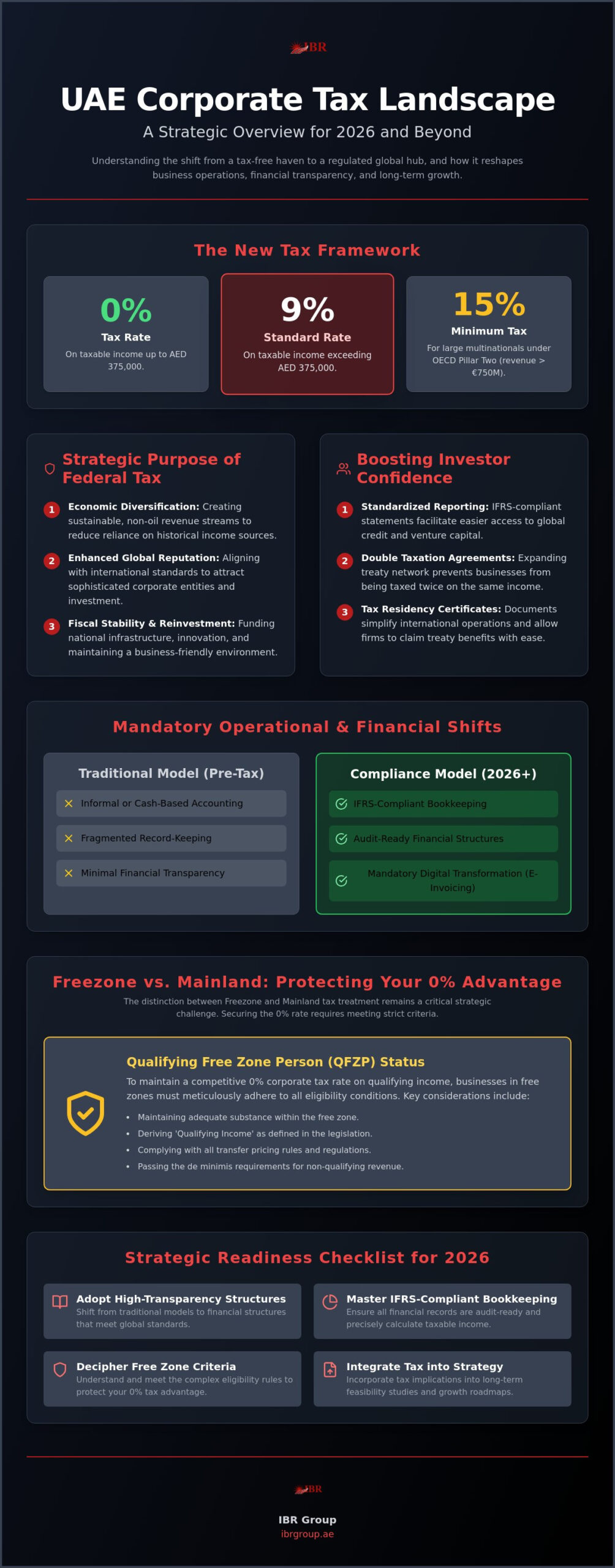
This landscape is no longer experimental. With the full implementation of the OECD Pillar Two framework, specifically the 15% Domestic Minimum Top-up Tax for multinational enterprise groups with revenues exceeding EUR 750 million, the UAE has solidified its status as a responsible global partner. For smaller entities, the standard 9% rate on income exceeding AED 375,000 provides a clear, predictable framework for financial planning. 2026 marks the phase where compliance moves from a reactive task to a proactive strategic advantage, helping firms build the credibility needed to scale locally and internationally.
The Strategic Purpose of Federal Tax
Why did the government introduce this regime? The primary driver is economic diversification, specifically reducing the historical reliance on oil revenue by creating sustainable, non-oil income streams. This fiscal policy enhances the UAE’s reputation within the Global Forum on Transparency and Exchange of Information for Tax Purposes, making it a more attractive destination for sophisticated corporate entities. The Federal Corporate Tax Law serves as a sophisticated instrument for economic stability, providing the government with the resources needed to reinvest in national infrastructure and innovation while maintaining a business-friendly environment. It’s a structured approach that ensures the nation’s growth is supported by a broad and resilient fiscal base.
Impact on Global Investor Confidence
How does a tax regime attract more investment? Institutional capital often seeks markets with standardized financial reporting and clear regulatory oversight. By adopting a formal tax structure, the UAE provides the level of transparency that global funds require before committing significant capital. This shift has several practical benefits for the investment climate:
- Standardized Financial Reporting: Businesses now produce IFRS-compliant statements that are recognizable to international banks and venture capitalists, facilitating easier access to credit.
- Double Taxation Agreements: An expanding network of treaties prevents businesses from being taxed twice on the same income, which is a critical factor for 2026 investment strategies.
- Tax Residency Certificates: These documents simplify international operations, allowing firms to prove their tax status and claim treaty benefits with precision and ease.
By 2026, the presence of a robust tax framework is no longer seen as a deterrent. Instead, it’s a mark of a mature, sophisticated economy that protects the interests of both the state and the private sector.
Operational and Financial Shifts in Business Management
How does a business move from casual record-keeping to a rigorous, audit-ready financial structure? The corporate tax impact on uae businesses is felt most acutely in the back office, where the era of informal accounting has come to an end. It’s no longer enough to track cash flow on basic ledgers or fragmented sheets. Businesses are now required to adopt IFRS-compliant bookkeeping to ensure that taxable income is calculated with absolute precision. This transition often reveals operational inefficiencies that were previously hidden, prompting a total overhaul of internal controls and document retention policies. By 2026, these shifts have become the standard for any entity looking to maintain its credibility in a regulated market.
According to the Official UAE Corporate Tax information, the Federal Tax Authority (FTA) maintains strict expectations for financial transparency. This has a direct influence on profit margins. Management teams must now factor the 9% tax rate into their pricing models, ensuring that the tax burden is integrated into the cost of goods and services. Failing to adjust pricing can lead to unexpected erosion of net income. To protect the bottom line, companies are increasingly relying on tax-inclusive financial forecasting to navigate the new fiscal reality.
The Rise of Digital Accounting Systems
Manual spreadsheets are no longer sufficient for the complexities of modern tax compliance. Real-time reporting and accurate data retrieval are now essential. Many firms are prioritizing accounting software implementation to automate the integration of VAT and Corporate Tax workflows. This digital transformation reduces the risk of human error and ensures that filings are seamless. It also provides business owners with the peace of mind that their records are stored securely and are easily accessible during an FTA audit. If you’re looking to modernize your records, IBR Group provides expert bookkeeping services designed for these high standards.
Professional Auditing as a Business Requirement
Why have external audit firms in dubai become such a critical part of the corporate ecosystem? For mainland firms and those seeking to maintain robust corporate bank accounts, audited financials are often a non-negotiable requirement. Banks now frequently request audited reports to verify the legitimacy of business operations and tax compliance before approving credit lines or maintaining accounts. These reports serve as a protective shield, offering a clear and authoritative resolution to complex queries from both financial institutions and the FTA. In 2026, an audit is not just a regulatory hurdle; it’s a vital tool for corporate bank account maintenance and long-term financial health.
Freezone vs. Mainland: The Shifting Competitive Advantage
Does the choice of jurisdiction still provide the same competitive edge it did five years ago? The UAE Government Corporate Tax Law has introduced a layer of complexity that requires a more granular approach to jurisdiction selection. While the 0% rate remains a significant draw for many, the corporate tax impact on uae businesses now includes the rigorous maintenance of “Qualifying” status. This means the decision to pursue a freezone company setup uae must be balanced against the administrative costs of proving you meet every FTA requirement. It’s no longer just about where you’re located; it’s about how you operate within that space.
Becoming a Qualifying Free Zone Person (QFZP) is an active compliance state rather than a passive benefit. Businesses must ensure they derive income from “Qualifying Activities” while keeping “Excluded Income” within the de minimis threshold. If these boundaries are crossed, the entire entity could lose its 0% status and be taxed at the standard 9% rate. This risk makes jurisdictional choice a primary pillar of risk management for 2026. The hidden costs of maintaining these exemptions often include more frequent external audits and specialized bookkeeping to keep mainland and freezone revenue streams clearly separated.
Maintaining the 0% Rate in Freezones
How can a business protect its tax-free status? The Federal Tax Authority emphasizes “Adequate Substance,” which requires a physical presence, adequate assets, and qualified employees within the freezone. Managing “Excluded Income” is equally critical. If your freezone entity generates too much revenue from non-qualifying activities or certain transactions with mainland persons, your tax-free status is at risk. Strategic bookkeeping is essential here, especially for entities with mainland branches, to ensure that every dirham is attributed correctly and that the 0% rate remains defensible under scrutiny.
Mainland Business Resilience
Why do many entrepreneurs still prefer a mainland license despite the 9% tax? The mainland structure offers unparalleled access to the local market and government procurement opportunities, which often outweigh the tax savings of a freezone. Furthermore, the 9% rate remains globally competitive, sitting well below the corporate tax rates of most developed economies. Mainland firms can also utilize Small Business Relief if their revenue is AED 3 million or less, effectively treating their taxable income as zero for tax periods ending on or before December 31, 2026. By leveraging deductible expenses and professional tax planning, mainland businesses can maintain high levels of profitability while enjoying the freedom of domestic trade.
Strategic Planning and Compliance Readiness for 2026
How can a new venture ensure its financial projections remain accurate in a post-tax environment? Strategic planning for 2026 requires more than just a passing glance at the balance sheet. It demands a comprehensive business feasibility study that incorporates the nuances of the current tax regime. The corporate tax impact on uae businesses is most significant when it isn’t anticipated. For existing companies, developing a 5-year tax optimization roadmap is the only way to safeguard future dividends and reinvestment capabilities. This proactive stance allows management to align their fiscal years, accounting methods, and capital expenditures with the most favorable tax outcomes.
Beyond the tax return, corporate standing in 2026 is heavily influenced by anti-money laundering protocols. Completing your goaml registration uae is a vital step in demonstrating to the FTA and financial institutions that your business operates with integrity. This registration, combined with a clean tax record, forms the foundation of a “low-risk” profile during potential FTA audits. When businesses take these steps early, they avoid the frantic rush of voluntary disclosures and the stress of reactive compliance. To secure your company’s future, consider commissioning a comprehensive strategic business feasibility study to identify every potential tax advantage available to you.
Tax-Efficient Corporate Restructuring
Can your corporate structure be optimized to reduce the overall tax burden? Many related parties are now evaluating group tax registration, which allows a parent company and its subsidiaries to be treated as a single taxable person. This can simplify filing and allow for the offsetting of losses between entities. However, this requires meticulous transfer pricing documentation to ensure all inter-company transactions are conducted at arm’s length. For those managing BVI or other offshore entities within a UAE tax group, 2026 brings stricter scrutiny. You must ensure these structures don’t inadvertently create tax leakages or compliance red flags.
Risk Mitigation and Penalties
The cost of non-compliance is steep. For example, a penalty of AED 10,000 is imposed for late corporate tax registration, while late filing penalties start at AED 500 per month. These avoidable costs can quickly erode the ROI of a business. When the FTA issues a query, responding with an expert report from a multidisciplinary advisory team is often the most efficient path to resolution. Proactive management isn’t just about avoiding fines; it’s about the peace of mind that comes from professional oversight. Some common pitfalls include:
- Delayed Registration: Missing the three-month window for new incorporations.
- Inaccurate Record-Keeping: Failing to maintain documents for the required seven-year period.
- Misinterpreting Exemptions: Claiming small business relief without meeting the AED 3 million revenue threshold.
By addressing these risks early, businesses can focus on growth rather than damage control.
Securing Long-Term Growth with IBR Group Advisory
How can an organization transform these regulatory challenges into a distinct competitive advantage? The corporate tax impact on uae businesses is profound, touching every facet of operations from daily bookkeeping to long-term jurisdictional strategy. Navigating this new era requires more than just basic compliance; it requires foresight and a deep understanding of the regional business ecosystem. IBR Group acts as your steady guide, providing the professional authority and stability needed to manage these intricate financial landscapes with absolute confidence. By professionalizing your financial architecture today, you ensure that your business is prepared for the transparency requirements of 2026 and beyond.
Our multidisciplinary approach is designed to provide peace of mind to entrepreneurs and corporate leaders. We understand that tax does not exist in a vacuum. It is deeply connected to your corporate structure, your audit requirements, and your ability to scale. Professional bookkeeping is the engine of this growth, providing the clear financial reporting necessary for informed decision-making. When your records are precise and your strategy is proactive, the administrative burden of tax becomes a foundation for excellence rather than a hurdle to overcome.
Comprehensive Compliance Management
We provide end-to-end support that covers every stage of the tax lifecycle. This begins with accurate corporate tax registration and extends to the meticulous preparation and filing of your final tax returns. Our specialists offer tailored solutions that address the specific needs of mainland firms, freezone entities, and even BVI jurisdictions within a UAE tax group. We also recognize that business success is often tied to personal stability. Our team provides expert assistance with Golden Visas, ensuring that your long-term residency is as secure as your corporate standing. This holistic view of compliance ensures that no detail is overlooked.
Your Partner in Financial Excellence
Choosing a partner with over 15 years of experience in the UAE financial sector provides a level of security that only seasoned professionals can offer. We ensure that your accounts are bank-ready and fully compliant with the latest FTA standards, facilitating smoother interactions with financial institutions and regulators alike. Our team of tax specialists, accountants, and auditors works in unison to simplify complexity and empower your strategic growth. We value precision above all else, acting as a proactive advisor that protects your interests in an evolving market. Consult with IBR Group for Corporate Tax Success and take the next step toward a seamless, compliant, and prosperous future.
Future-Proofing Your Business in a Regulated UAE Market
By 2026, the transition toward a fully transparent and regulated financial hub is complete. Success in this environment requires a fundamental shift from reactive filing to proactive strategic management. Understanding the corporate tax impact on uae businesses means recognizing that IFRS-compliant bookkeeping and robust internal controls are now the minimum standard for corporate credibility. Whether you’re navigating the complexities of Qualifying Free Zone status or optimizing mainland operations through group registration, the decisions you make today will define your growth trajectory for the next decade.
Navigating these intricate regulatory shifts doesn’t have to be an overwhelming burden. With over 15 years of UAE financial sector experience, IBR Group provides the stability and deep-rooted expertise your organization needs. We offer comprehensive support for both mainland and freezone entities, ensuring your accounts are bank-ready and your tax filings are flawlessly FTA-compliant. You deserve the peace of mind that comes from working with a multidisciplinary team of specialists dedicated to your long-term prosperity. Partner with IBR Group for Expert Corporate Tax Advisory and secure your company’s place in the UAE’s thriving economic future. Your path to sustainable scaling starts with a partner you can trust.
Frequently Asked Questions
What is the threshold for corporate tax in the UAE for 2026?
The standard corporate tax threshold for 2026 is AED 375,000. Taxable income up to this amount is subject to a 0% rate, while any income exceeding this threshold is taxed at a standard rate of 9%. This tiered structure is designed to support small and medium enterprises while ensuring larger corporations contribute to the nation’s economic diversification.
Do freezone companies still enjoy 0% tax under the new regime?
Freezone entities can still benefit from a 0% tax rate provided they maintain “Qualifying Free Zone Person” status. This requires the business to maintain adequate substance, derive income from qualifying activities, and meet specific regulatory conditions. If these requirements aren’t met, the corporate tax impact on uae businesses in freezones results in the standard 9% rate being applied to all taxable income.
Is an external audit mandatory for all businesses in the UAE?
External audits aren’t mandatory for every business, but they are required for entities with annual revenue exceeding AED 50 million and for all Qualifying Free Zone Persons. Regardless of the legal mandate, many commercial banks and freezone authorities require audited financial statements to maintain corporate accounts and licenses. It’s a critical step for ensuring your financial reporting remains transparent and bank-ready.
How does corporate tax impact small businesses and startups?
Small businesses and startups with annual revenue of AED 3 million or less can claim Small Business Relief. This provision allows eligible entities to treat their taxable income as zero for tax periods ending on or before December 31, 2026. This relief significantly mitigates the corporate tax impact on uae businesses during their early growth phases, provided they maintain accurate records to prove their eligibility.
What are the penalties for late corporate tax registration in the UAE?
The Federal Tax Authority imposes a fixed penalty of AED 10,000 for late corporate tax registration. This fine applies if a business fails to submit its registration application within the timelines specified by the FTA. For companies incorporated on or after March 1, 2024, the registration deadline is typically within three months of the date of incorporation.
Can I deduct business expenses to reduce my taxable income?
You can deduct legitimate business expenses provided they are incurred wholly and exclusively for the purposes of the business. It’s important to note that certain costs, such as client entertainment, are only 50% deductible under current regulations. Precise bookkeeping is essential to ensure that all deductions are supported by valid documentation during a potential FTA audit.
How often do I need to file corporate tax returns?
Corporate tax returns must be filed once per financial year. The deadline for filing the return and paying any tax due is nine months from the end of the relevant tax period. For businesses with a financial year ending on December 31, 2025, the mandatory filing and payment deadline is September 30, 2026.
Do I need a tax residency certificate if my company is registered in the UAE?
You don’t need a tax residency certificate for domestic tax compliance, but it’s vital if your company operates internationally. This certificate allows you to claim benefits under the UAE’s extensive network of Double Taxation Agreements. It serves as formal proof of your tax status, helping to prevent your income from being taxed in multiple jurisdictions.