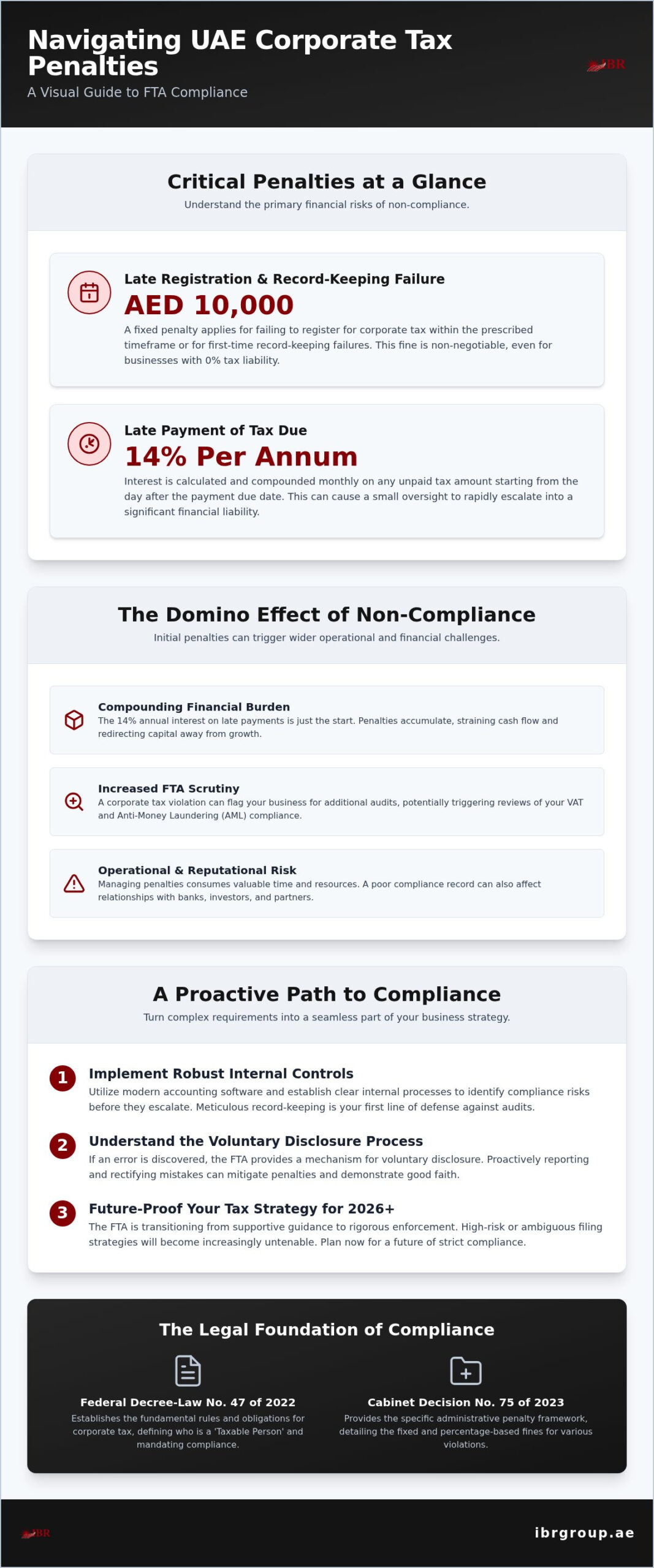
A single administrative oversight in your tax filing isn’t just a minor error; it’s a compounding financial liability that can compromise your business’s operational stability. You likely understand that keeping pace with the Federal Tax Authority’s evolving regulations is a significant challenge, especially when uae corporate tax penalties for non-compliance can reach AED 10,000 for a first-time record-keeping failure or trigger a 14% annual interest rate on late payments. It’s natural to feel a sense of uncertainty as the regulatory environment shifts, but these risks are manageable with the right strategic approach.
We’ve designed this guide to provide the professional clarity and peace of mind you need to navigate the FTA’s framework confidently. You’ll gain a precise understanding of the current penalty amounts and the specific triggers that lead to audits. By following our structured path, you’ll learn how to implement a framework for preventing errors and exactly what steps to take if you receive a penalty notice. Let’s explore how to turn complex compliance requirements into a seamless part of your business growth strategy.
Key Takeaways
- Understand how the FTA applies uae corporate tax penalties for non-compliance, including the AED 10,000 fixed fine for late registration and escalating charges for missed filing deadlines.
- Recognize the hidden costs of non-compliance, such as the 14% annual interest on unpaid tax and the potential for a “domino effect” that triggers additional VAT or AML scrutiny.
- Learn how to implement robust internal accounting controls and software to identify compliance risks before they lead to an official FTA audit.
- Gain insights into the voluntary disclosure process and how to manage penalty notices to minimize long-term financial and operational disruption.
- Discover why moving away from high-risk tax filing strategies in 2026 is essential for maintaining a seamless relationship with the Federal Tax Authority.
Table of Contents
Understanding the FTA Administrative Penalty Framework
The introduction of corporate tax marks a significant evolution in Taxation in the United Arab Emirates, shifting the focus toward a more structured and transparent financial ecosystem. Within this environment, administrative penalties serve as the primary mechanism for the Federal Tax Authority (FTA) to ensure adherence to statutory requirements. These are financial sanctions, rather than criminal charges, designed to discourage negligence and incentivize accurate reporting. As we move through 2026, the FTA’s approach is transitioning from an initial phase of supportive guidance to one of rigorous enforcement. Businesses that fail to adapt now face a landscape where uae corporate tax penalties for non-compliance are no longer theoretical risks but active financial liabilities.
Cabinet Decision No. 75 of 2023 provides the specific framework for these fines, categorizing them into fixed and percentage-based structures. Fixed penalties often apply to procedural errors, such as failing to maintain proper records or missing a registration deadline. In contrast, percentage-based penalties typically target financial discrepancies, such as underpaid tax amounts or late payments. This two-tiered system ensures that the severity of the fine correlates with the nature of the violation. For many entrepreneurs, the most daunting aspect is the compounding nature of these costs. A simple oversight can quickly escalate through monthly interest or repeat-offense multipliers.
The Legal Basis: Federal Decree-Law No. 47
The entire penalty structure is anchored in Federal Decree-Law No. 47 of 2022, which establishes the rules for corporate tax across the Emirates. This law mandates that every ‘Taxable Person’ must comply with specific registration and filing timelines to avoid scrutiny. According to Decree-Law 47, a Taxable Person is any Resident or Non-Resident Person who has a Taxable Income and is subject to the Corporate Tax regime. This broad definition ensures that almost every commercial entity, including many in Free Zones, falls under the regulatory umbrella. Compliance isn’t a choice; it’s a statutory obligation that requires meticulous attention to detail.
Types of Violations Subject to Fines
Violations generally fall into two categories: procedural and financial. Procedural violations include missing the registration window or failing to submit documents in Arabic when requested. Financial violations are more complex, often involving understatements of tax liability in a return. The FTA typically communicates these penalties through the EmaraTax portal, issuing formal notices that detail the specific violation and the associated fine. Understanding how to interpret these notices is the first step in managing uae corporate tax penalties for non-compliance effectively. Timely action is essential, as delay often leads to additional interest charges that can strain a company’s cash flow.
Primary Penalty Categories for UAE Businesses
How does a simple administrative delay transform into a significant financial burden? For many businesses, the answer lies in the compounding nature of the Federal Tax Authority’s enforcement strategy. Understanding the specific categories of uae corporate tax penalties for non-compliance is essential for protecting your company’s bottom line. The framework isn’t designed solely to punish, but rather to ensure that every entity maintains the high standards of transparency required in the modern UAE economy. While some fines are fixed, others grow over time, making early detection and resolution your most effective defense.
The most immediate risk for new entities is the late registration penalty. Failing to submit a corporate tax registration application within the timeframe prescribed by the FTA results in a fixed administrative penalty of AED 10,000. Unlike filing errors, which may allow for corrections, this registration fine is a one-time charge that applies even if your business is currently exempt or qualifies for a 0% tax rate. It’s a clear signal from the authorities that formal entry into the tax system is a non-negotiable first step for every taxable person.
Perhaps the most overlooked risk is the 14% per annum interest applied to late payments. This is where the “strategic risk” mentioned earlier becomes reality. This interest is calculated monthly on any unpaid tax amount starting from the day after the due date. If you’re managing complex cash flows, an unaddressed tax debt can quickly snowball, far exceeding the original liability. Many entrepreneurs find that an external audit is a vital tool for identifying these potential payment gaps before they attract such high-interest accruals.
Registration and Filing Deadlines
Deadlines are not uniform across all entities. While corporate tax returns are generally due within nine months from the end of the relevant tax period, the specific triggers for registration depend on your license type and date of incorporation. Late filing penalties start at AED 500 for each month for the first twelve months. After this period, the fine increases to AED 1,000 per month. This cumulative structure means that ignoring a filing requirement for two years could result in thousands of dirhams in avoidable costs, a much steeper curve than the fixed penalties often seen in VAT compliance.
Record Keeping and Documentation Standards
The FTA requires businesses to maintain financial and tax records for a minimum of seven years. If an audit reveals that your records are inadequate, you’ll face a first-time penalty of AED 10,000. The stakes rise significantly for repeat offenses; if the same violation occurs within 24 months, the fine doubles to AED 20,000. Additionally, you must be prepared to provide these documents in Arabic if requested. Failure to submit required records in Arabic carries a specific penalty of AED 5,000, emphasizing the need for a professional approach to your bilingual documentation strategy.
The Financial and Operational Impact of Non-Compliance
What is the true cost of a tax penalty? While the immediate financial outlay is the most visible consequence, the operational ripples can be far more destructive to a growing enterprise. When a business incurs uae corporate tax penalties for non-compliance, it’s rarely a localized event. Instead, these fines often act as a catalyst for a broader regulatory review, drawing attention to every facet of your financial reporting. For leadership teams, an unbudgeted administrative fine represents more than just a loss of capital; it’s a signal of internal process failure that can dampen investor confidence and stall strategic expansion plans.
The immediate strain on cash flow is often the first hurdle. Most businesses operate on precise forecasts where sudden, multi-thousand dirham penalties haven’t been factored in. This liquidity drain can force companies to delay essential hires or postpone infrastructure upgrades. Beyond the balance sheet, the reputational risk is significant. In the UAE’s tightly knit business community, a history of tax non-compliance can complicate mergers, acquisitions, or even simple vendor contract negotiations. Partners want to know they’re aligned with an entity that prioritizes professional excellence and regulatory stability.
The Compliance Domino Effect
Is your corporate tax health isolated from your other obligations? In reality, the Federal Tax Authority maintains an integrated view of your business. An error in corporate tax reporting often leads the authority to re-examine your VAT return filing UAE history, looking for systemic inconsistencies. This cross-departmental scrutiny can expand a minor query into a full-scale investigation involving Anti-Money Laundering (AML) protocols. Banking institutions are also increasingly sensitive to tax status. A recorded penalty might trigger a request for an expert report for UAE bank queries, as lenders seek to verify that your business remains a low-risk client worthy of continued credit facilities.
Audit Readiness and Risk Profiling
The FTA uses sophisticated risk-based profiling to select firms for comprehensive tax audits. Companies that consistently trigger uae corporate tax penalties for non-compliance are naturally moved to the top of the “high-risk” list. Once you’re flagged, the frequency and depth of audits typically increase, creating a cycle of administrative friction that consumes valuable management time. Engaging with established external audit firms in dubai allows you to identify these risk triggers before they become official red flags. By conducting regular internal health checks, you ensure that your firm presents a profile of stability and precision, effectively insulating your operations from the disruptions of a surprise audit.
Strategic Steps to Prevent and Rectify Tax Violations
How can a proactive strategy transform a potential penalty into a manageable administrative step? Compliance is not a passive state. It requires active management and a forward-thinking approach to financial governance. For businesses operating in the UAE, the goal is to shift from a reactive mindset to one of strategic empowerment. By implementing robust internal controls, you don’t just avoid uae corporate tax penalties for non-compliance; you build a foundation for sustainable growth and operational excellence. Prevention is always more cost-effective than rectification, especially when the FTA’s interest rates and fixed fines are structured to escalate rapidly.
Regular internal health checks are the most effective way to identify risks before the authority does. These reviews should go beyond simple arithmetic to examine the underlying logic of your tax positions, particularly regarding complex areas like transfer pricing or cross-border transactions. Strategic tax planning ensures that every deadline is mapped out well in advance, leaving no room for the last-minute errors that often trigger administrative scrutiny. When your internal teams are aligned with a clear compliance roadmap, the risk of unbudgeted penalties diminishes significantly.
The Voluntary Disclosure Process
Even with the best systems, errors can occur. If you discover a discrepancy in a previously submitted return, the FTA provides a formal mechanism for correction known as Voluntary Disclosure. Timing is the most critical factor here. If you make a disclosure after receiving a tax audit notice, the financial stakes increase. A fixed penalty of 15% on the tax difference is applied, along with a 1% monthly penalty that runs until the disclosure is finalized. However, acting proactively before an audit notice arrives can significantly reduce these liabilities and demonstrate your commitment to transparency. It’s a vital tool for maintaining a positive risk profile with the authorities.
Internal Controls and Bookkeeping
Precision in record-keeping is the cornerstone of a successful tax strategy. The statutory requirement to maintain financial and tax records for seven years means your documentation must be both comprehensive and easily accessible. Standardizing these processes ensures that your books are always “audit-ready,” regardless of when the FTA might request a review. Training your in-house teams on UAE-specific regulations is essential, but many firms find that leveraging professional bookkeeping services provides an extra layer of security. This professional oversight ensures that every transaction is recorded according to the latest regulatory standards, effectively insulating your business from the procedural errors that lead to avoidable fines.
Ensuring Long-Term Compliance with Professional Tax Advisory
Why is a “Do-It-Yourself” approach to tax compliance becoming a high-risk strategy in 2026? As the UAE’s regulatory environment matures, the margin for administrative error has narrowed significantly. Relying on internal guesswork to navigate uae corporate tax penalties for non-compliance often leads to the very financial strain that professional advisory is designed to prevent. Expert advisors don’t just file returns; they bridge the critical gap between complex FTA statutes and your daily business operations, ensuring that every strategic decision is made with full awareness of its tax implications. This protective oversight allows leadership teams to focus on growth while maintaining the peace of mind that their compliance standing is secure.
A unified compliance partner provides a distinct advantage by consolidating Tax, Audit, and AML responsibilities under a single umbrella of expertise. This integrated approach prevents the data silos that often lead to inconsistencies during an FTA review. When your bookkeeping, VAT filings, and corporate tax records are managed with a singular standard of professional excellence, the likelihood of triggering an audit decreases. Building a “compliance-first” culture isn’t merely about avoiding fines; it’s about positioning your business as a stable, transparent, and attractive entity for international investors and local banking partners alike.
Comprehensive Compliance Management
Success in the regional market requires a holistic view of your legal obligations. Integrating your corporate tax registration with your initial freezone company setup UAE ensures that your business structure is tax-optimized from the very first day of operations. At IBR Group, we leverage over 15 years of UAE financial sector experience to resolve complex FTA queries and manage bank-level scrutiny. We ensure that transitions during regulatory updates are seamless, protecting your entity from the 14% interest rates and compounding penalties that can arise from even minor delays in adapting to new laws.
Next Steps for Your Business
The first step toward total compliance is a comprehensive gap analysis of your current tax status. This review identifies hidden vulnerabilities in your record-keeping or filing history before they attract official attention. Scheduling a consultation for a full compliance roadmap provides you with a structured path to follow, turning regulatory requirements into a predictable part of your business cycle. Proactive tax health checks serve as a critical safeguard by identifying potential discrepancies before they escalate into official administrative fines. By acting now, you secure your company’s financial future and ensure that uae corporate tax penalties for non-compliance never become a barrier to your professional excellence.
Securing Your Financial Future in a Mature Regulatory Landscape
As the UAE corporate tax regime moves into its next phase, the distinction between a compliant entity and a penalized one often comes down to the quality of internal oversight. We’ve explored how uae corporate tax penalties for non-compliance can manifest as fixed fines or compounding interest, potentially impacting everything from your cash flow to your banking relationships. By implementing robust record-keeping and utilizing mechanisms like voluntary disclosure, you can effectively mitigate these risks before they escalate into significant financial liabilities.
Navigating this intricate environment doesn’t have to be a solo endeavor. With over 15 years of expert financial advisory experience, our team specializes in FTA query resolution and comprehensive tax and audit solutions that prioritize your peace of mind. Secure your business with professional UAE tax compliance and advisory from IBR Group and transform your regulatory obligations into a strategic advantage. We’re here to ensure your journey through the 2026 tax landscape is both seamless and successful.
Frequently Asked Questions
What is the penalty for late corporate tax registration in the UAE?
The administrative penalty for failing to submit a corporate tax registration application within the prescribed timeframe is a fixed amount of AED 10,000. This is a one-time penalty applied to any taxable person who misses the deadline set by the FTA. It’s essential to complete this step even if you expect your business to qualify for a 0% tax rate, as the fine applies specifically to the procedural failure of registration.
How much interest does the FTA charge on late tax payments?
The FTA applies a late payment penalty of 14% per annum on any unpaid tax amount. This interest is calculated on a monthly basis starting from the day immediately following the tax due date. Managing uae corporate tax penalties for non-compliance requires careful cash flow planning to avoid this compounding interest, which can significantly increase the total amount owed if left unaddressed for several months.
Can I appeal a corporate tax penalty notice?
Yes, businesses have the right to appeal a penalty notice by submitting a request for reconsideration to the FTA. This application must typically be made through the EmaraTax portal within 40 business days of receiving the notice. You’ll need to provide a clear legal and factual justification for why the penalty should be waived or reduced. Professional assistance is often recommended to ensure your appeal is structured effectively and meets all procedural requirements.
What happens if I fail to maintain proper financial records?
Failing to maintain proper financial and tax records results in a penalty of AED 10,000 for the first violation. If the same error is repeated within 24 months, the fine doubles to AED 20,000. These records must be detailed enough to allow the FTA to verify your tax liability accurately. Maintaining “audit-ready” books is the most reliable way to protect your business from these avoidable administrative costs and ensure long-term stability.
What is a Voluntary Disclosure and how does it help reduce fines?
A Voluntary Disclosure is a formal submission used to correct errors or omissions in a previous tax return or assessment. If you submit this disclosure after receiving a tax audit notice, a fixed penalty of 15% applies to the tax difference, plus a 1% monthly penalty. Proactively filing a disclosure before an audit is initiated is a strategic way to demonstrate transparency and potentially minimize the financial impact of unintentional errors.
Is there a penalty for submitting tax documents in English instead of Arabic?
While businesses often maintain records in English, the FTA can request specific documents in Arabic during a review. Failing to provide these translations when requested results in a penalty of AED 5,000. This requirement highlights the importance of having a bilingual documentation strategy. It ensures that uae corporate tax penalties for non-compliance don’t arise from simple linguistic oversights during a formal review or audit process.
How long must I keep my business records for UAE corporate tax purposes?
You are legally required to keep all financial and tax-related records for a minimum of seven years. This duration ensures that the FTA can conduct a historical audit if necessary to verify past filings. Records should include all invoices, receipts, bank statements, and accounting ledgers that support the figures reported in your tax returns. Proper archiving is essential to meet this statutory obligation and avoid significant record-keeping fines.
Does the FTA offer a grace period for first-time tax filers in 2026?
No, there is no general grace period for first-time filers in 2026. As the corporate tax regime has now moved past its introductory phase, the FTA is prioritizing full enforcement of the law. Businesses are expected to be fully registered and compliant with all filing and payment deadlines. This shift makes it more important than ever to conduct internal health checks and ensure your tax positions are technically sound before deadlines pass.