
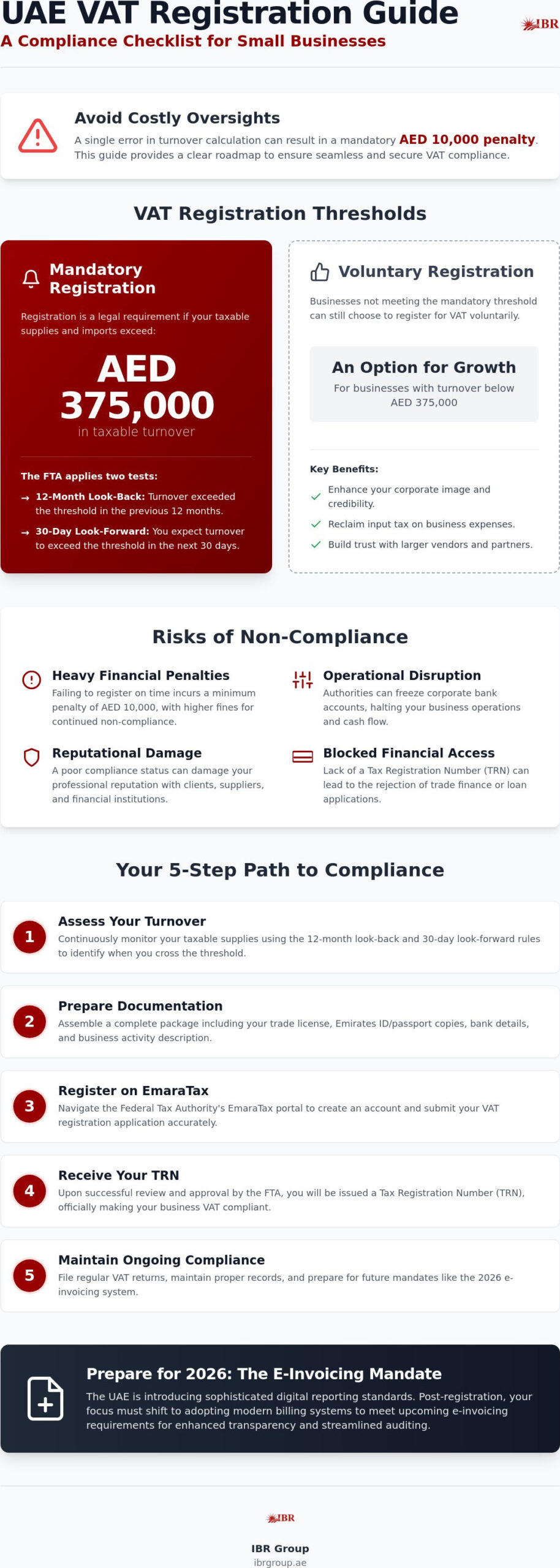
A single oversight in your turnover calculation could result in a mandatory AED 10,000 penalty before you’ve even issued your first tax invoice. It’s understandable why many entrepreneurs feel a sense of anxiety when approaching the EmaraTax portal, especially when the line between mandatory and voluntary thresholds seems blurred. Managing vat registration for small business dubai shouldn’t feel like a gamble with your company’s hard-earned capital or its long-term reputation. You’ve worked hard to build your enterprise; you shouldn’t have to fear that administrative complexity will stall your progress.
You deserve a clear, professional roadmap that transforms this complex regulatory requirement into a structured strategic milestone. This 2026 compliance checklist provides an authoritative guide to eligibility, required documentation, and the essential steps to protect your business from administrative burdens. We’ll walk you through the precise details needed for a successful application, ensuring your path to compliance is both seamless and secure. By following this methodical approach, you can maintain your focus on growth while we help you navigate the intricacies of the UAE tax landscape with confidence.
Key Takeaways
- Determine whether your business meets the mandatory AED 375,000 threshold or benefits from voluntary registration through precise turnover assessment rules.
- Assemble a complete documentation package, from trade licenses to Emirates ID copies, to ensure a seamless approval process through the Federal Tax Authority.
- Navigate the complexities of vat registration for small business dubai with a structured, step-by-step guide to the EmaraTax portal.
- Prepare your enterprise for the 2026 e-invoicing mandate by understanding the digital reporting standards required for modern billing systems.
- Establish a roadmap for ongoing compliance that protects your company from administrative penalties while supporting long-term scalability and financial stability.
Table of Contents
Understanding VAT Registration for Small Businesses in the UAE
How prepared is your venture for the upcoming shifts in the UAE’s tax environment? Since its inception, Value Added Tax (VAT) has operated as an indirect tax on the consumption of goods and services, collected by businesses on behalf of the government. The Federal Tax Authority (FTA) maintains strict oversight of this system to ensure national tax compliance remains consistent across all sectors. For many entrepreneurs, managing vat registration for small business dubai represents the first major step toward institutional stability. 2026 is set to be a pivotal year, as the UAE introduces more sophisticated digital reporting standards designed to enhance transparency and streamline auditing processes. Obtaining a Tax Registration Number (TRN) does more than satisfy a legal requirement; it establishes your firm as a verified participant in the regional economy, which is vital for building trust with vendors and securing credit facilities.
The Core Purpose of VAT in the National Economy
The implementation of VAT is a cornerstone of the UAE’s strategy to diversify its revenue streams away from oil dependency. By taxing consumption, the government generates sustainable funds for public services and infrastructure development. Understanding VAT in the UAE is essential for recognizing how businesses function as vital intermediaries in this economic cycle. You aren’t simply paying a tax; you’re assuming the role of a custodian, managing public funds until they’re remitted to the FTA. VAT registration serves as a mandatory gateway for businesses that exceed the specific financial thresholds mandated by the Federal Tax Authority. This system ensures that the tax burden is distributed fairly across the supply chain, allowing for the deduction of input tax and preventing a “tax on tax” effect that could stifle growth.
Risks of Non-Compliance and Late Registration
What are the consequences of delaying your application? The FTA imposes significant administrative penalties for failing to register within the legal timeframe, often starting at AED 10,000 and potentially reaching higher figures for continued non-compliance. Beyond direct financial loss, a lack of compliance can lead to the freezing of corporate bank accounts or the rejection of trade finance applications. It’s difficult to maintain a professional reputation when your compliance status is in question. Utilizing expert VAT advisory services uae helps mitigate these operational risks by ensuring your turnover assessments are accurate and your documentation is flawless. Precision in vat registration for small business dubai is the most effective way to protect your scalability and ensure that your daily operations remain uninterrupted by regulatory friction.
Mandatory vs. Voluntary Registration: Determining Your Threshold
How do you know when your business has crossed the legal line into tax responsibility? For many entrepreneurs, vat registration for small business dubai is triggered by hitting the mandatory turnover threshold of AED 375,000. This calculation isn’t as simple as checking your annual profit. You must monitor your taxable supplies, which includes standard 5% rated goods, zero-rated items, and imports under the reverse charge mechanism. Failing to include these elements can lead to an underestimation of your turnover, leaving your business vulnerable to late registration penalties. Checking the official VAT registration guidelines ensures you stay aligned with current regulatory expectations and avoid costly oversights.
The Federal Tax Authority (FTA) applies two specific tests to determine your status: the 12-month look-back and the 30-day look-forward. If your taxable supplies exceeded the AED 375,000 threshold in the previous 12 months, or if you expect them to exceed it in the next 30 days, registration is a legal requirement. Precision is vital here. Maintaining accurate records is the only way to identify the exact moment your compliance obligations begin. If you’re unsure about your current turnover status, our team can assist with professional bookkeeping to ensure your financial declarations are flawless.
Mandatory Registration Criteria
Once your business exceeds the AED 375,000 limit, you have a strict 30-day window to submit your application through the EmaraTax portal. It’s a common misconception that only profitable companies must register; the threshold is based entirely on gross taxable turnover. Foreign businesses should be particularly cautious. If you’re a non-resident making taxable supplies in the UAE and no one else is responsible for the tax, you may have to register regardless of the turnover amount. This nuance often catches international startups off guard, making early assessment a strategic necessity.
The Strategic Case for Voluntary Registration
Why would a business register before they’re legally forced to? If your turnover exceeds AED 187,500, you’re eligible for voluntary registration, which offers significant advantages for growing firms. It allows you to reclaim input tax on business expenses, startup costs, and capital assets, which can provide a welcome boost to your cash flow. Beyond the financial benefits, being VAT-registered builds immediate credibility. Many large corporate clients and government entities prefer to work with VAT-compliant suppliers. Choosing to register early demonstrates institutional maturity and ensures you aren’t rushing through a mandatory application at the last minute when the stakes are much higher.
The Essential VAT Registration Documentation Checklist
Are you ready to submit your application, or will a missing signature cause an immediate rejection? The success of vat registration for small business dubai depends heavily on the precision of your documentation. The Federal Tax Authority (FTA) requires a comprehensive set of records that verify your business’s legal existence and its financial standing. Gathering these documents in advance prevents the frustration of multiple follow-up queries and ensures a seamless transition into the UAE’s tax system. Precision at this stage is the most effective way to demonstrate your company’s commitment to compliance and professional excellence.
Corporate and Legal Documentation
Your trade license is the foundation of your application. It must be current and accurately reflect all your business activities. If you operate in a Freezone, your requirements might differ slightly from Mainland entities, particularly regarding the specific authority that issued your license and the format of your registration certificate. You’ll also need your Certificate of Incorporation and the Memorandum of Association (MOA). The MOA is critical because it identifies the authorized signatory or manager who has the legal right to represent the company in tax matters. If the person managing the EmaraTax portal isn’t named in the MOA, a notarized Power of Attorney (POA) becomes an essential addition to your checklist to prevent authorization delays.
Financial Records and Turnover Evidence
How do you prove your turnover to the FTA? You’ll need a Turnover Declaration Letter, which must be signed and stamped by the authorized person. This letter should provide a month-by-month breakdown of your sales over the previous 12 months. For those seeking voluntary registration, documenting your taxable expenses is equally important to justify your eligibility. It’s helpful to cross-reference your figures with the official VAT registration thresholds to ensure your application category is correct. This ensures that your business is positioned accurately within the regulatory framework from day one.
A Turnover Declaration must be supported by audited financial statements or bank statements if requested by the FTA. This level of detail confirms that your reported income aligns with your actual business activity. We recommend maintaining clean, organized ledgers to ensure these documents are ready at a moment’s notice. Precision in these records not only facilitates vat registration for small business dubai but also builds a strong foundation for your future tax obligations. Taking the time to verify every scan and signature now will save your business from administrative friction and potential queries during the review process.
Navigating the EmaraTax Portal: A Step-by-Step Guide
Have you explored the EmaraTax portal yet? Completing vat registration for small business dubai requires a methodical approach to the Federal Tax Authority’s primary digital platform. The portal is designed to be a comprehensive hub for all tax related activities, but its precision demands careful attention to detail. A single clerical error can lead to an application rejection, forcing you to restart a process that typically takes the FTA between 10 to 20 business days to review. By following a structured sequence, you can ensure your submission is both accurate and professional.
- Step 1: Create a Taxable Person Account. This serves as your digital identity within the EmaraTax ecosystem.
- Step 2: Complete the ‘About the Applicant’ and ‘Contact Details’ sections. Every entry here must mirror your legal trade license exactly.
- Step 3: Detail your business activities and provide your corporate bank account information. Accuracy in your IBAN is non negotiable.
- Step 4: Upload the documentation checklist. Ensure all files are in the accepted formats, such as PDF or JPEG, and stay within the platform’s size limits.
- Step 5: Perform a final review. Once you’re certain of the data’s integrity, submit the application for official FTA review.
Account Setup and Initial Configuration
Choosing the correct legal form is your first critical decision. You must distinguish between a Natural Person, typically for sole establishments, and a Legal Person, which applies to incorporated entities like LLCs. It’s vital to link the account to a monitored corporate email address rather than a personal one. This ensures that official notifications regarding your TRN or future audit requests aren’t missed. You should also verify that the ‘Authorized Signatory’ details align perfectly with the Power of Attorney or MOA we discussed in the previous section. Consistency across these digital fields and your physical documents is what builds immediate credibility with the FTA reviewers.
Avoiding Common Application Pitfalls
Technical glitches often stem from simple formatting errors. If your file sizes exceed the FTA specifications, the portal may fail to save your progress, leading to unnecessary frustration. Double checking your bank IBAN details is equally important for the long term. Incorrect banking data won’t just delay your registration; it will complicate the VAT refund process uae later when you seek to reclaim overpaid tax. We recommend a professional review of your digital application before hitting the final submit button to catch these subtle discrepancies. If you’d like to ensure your submission is flawless from the start, our team can manage your FTA filings with the precision your business deserves.
Post-Registration: Maintaining 2026 Compliance Standards
What happens after you receive your Tax Registration Number? While successfully completing vat registration for small business dubai is a significant milestone, it marks the beginning of a cycle of disciplined record-keeping and reporting. You’ll be assigned a specific tax period, usually quarterly for most small enterprises, with a strict 28-day deadline to file and pay your liabilities through the EmaraTax portal. Missing these dates can lead to an immediate AED 1,000 penalty for the first instance, which increases to AED 2,000 for subsequent delays within 24 months. Consistent vat return filing uae is the primary mechanism for maintaining your company’s standing with the FTA and ensuring your operations remain uninterrupted by regulatory friction.
2026 serves as a critical preparation phase for the UAE’s upcoming e-invoicing mandate. While the mandatory implementation for businesses with revenue over AED 50 million begins on January 1, 2027, small businesses should begin aligning their billing systems now to avoid future technical hurdles. You’re legally required to retain all tax invoices, credit notes, and financial records for a minimum of five years. Effective January 1, 2026, the FTA has also enforced a five-year limit for reclaiming any excess refundable VAT. This makes timely and accurate record-keeping more important than ever for your cash flow management.
Transitioning to Digital Tax Accounting
How can you streamline these ongoing responsibilities? Implementing FTA-compliant accounting software is no longer optional for businesses aiming for high standards of professional excellence. These digital tools automate record-keeping and ensure that every transaction is categorized correctly for your returns. Training your staff on the nuances of tax-compliant invoicing and expense tracking prevents small errors from snowballing into significant audit risks. By maintaining organized digital archives, you’re always ready for fta tax audit preparation, transforming a potentially stressful event into a routine verification of your commitment to quality.
The Value of Continuous Tax Advisory
The regulatory environment in the UAE is dynamic, with frequent circulars and legislative changes that require close monitoring. Engaging an external audit firm in dubai provides an extra layer of security through periodic reviews of your tax positions and financial declarations. These experts help resolve complex bank queries and provide clarifications on FTA rulings that might impact your specific industry. Professional advisory ensures that your vat registration for small business dubai remains a source of corporate credibility rather than an administrative burden. This proactive approach allows you to focus entirely on your strategic growth while your compliance is managed with seasoned expertise.
Securing Your Business Legacy Through Strategic Tax Compliance
Managing the transition to a VAT-registered entity is a transformative step for any entrepreneur. You’ve now seen how accurate threshold monitoring and meticulous documentation form the bedrock of a successful application. As the UAE moves toward the 2026 digital reporting standards, your ability to maintain precise records will distinguish your business as a leader in professional excellence. Successfully navigating vat registration for small business dubai ensures that your enterprise remains resilient against administrative penalties while unlocking new opportunities for corporate growth and scalability.
Don’t let regulatory complexity stall your progress. With over 15 years of UAE tax expertise, IBR Group provides comprehensive FTA compliance support and seamless EmaraTax portal management to protect your interests. Secure your business compliance with IBR Group’s expert VAT registration services today. Your dedication to high standards today builds the foundation for a prosperous and compliant tomorrow. We’re here to ensure your journey is efficient, transparent, and strategically empowered.
Frequently Asked Questions
What is the mandatory VAT registration threshold for small businesses in the UAE?
The mandatory registration threshold is AED 375,000 in taxable supplies and imports. This requirement is triggered if your turnover exceeded this limit during the previous 12 months or if you expect it to do so in the next 30 days. Monitoring these figures with precision is a vital part of managing vat registration for small business dubai to ensure you remain compliant with Federal Tax Authority regulations.
How long does the VAT registration process take in 2026?
The Federal Tax Authority typically reviews and approves applications within 10 to 20 business days. This timeline can be extended if the FTA requires additional clarifications or further documentation to verify your turnover. Ensuring your initial submission is complete and professional is the most effective way to prevent delays and receive your Tax Registration Number within the standard window.
Can a small business register for VAT voluntarily if they are below the threshold?
Yes, businesses can apply for voluntary vat registration for small business dubai if their taxable supplies or expenses exceed AED 187,500. This is often a strategic choice for startups that want to reclaim input tax on their initial capital expenditures. It also helps establish corporate credibility with larger clients who may only conduct business with VAT-registered suppliers in the UAE.
What are the penalties for late VAT registration with the FTA?
The penalty for failing to register within the required timeframe is a fixed amount of AED 10,000. You must submit your application through the EmaraTax portal within 30 days of reaching the mandatory threshold to avoid this fine. Staying proactive with your turnover assessments protects your company’s financial health and ensures your registration journey remains a positive milestone for your enterprise.
Is a trade license enough for VAT registration, or are other documents required?
A trade license is essential, but it isn’t the only document you’ll need for a successful application. You must also provide passport and Emirates ID copies for the authorized signatories, a stamped turnover declaration letter, and your company’s bank account details. Providing a comprehensive documentation package from the start demonstrates institutional maturity and simplifies the FTA’s review process for your business.
Do Freezone companies need to register for VAT in the UAE?
Freezone entities are subject to the same VAT registration thresholds as Mainland companies. While businesses in certain “Designated Zones” may benefit from specific tax treatments for goods, most services provided within the UAE are still taxable at the standard 5% rate. It’s vital for Freezone entrepreneurs to assess their specific activities to determine their exact compliance obligations under the UAE tax law.
What is a TRN, and how do I use it after registration?
A TRN is a unique 15-digit Tax Registration Number assigned to your business by the Federal Tax Authority. Once issued, you must display this number on all your tax invoices, credit notes, and official correspondence with the FTA. It’s the primary identifier that allows your clients to reclaim the VAT you charge them, making it a critical component of your daily commercial operations.
Can I reclaim VAT on expenses incurred before my registration date?
You can generally reclaim VAT on goods and services purchased before your registration, provided they were used to make taxable supplies. There are specific time limits and conditions, such as the requirement that goods must still be in your possession on the date of registration. Keeping organized records of your startup expenses ensures you can maximize these claims once your TRN is officially active.