
Could a zero percent tax rate become a significant liability if your documentation fails to meet the highest standards of scrutiny? For many entrepreneurs, the search for corporate tax exemptions uae often leads to more questions than answers, especially as the Federal Tax Authority reinforces its 2026 compliance framework. It’s understandable to feel a sense of unease when distinguishing between Mainland status and the intricate ‘Qualifying Income’ definitions that govern Free Zone entities.
We recognize that the fear of unexpected penalties can often overshadow the strategic benefits of the UAE’s tax regime. This guide is designed to provide you with a clear understanding of which entities qualify for zero tax and how to maintain a compliant exempt status under the latest regulations. You’ll discover the specific categories of exempt persons, the essential criteria for Small Business Relief, and the methodical steps required to ensure your business remains on the right side of the law. By the end of this article, you’ll have the step-by-step knowledge needed to secure your financial standing and gain total peace of mind regarding your FTA obligations.
Key Takeaways
- Understand the legal distinction between standard tax rates and specific corporate tax exemptions uae defined under the latest Federal Decree-Law.
- Identify the rigorous substance and income criteria required to maintain ‘Qualifying Free Zone Person’ status for a 0% tax rate.
- Evaluate your eligibility for Small Business Relief if your gross revenue remains below the AED 3 million threshold through the 2026 period.
- Recognize why mandatory registration and external audits are essential for validating your exempt status with the Federal Tax Authority.
- Learn the documentation standards necessary to safeguard your entity against compliance risks and unexpected financial penalties.
Table of Contents
What are UAE Corporate Tax Exemptions?
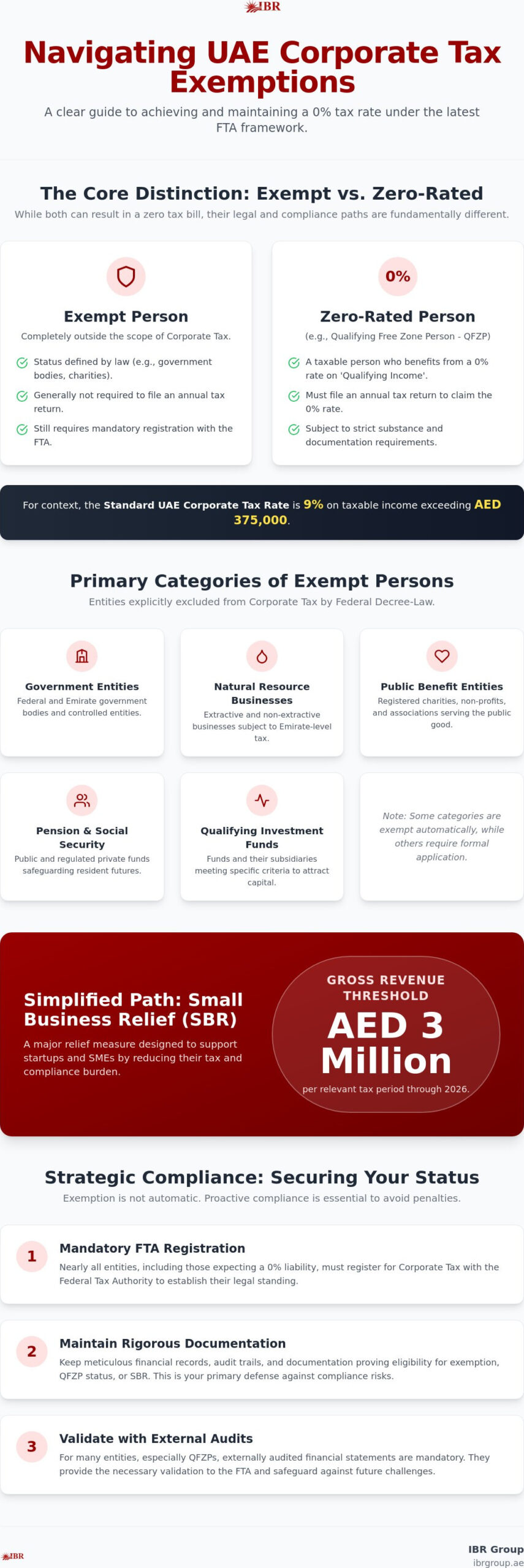
How does a business distinguish between a standard tax liability and a complete exclusion from the tax regime? Under the Federal Decree-Law No. 47 of 2022, the UAE government has established a clear structure for corporate tax exemptions uae to ensure the nation remains a competitive global hub. An Exempt Person is an entity not subject to UAE Corporate Tax due to specific legal criteria. These exemptions aren’t merely administrative oversights; they’re strategic tools used to promote public benefit, encourage long-term investment, and support the country’s economic diversification goals. By excluding certain sectors from the tax net, the UAE maintains its status as a premier destination for both regional and international capital.
The Legal Framework of Corporate Taxation
The UAE corporate tax system generally applies a standard rate of 9% on taxable income that exceeds the AED 375,000 threshold. However, the framework is designed with enough flexibility to accommodate global shifts. This alignment with international OECD Pillar Two standards ensures that the UAE remains compliant with global transparency requirements while protecting specific sectors. The Ministry of Finance (MoF) maintains the authority to determine which categories merit this status, often focusing on government-linked entities or those performing essential social functions. It’s a balanced approach that supports the local economy while adhering to international tax norms.
Exempt vs. Zero-Rated: Clearing the Confusion
It’s common for business owners to confuse being “tax-exempt” with being “zero-rated.” While they might both result in a zero balance on a tax bill, the compliance paths differ significantly. An exempt person is typically outside the scope of the tax entirely. In contrast, a Qualifying Free Zone Person (QFZP) is a taxable person who happens to benefit from a 0% rate on qualifying income. This distinction is vital because it dictates whether you’re required to file an annual tax return or maintain specific types of documentation for the Federal Tax Authority. Most exempt persons still need to register for tax purposes, even if they don’t expect to pay a single dirham.
Don’t mistake “exempt income” for an “exempt person.” A taxable company might earn dividends or capital gains that are considered exempt income, but the company itself still falls within the tax net and must fulfill all filing obligations. An exempt person, such as a government entity or a public benefit organization, isn’t a taxable person at all. Understanding this nuance is the first step toward achieving long-term compliance and peace of mind. As we move into 2026, the clarity of these definitions becomes even more critical for maintaining a corporate tax exemptions uae status that stands up to professional audit standards.
Primary Categories of Exempt Persons in the UAE
Identifying which entities fall within the scope of corporate tax exemptions uae is the first step toward strategic financial planning. While many businesses face the standard 9% rate, the Official UAE Corporate Tax Law explicitly defines several categories that remain outside the tax net. These primarily include federal and local government entities, as well as government-controlled entities engaged in mandated activities. Additionally, extractive and non-extractive natural resource businesses are generally exempt from federal corporate tax because they’re already subject to emirate-level taxation. This structure prevents double taxation while ensuring the UAE’s resource wealth is managed effectively at the local level.
Other vital categories include:
- Qualifying Public Benefit Entities (QPBE): These include registered charities, non-profits, and professional bodies that contribute to the social fabric of the UAE.
- Pension and Social Security Funds: Both public and private funds that meet specific regulatory criteria are protected to safeguard the future of residents.
- Qualifying Investment Funds: These funds, along with their wholly-owned UAE subsidiaries, can maintain exempt status to ensure the UAE remains an attractive destination for global asset management.
Automatically Exempt vs. Application-Based Entities
Does every exempt entity gain this status automatically? Not exactly. While federal and local government bodies are exempt by default, other organizations must follow a formal notification or application process. For instance, Qualifying Public Benefit Entities must be listed in a Cabinet Decision to secure their status. Similarly, Investment Funds don’t just claim an exemption; they must apply to the Federal Tax Authority (FTA) and meet stringent conditions regarding their regulatory oversight and investor base. Proactive planning is essential, and engaging with external audit services can help verify that your application meets all necessary financial benchmarks.
Subsidiaries and Controlled Entities
Exemption status can often extend beyond the primary entity. A 100% UAE-owned subsidiary of an exempt person may also be eligible for exemption, provided it performs a “mandated activity” on behalf of its parent. This is particularly relevant for government-controlled entities. To prove this to the FTA, you’ll need robust documentation, including organizational charts, ownership certificates, and detailed activity logs. It’s not enough to simply be owned by a government body; the subsidiary’s operational purpose must align with the parent’s sovereign or public functions. Maintaining this level of transparency is where many businesses struggle without professional guidance. Accuracy in these ownership structures isn’t just a preference; it’s a compliance mandate for 2026.
The Role of Free Zones: Qualifying Free Zone Person (QFZP) Status
Is your Free Zone entity automatically shielded from the 9% tax rate? This is perhaps the most common misconception among expatriate investors. While Free Zones remain a cornerstone of the UAE’s economic appeal, the 2026 regulations clarify that a 0% rate is a benefit earned through strict compliance, not a blanket right. To secure this advantage, an entity must achieve the status of a Qualifying Free Zone Person (QFZP). This status allows for a 0% tax rate on ‘Qualifying Income,’ but it requires meeting several cumulative conditions outlined in the Official UAE Government Corporate Tax Law. Understanding these corporate tax exemptions uae rules for Free Zones is vital, as failing even one of these criteria could shift your entire profit margin into the 9% taxable bracket.
Planning for this transition is not a task for the final month of the financial year. Many successful firms now utilize a business feasibility study to map out their operational structures before they even begin trading. This proactive approach ensures that your revenue streams are categorized correctly from day one, allowing you to maximize available tax benefits without risking non-compliance.
Defining ‘Adequate Substance’ in the UAE
To maintain your 0% status, you must demonstrate “adequate substance” within your specific Free Zone. This isn’t just about having a registered address. You must have a physical office space and a sufficient number of full-time, qualified employees residing in the UAE. Most importantly, your Core Income Generating Activities (CIGA) must be performed locally. If you outsource these critical functions to a third party or an offshore branch, you risk compromising your eligibility for corporate tax exemptions uae. The FTA expects to see that the economic value is being created within the borders of the Emirates, supported by physical presence and local expenditure.
Qualifying vs. Non-Qualifying Income
The distinction between qualifying and non-qualifying income is where most complexity lies. Generally, income derived from transactions with other Free Zone persons is qualifying, provided it isn’t from an “excluded activity.” However, transactions with Mainland businesses are often subject to the standard 9% rate unless they fall under specific exceptions. There’s also the “De Minimis” rule to consider. If your non-qualifying revenue exceeds 5% of your total revenue or AED 5 million (whichever is lower), you lose your QFZP status for that entire tax period. IBR Group provides a detailed corporate tax impact analysis to help Free Zone entities navigate these thresholds with precision. This level of scrutiny ensures that unexpected revenue spikes or minor mainland sales don’t lead to a total loss of your tax benefits.
Small Business Relief (SBR): Simplified Exemptions for SMEs
How can a growing enterprise manage its fiscal responsibilities without the burden of complex administrative overhead? The UAE’s Small Business Relief (SBR) provides a vital solution for the nation’s entrepreneurial ecosystem. It allows resident taxable persons with a gross revenue of AED 3 million or less to elect for a 0% tax rate. This initiative is a cornerstone of corporate tax exemptions uae policy, specifically designed to support the SME sector by treating the business as having zero taxable income for the relevant period. Beyond the tax savings, SBR significantly simplifies compliance by removing the need for complex transfer pricing documentation, which often requires extensive professional resources.
It’s critical to understand the temporal nature of this relief to avoid long-term compliance gaps. Currently, the SBR provisions apply to tax periods starting on or after 1 June 2023 and ending before or on 31 December 2026. As we approach this sunset date, business owners must stay vigilant regarding potential extensions or modifications by the Federal Tax Authority. This makes 2026 a pivotal year for strategic planning, as the relief acts as a temporary bridge for businesses to scale before entering the standard 9% tax bracket.
How to Elect for Small Business Relief
Electing for SBR doesn’t happen by accident; it’s a deliberate choice made during your annual filing. You must actively claim the relief when submitting your tax return to the Federal Tax Authority. Even if you qualify for the 0% rate, you’re still legally required to complete your Corporate Tax Registration to maintain a valid tax profile. The FTA also mandates that you keep accurate financial records for seven years. These records must clearly justify your revenue figures, ensuring that you haven’t exceeded the AED 3 million threshold through artificial means or accounting errors.
Limitations of Small Business Relief
There are specific boundaries to this support that every business owner should recognize. For instance, Multi-National Enterprises (MNEs) that are part of a group with consolidated revenues exceeding AED 3.15 billion are strictly excluded from SBR, regardless of their local UAE revenue. Additionally, if you elect for this relief, you cannot carry forward tax losses from that period to future years. SBR is an elective relief that must be claimed in each relevant tax period. This trade-off requires careful consideration to ensure it aligns with your long-term growth strategy. To ensure your business remains compliant while maximizing these benefits, it’s essential to partner with experts for your corporate tax filing needs.
Strategic Compliance: Securing and Maintaining Exempt Status
How do you ensure a 0% tax rate doesn’t turn into a 9% penalty plus interest? Many business owners mistakenly treat corporate tax exemptions uae as a “set and forget” status. In reality, the Federal Tax Authority requires a proactive approach to maintain these privileges. Most exempt entities, including those under Small Business Relief or government-controlled categories, must still complete Corporate Tax registration. You’re also required to file a tax return within nine months from the end of the relevant tax period. This filing acts as a formal declaration of your exempt status, backed by the necessary financial evidence. IBR Group’s professional advisory services are designed to manage these recurring obligations, providing a layer of protection against administrative oversights.
The Importance of Audited Financial Statements
For Free Zone entities aiming for QFZP status, audited financial statements are a non-negotiable requirement. These audits do more than just check boxes; they validate that your income is truly “qualifying” and that your “adequate substance” is documented. Professional external audit services also help international firms prevent “Permanent Establishment” issues. By verifying that your core income-generating activities stay within the UAE, an audit confirms your right to remain outside the higher tax brackets. It all starts with bookkeeping accuracy. Without precise records, even the most legitimate exemption claim can crumble under scrutiny.
FTA Audits and Exemption Revocation
What triggers an FTA investigation? Sudden spikes in non-qualifying revenue or a lack of physical presence are common red flags. If the FTA determines that you’ve failed to meet the conditions for corporate tax exemptions uae mid-year, the consequences can be severe. This often results in a retrospective revocation of your exempt status, leading to back taxes and significant fines. It’s also vital to plan for growth. If your business scales beyond the AED 3 million SBR threshold, you must transition from exempt to taxable status seamlessly. This shift requires a structured update to your accounting processes and filing strategies. We act as your steady guide through these transitions, ensuring that your compliance remains as agile as your business.
Securing Your Fiscal Future in the UAE’s Evolving Tax Landscape
Navigating the complexities of corporate tax exemptions uae requires more than just an understanding of the law; it demands a commitment to meticulous documentation and proactive registration. As we look toward 2026, it’s clear that maintaining a 0% tax status is a continuous process of validation rather than a one-time event. Whether you’re managing a Qualifying Free Zone Person status or leveraging Small Business Relief, the burden of proof remains with your entity. Success in this new era depends on your ability to align daily operations with the Federal Tax Authority’s rigorous standards for substance and qualifying income.
You don’t have to face these regulatory challenges alone. With over 15 years of UAE financial sector experience, our team provides the stability and deep-rooted expertise your business needs to thrive. We offer FTA-aligned tax advisory, comprehensive audit services, and AML support to ensure your exempt status remains undisputed. Secure your business compliance with IBR Group’s expert corporate tax services today. By building a foundation of precision and transparency now, you can focus on what truly matters: the sustainable growth and professional excellence of your enterprise.
Frequently Asked Questions
Are all Free Zone companies automatically exempt from UAE Corporate Tax?
No, Free Zone entities aren’t automatically exempt from the tax regime. To benefit from a 0% rate on qualifying income, a company must meet the strict criteria of a Qualifying Free Zone Person (QFZP). This includes maintaining adequate substance in the UAE, such as physical offices and local employees, and ensuring that non-qualifying revenue doesn’t exceed the de minimis threshold.
What is the maximum revenue for Small Business Relief in 2026?
The gross revenue threshold for Small Business Relief is AED 3 million for tax periods ending on or before 31 December 2026. This relief is a cornerstone of corporate tax exemptions uae, allowing eligible resident persons to be treated as having no taxable income. It’s an elective relief, so you must actively claim it during your annual tax return filing to benefit.
Does an exempt person still need to register with the Federal Tax Authority?
Yes, most exempt persons are required to complete their Corporate Tax registration with the FTA. Registration is the mandatory first step that allows the authority to identify your entity and acknowledge its exempt status. Even if your tax liability is zero, failing to register within the specified timelines can result in significant administrative penalties.
Can a charity or non-profit qualify for a corporate tax exemption?
Charities, non-profits, and other social organizations can qualify as Qualifying Public Benefit Entities (QPBE). These entities are exempt from corporate tax provided they are established for the public benefit and are formally listed in a UAE Cabinet Decision. The exemption typically applies to income generated from activities directly related to their non-profit purpose.
What happens if my business revenue exceeds the AED 375,000 threshold?
Income up to AED 375,000 is subject to a 0% tax rate, while any taxable income above this amount is taxed at the standard 9%. It’s important to distinguish between taxable income and gross revenue. If your total revenue is below the AED 3 million Small Business Relief limit, you might still avoid the 9% tax by electing for that specific relief.
Do I need an external audit to claim a Free Zone tax exemption?
Yes, having audited financial statements is a mandatory requirement for any Free Zone entity wishing to maintain QFZP status. The FTA relies on these audits to ensure that the entity’s financial records accurately reflect its qualifying income and substance. Skipping this step will disqualify the firm from the 0% rate, regardless of its location or activity.
How do I apply for a Corporate Tax exemption for an investment fund?
Investment funds must submit a formal application to the Federal Tax Authority to be recognized as an exempt person. To qualify, the fund must meet stringent conditions, such as being subject to local regulatory oversight and demonstrating that it’s not used primarily for tax avoidance. Wholly-owned UAE subsidiaries of these funds may also inherit this exempt status under certain conditions.
Can a foreign company be exempt from UAE Corporate Tax?
Foreign companies are usually only exempt if they don’t have a Permanent Establishment in the UAE or if their income is not UAE-sourced. However, certain foreign entities, such as those owned by foreign governments and engaged in sovereign activities, may qualify for specific exemptions. Many businesses also look to international double tax treaties to clarify their specific obligations and potential relief.