
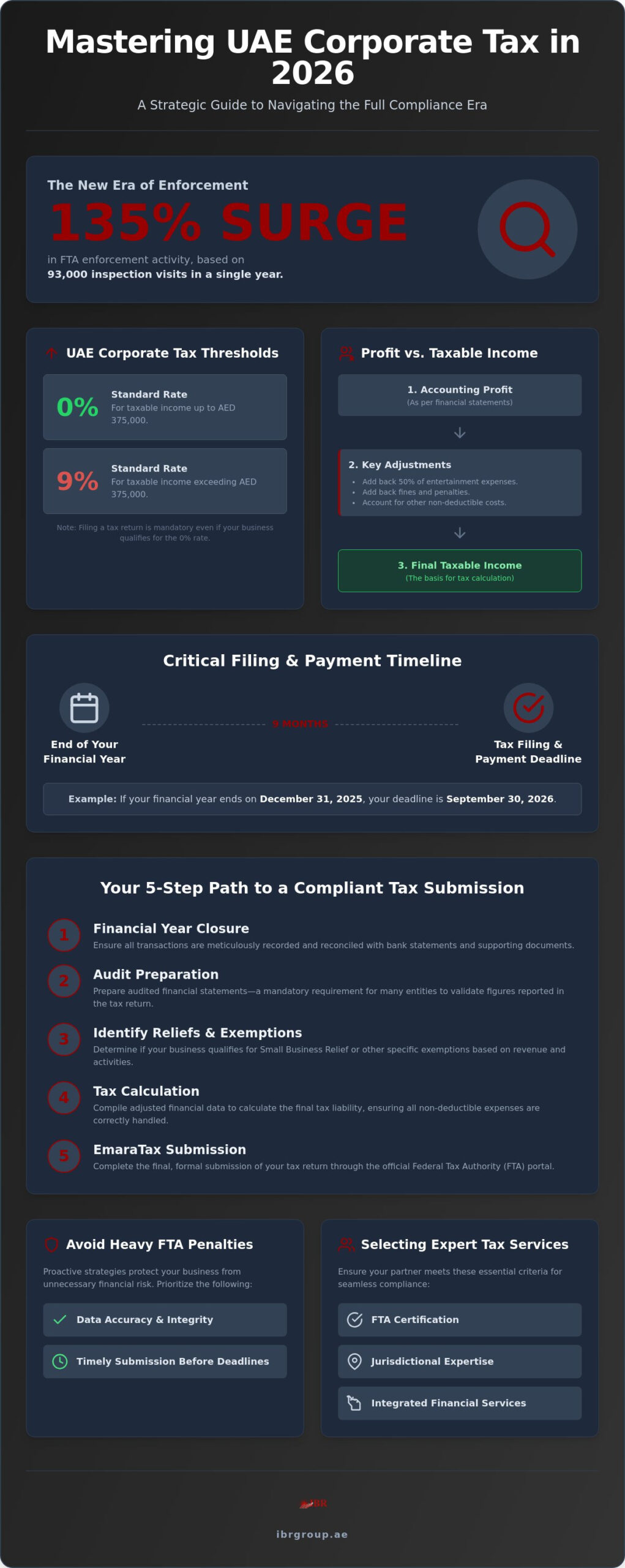
Did you know that the Federal Tax Authority recently conducted 93,000 inspection visits in a single year, representing a 135% surge in enforcement activity? This sharp increase in oversight signals a new era of accountability for every business operating within the Emirates. We understand that the transition from standard bookkeeping to rigorous tax compliance can feel daunting, particularly when the distinction between accounting profit and taxable income is so easily misunderstood. It’s natural to feel concerned about the potential for heavy penalties or the intricate requirements of transfer pricing documentation as the 2026 deadlines approach.
By partnering with expert corporate tax filing services uae, you can replace this uncertainty with a clear, strategic path toward full compliance. This guide provides a comprehensive roadmap to mastering the 2026 tax regime, ensuring your submissions are both accurate and timely. We’ll examine the specific steps required for professional filing, highlight how to optimize your available exemptions before key reliefs expire, and detail the proactive strategies that protect your business from unnecessary financial risk.
Key Takeaways
- Understand how the UAE’s regulatory environment is shifting from initial implementation to a phase of rigorous enforcement and full compliance in 2026.
- Identify the essential criteria for selecting professional corporate tax filing services uae, emphasizing the importance of FTA certification and jurisdictional expertise.
- Learn the critical preparation steps for closing your financial year, including the mandatory requirement for audited financial statements for many business entities.
- Discover proactive strategies to mitigate the risks of heavy FTA penalties by prioritizing data accuracy and timely submission.
- Explore how integrating bookkeeping, audit, and tax services creates a seamless financial strategy that supports long-term business stability.
Table of Contents
Understanding the UAE Corporate Tax Filing Landscape in 2026
What does it mean for your business to be fully compliant in the current fiscal year? Corporate tax filing is the formal process of submitting your company’s financial data and calculated tax liability to the Federal Tax Authority (FTA). While the initial rollout years focused on registration and onboarding, 2026 marks the beginning of the full compliance era. It’s no longer sufficient to merely be aware of the regulations; businesses must now demonstrate absolute precision in their annual submissions. Engaging expert corporate tax filing services uae is the most reliable way to manage this transition from basic bookkeeping to a rigorous, audit-ready tax strategy.
To appreciate the significance of these requirements, it’s helpful to view them within the broader context of Taxation in the United Arab Emirates. The system has evolved rapidly to align with international standards, ensuring the UAE remains a transparent and competitive global business hub. A common point of confusion for many entrepreneurs is the distinction between tax registration and the annual filing obligation. Registration is a foundational, typically one-time event that brings your entity into the FTA’s system. Filing, however, is a recurring annual duty. Even if your business qualifies for a 0% rate because its taxable income is below the AED 375,000 threshold, you’re still legally required to file a return. For income exceeding that amount, the standard 9% rate applies, necessitating careful calculation and documentation.
Key Deadlines and Filing Cycles for UAE Businesses
How does your financial year-end dictate your submission timeline? The FTA mandates a nine-month window for both filing and payment following the close of your financial year. For instance, if your financial year ends on December 31, 2025, your deadline for submission is September 30, 2026. Conversely, if your year ends on June 30, 2026, your deadline moves to March 31, 2027. A Tax Period is the specific timeframe for which a Tax Return must be prepared and submitted. Missing these windows can result in immediate administrative penalties, so tracking your specific cycle is a critical administrative priority.
Taxable Income vs. Accounting Profit: The Crucial Difference
Your net profit as shown on your financial statements is rarely the exact amount you’ll pay tax on. Converting accounting profit into taxable income requires several specific adjustments. Certain costs are considered non-deductible; for example, you can only deduct 50% of entertainment expenses, and fines or penalties paid to government bodies are generally excluded entirely. Understanding the corporate tax impact on uae businesses is essential for long-term planning, as these adjustments can significantly alter your effective tax rate. Professional oversight helps identify these nuances, ensuring you don’t overpay while remaining fully compliant with the Decree-Law.
Step-by-Step Guide to Corporate Tax Filing in the UAE
How do you move from raw financial data to a successful, compliant submission with the Federal Tax Authority (FTA)? Transitioning from daily operations to a formal tax filing requires a methodical approach that prioritizes data integrity. While registration was the initial hurdle, the actual filing process is where your internal records are put to the test. Utilizing professional corporate tax filing services uae ensures that each of the following five steps is handled with the precision the regulatory environment demands.
- Step 1: Financial Year Closure. This begins with meticulous bookkeeping and reconciliation. You must ensure all transactions are accounted for and align perfectly with your bank statements and supporting vouchers.
- Step 2: Audit Preparation. For many entities, preparing audited financial statements is a legal necessity to validate the figures reported in the tax return.
- Step 3: Identifying Reliefs. You must determine if your business qualifies for Small Business Relief or other specific industry exemptions based on your revenue and activity.
- Step 4: Tax Calculation. Compile your adjusted financial data to calculate the final tax liability, ensuring all non-deductible expenses are correctly identified and added back to your profit.
- Step 5: EmaraTax Submission. The final step involves uploading your data to the EmaraTax portal and settling any outstanding tax dues before the nine-month deadline.
The Role of Audited Financial Statements in Filing
Why does the FTA place such high value on an audit? For businesses with revenue exceeding AED 50 million, or those operating within specific freezone jurisdictions, audited accounts are often mandatory. Even when not strictly required, an audit serves as undeniable evidence of financial transparency. Partnering with reputable external audit firms in dubai provides the assurance that your data is robust enough to withstand official scrutiny. If you’re concerned about your current records, our team can provide a preliminary assessment of your compliance needs to identify any gaps before the filing deadline.
Applying for Exemptions and Small Business Relief
Small Business Relief (SBR) remains a vital provision for the 2026 tax period, allowing eligible businesses with revenue below AED 3 million to elect for a nil taxable income. It’s vital to remember that these benefits aren’t automatic; you must proactively claim them during the filing process. Engaging the right corporate tax filing services uae helps you navigate these elections accurately, ensuring you don’t miss out on legitimate tax-saving opportunities. For more complex structures, consulting a detailed list of corporate tax exemptions uae can reveal specific industry exclusions. Detailed information regarding the scope and rates can be found on the UAE Government Corporate Tax Portal, which remains the definitive source for current legislative updates.
Evaluating Corporate Tax Filing Services: What to Look For
Selecting a partner to manage your fiscal responsibilities is a decision that impacts your company’s long-term stability and reputation. What qualities should define your chosen provider? When evaluating potential corporate tax filing services uae, you must first verify that the firm holds official registration as a certified tax agent with the Federal Tax Authority (FTA). This certification is your primary assurance that the provider possesses the technical proficiency and ethical standing required by the UAE Government Corporate Tax Guide. A certified agent acts as a knowledgeable bridge between your business and the regulator, ensuring that your filings meet the highest standards of accuracy.
Beyond basic certification, look for a partner with deep-rooted experience in both mainland and freezone jurisdictions. The regulations governing Qualifying Free Zone Persons are highly specialized; a minor misinterpretation of “qualifying income” can lead to the unintended loss of your 0% tax status. Furthermore, many UAE entities operate within complex international frameworks, involving BVI structures or requirements for international tax residency. A firm capable of managing these intricate layers provides a level of strategic empowerment that a standard accounting service simply cannot match. You need a guide who understands how regional laws intersect with global financial standards.
In-house Compliance vs. Professional Tax Outsourcing
Is it more efficient to build an internal tax department or to outsource? For most enterprises, the overhead of a dedicated, high-level tax manager is significant. Outsourcing to a professional firm provides immediate access to a pool of experts who remain updated on every legislative nuance. This model offers superior risk reduction. An external provider acts as an objective second pair of eyes, catching potential errors in classification or deduction that might be overlooked by an internal team focused on daily operations. As your business grows, an outsourced partner scales their support seamlessly, matching your expanding compliance needs without the friction of internal hiring.
The Advantage of Integrated Audit and Tax Services
When the same firm manages your audit and tax filing, you eliminate the data silos that often lead to compliance gaps. This synchronized approach ensures that the figures reported to the FTA are perfectly aligned with your audited financial statements. This integration is particularly valuable during the tax season when financial institutions may request additional documentation. For instance, an expert report for uae bank queries can be generated much faster when your tax and audit records are already unified. Additionally, for those looking to expand, conducting a business feasibility study dubai ensures that your future growth is planned with tax efficiency as a core priority.
Mitigating Risks: Avoiding Penalties and Ensuring Compliance
Is the investment in professional tax assistance truly an expense, or is it a safeguard for your company’s future? Many business owners hesitate at the cost of outsourcing, yet the financial impact of a single filing error often far outweighs the price of expert guidance. The Federal Tax Authority (FTA) has established a rigorous penalty regime to ensure data integrity. For instance, failing to maintain the required financial records for seven years carries an immediate AED 10,000 fine, which can double for repeat violations. Late filing of your tax return triggers a monthly penalty of AED 500 for the first twelve months, increasing to AED 1,000 thereafter. These administrative costs accumulate rapidly, making corporate tax filing services uae a strategic necessity for risk mitigation.
Beyond simple filing, your entity’s overall standing depends on a holistic approach to compliance. This includes maintaining robust Anti-Money Laundering (AML) standards and ensuring all digital records are easily accessible for potential audits. A proactive stance on compliance protects your reputation with both regulators and financial institutions. If you’re looking to secure your business against these financial risks, you can consult our specialists for comprehensive tax and AML support to ensure every detail of your corporate standing is protected. By utilizing professional corporate tax filing services uae, you ensure that every calculation is verified against current FTA standards.
Transfer Pricing Documentation in the 2026 Cycle
How does the FTA view transactions between your various business entities? The “Arm’s Length Principle” dictates that any transaction between related parties must be priced as if they were independent entities. For large businesses, this requires the preparation of detailed Master Files and Local Files. You must accurately identify all “connected persons,” which includes owners, directors, and their relatives, to ensure your internal pricing doesn’t match what independent parties would agree upon. Mismanaging these disclosures is a primary cause of audit inquiries in the 2026 cycle.
Common Filing Errors and How to Prevent Them
Discrepancies often arise during the reconciliation between VAT and Corporate Tax returns. If your reported turnover for VAT doesn’t align with your CT taxable income, the FTA may flag the inconsistency for review. Another frequent error involves the misclassification of capital gains or dividends as exempt income without sufficient supporting documentation. To prevent these issues, a thorough pre-filing tax audit is essential to identify and correct discrepancies before your final submission. This extra layer of scrutiny ensures that your data is beyond reproach when it reaches the EmaraTax portal.
Streamlining Your 2026 Tax Compliance with IBR Group
How can your business transform tax compliance from a seasonal burden into a strategic advantage? At IBR Group, we believe the answer lies in a unified approach to financial management. With over 15 years of deep-rooted experience in the UAE financial sector, we act as the essential bridge between complex FTA regulations and your long-term business growth. Our corporate tax filing services uae are designed to provide peace of mind by integrating every facet of your financial life, from initial bookkeeping to the final submission on EmaraTax. This integrated model ensures that your data is never siloed, allowing for a seamless transition between your annual audit and your tax filing.
We understand that no two businesses are identical. Whether you operate an established mainland corporation or a specialized freezone entity, your tax strategy must reflect your unique operational reality. Our role is to act as a steady guide, ensuring that your data remains robust, transparent, and fully aligned with the latest regulatory changes. By choosing an integrated partner, you don’t just file a return; you build a foundation of professional excellence that supports your company’s reputation with regulators and financial institutions alike. We prioritize precision and high standards, allowing you to navigate the 2026 landscape with absolute confidence.
Bespoke Solutions for Freezone and Mainland Entities
For freezone businesses, the concept of “Qualifying Income” is a critical focal point in the 2026 cycle. Maintaining a 0% tax rate requires strict adherence to specific conditions, and even a minor oversight can lead to significant tax liabilities on non-qualifying revenue. We specialize in assisting clients with the nuances of freezone company setup uae and the subsequent tax obligations that follow. Our expertise also extends to managing complex multi-jurisdictional structures, ensuring that entities with international ties or BVI registrations remain fully compliant with regional laws without sacrificing operational efficiency.
The IBR Group Compliance Roadmap
Engaging with our team for the 2026 filing season is a methodical and deliberate process. We begin with a thorough review of your current financial records, identifying potential gaps or reconciliation errors before they become liabilities. Our total compliance package goes beyond the tax return; we offer essential support for goaml registration uae, ensuring your AML standing is as secure as your tax filing. This comprehensive oversight allows you to focus on your core operations while we manage the intricate administrative and financial details that define modern UAE business standards.
Don’t leave your compliance to chance in an era of increased enforcement and rigorous FTA inspections. Contact IBR Group today for expert corporate tax filing services in the UAE.
Securing Your Business Legacy Through Strategic Compliance
Reflecting on the 2026 landscape, it’s clear that the era of simple registration has passed. Success now depends on the meticulous reconciliation of accounting profits and the strategic application of available reliefs before they expire. By integrating your audit and tax workflows, you remove the data silos that often lead to costly FTA inquiries. This proactive approach ensures your business remains a stable and respected entity within the regional ecosystem. It’s about more than just numbers; it’s about building a foundation of transparency that supports your long-term growth objectives.
Navigating these intricacies requires a partner with deep regional roots and a commitment to precision. When you engage professional corporate tax filing services uae, you gain the peace of mind that comes from 15 years of UAE financial expertise and the support of FTA-aligned specialists. Whether you’re managing a complex freezone structure or a mainland enterprise, our comprehensive support is tailored to your specific needs. Secure your business compliance with IBR Group’s expert corporate tax filing services. We look forward to empowering your continued success and ensuring your financial future remains secure.
Frequently Asked Questions
What are the penalties for late corporate tax filing in the UAE?
Failure to submit on time results in a monthly penalty of AED 500 for the first year of delay. From the 13th month onwards, this fine increases to AED 1,000 per month. Additionally, late tax payments attract a 14% annual interest charge, calculated monthly. These costs can accumulate rapidly, making it essential to track your financial year-end and submission deadlines with absolute precision.
Can a freezone company claim 0% corporate tax during the 2026 filing?
Yes, qualifying freezone entities can benefit from a 0% rate on their qualifying income. However, they must still register for tax and file an annual return. It’s vital to ensure your income meets the strict qualifying criteria, as non-qualifying revenue is subject to the standard 9% rate. Utilizing professional corporate tax filing services uae can help you navigate these distinctions and protect your tax-exempt status.
Is an external audit mandatory for corporate tax filing?
An external audit is mandatory for businesses with annual revenue exceeding AED 50 million and for all Qualifying Free Zone Persons. Even if your turnover is lower, the FTA may request audited financial statements to verify the accuracy of your reported figures. Maintaining audited records is a hallmark of professional excellence and ensures your business is prepared for any potential regulatory inspection.
How much is the corporate tax rate for small businesses in the UAE?
The standard corporate tax rate is 0% on taxable income up to AED 375,000. Additionally, businesses with revenues at or below AED 3 million can elect for Small Business Relief for tax periods ending on or before December 31, 2026. This allows eligible entities to treat their taxable income as nil for the period, provided they meet all procedural requirements for the election.
Can I file my own corporate tax return on the EmaraTax portal?
While the EmaraTax portal is accessible to all registered taxpayers, filing without professional oversight carries substantial risk. The conversion of accounting profit to taxable income involves complex adjustments and non-deductible expense calculations. Expert corporate tax filing services uae ensure that your data is accurate and compliant with the latest Cabinet Decisions, providing you with peace of mind during the submission process.
What documents are required for corporate tax filing in 2026?
You’re required to maintain financial statements, general ledgers, and all supporting vouchers for a minimum of seven years. Key documents include audited reports, transfer pricing documentation for related-party transactions, and evidence supporting any claimed exemptions. Digital record-keeping is highly encouraged to facilitate seamless FTA inspections and to ensure that your business can quickly resolve any queries raised by the authority.
What happens if I make a mistake in my corporate tax submission?
If you discover an error, you must submit a voluntary disclosure to correct the inaccuracy through the EmaraTax portal. Correcting mistakes proactively may reduce the severity of administrative penalties compared to errors found during an FTA audit. However, inaccuracies that result in a tax shortfall typically lead to fines, so it’s critical to verify all data before the final submission is made.
Does the UAE have a tax treaty with India for corporate residents?
Yes, the UAE and India maintain a comprehensive Double Taxation Avoidance Agreement (DTAA). This treaty prevents the same income from being taxed in both jurisdictions for qualifying corporate residents. It’s a vital tool for multi-jurisdictional businesses looking to optimize their tax position while ensuring full compliance with both Indian and UAE regulations, especially regarding tax residency certificates and treaty benefits.