
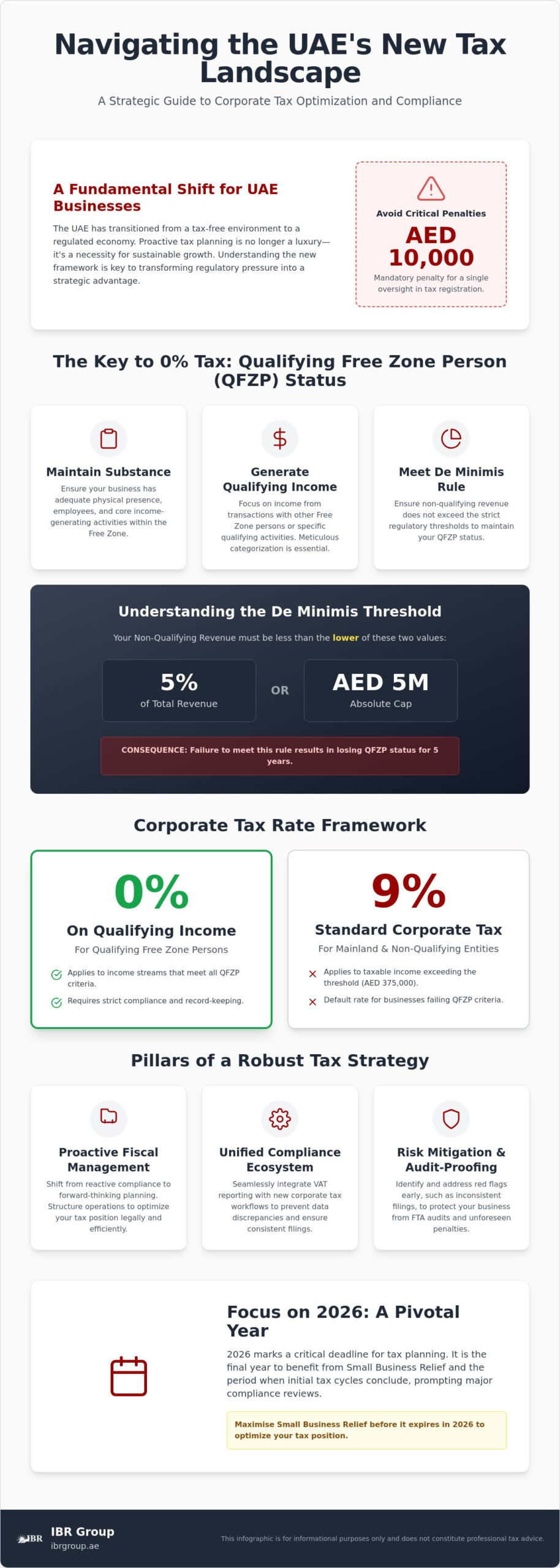
Is your current corporate structure a strategic asset, or has it become a hidden liability under the UAE’s evolving fiscal regime? For many entrepreneurs, the transition from a tax-free environment to a regulated landscape feels daunting, especially when a single oversight in registration can trigger a mandatory AED 10,000 penalty. Effective tax planning for uae companies isn’t just about meeting deadlines; it’s about building a foundation of professional excellence that protects your growth. We understand that the complexity of Qualifying Free Zone Person status and the nuances of the 9% tax threshold can create a sense of uncertainty for even the most seasoned business leaders.
In this article, you’ll master a sophisticated framework designed to optimize your corporate tax position while ensuring absolute compliance with the Federal Tax Authority. We provide a clear roadmap to help you maximize the use of Small Business Relief before it expires in 2026 and integrate your VAT workflows with new corporate tax requirements. By the end of this guide, you’ll have the clarity needed to transform regulatory pressure into a streamlined, tax-efficient operation that supports your long-term commercial goals.
Key Takeaways
- Transition from reactive compliance to proactive fiscal management by understanding the strategic shift in the UAE’s tax-regulated landscape.
- Identify the specific criteria required to maintain Qualifying Free Zone Person status and secure a 0% tax rate on qualifying income.
- Discover how to maximize available exemptions and Small Business Relief to optimize tax planning for uae companies before the 2026 fiscal deadlines.
- Establish a unified compliance ecosystem by seamlessly integrating your VAT reporting with annual corporate tax workflows to prevent data discrepancies.
- Gain a professional roadmap for structuring your business to ensure long-term stability and total regulatory compliance under the guidance of seasoned experts.
Table of Contents
Understanding the Strategic Importance of Tax Planning for UAE Companies
What does it mean to engage in professional tax planning? It’s a proactive method of arranging business operations to ensure fiscal efficiency while remaining strictly within the boundaries of the law. In the Emirates, this discipline has evolved from a luxury to a necessity. Effective tax planning for uae companies involves a deep analysis of financial records to identify legitimate ways to reduce taxable income, such as utilizing specific exemptions or group relief provisions.
For decades, the region was synonymous with a tax-free environment. However, the introduction of Federal Decree-Law No. 47 of 2022 signaled a permanent shift toward a tax-regulated economy. This UAE Taxation System Overview highlights how the nation has aligned itself with international standards like the OECD Pillar Two framework. Transitioning from zero tax to a 9% corporate tax rate requires a fundamental change in how businesses perceive their balance sheets and operational costs.
Why is 2026 such a pivotal year? It marks a period where many businesses will be concluding their initial tax cycles and facing their first major compliance reviews. It’s the time to audit historical filings and ensure that corporate structures remain optimal. We must distinguish between tax evasion, which involves illegal non-payment or underreporting, and tax optimization. Optimization is the strategic use of the law to achieve the most favorable fiscal outcome, ensuring you don’t pay a dirham more than is legally required. Strategic tax planning for uae companies is the only way to achieve this balance.
The Pillars of a Robust Tax Strategy
Compliance serves as the bedrock of any successful strategy. Without accurate bookkeeping, any planning effort is built on sand. Understanding the corporate tax impact on uae businesses is vital for long-term growth. Aligning your fiscal year with your operational cycle can also significantly improve cash flow management, allowing for better reinvestment opportunities and smoother tax payments.
Risk Mitigation and Regulatory Alignment
Identifying red flags early is the best way to prevent an FTA audit. These flags often include inconsistent VAT filings or unusual transactions with related parties. A business feasibility study dubai is often the first step in creating a tax-efficient structure for new ventures. This ensures all planning aligns with the latest Federal Tax Authority (FTA) circulars and protects the business from unforeseen penalties.
Evaluating Free Zone Advantage: Qualifying Income and 0% Tax Strategies
How do you ensure your free zone entity remains tax-exempt? While many entrepreneurs believe a free zone license is a blanket pass for 0% tax, the reality is far more nuanced. To benefit from the preferential rate, a business must attain the status of a Qualifying Free Zone Person (QFZP). This requires maintaining adequate substance, generating qualifying income, and complying with the de minimis rule for non-qualifying revenue. For those involved in tax planning for uae companies, distinguishing between these income streams is the difference between a 0% and a 9% tax liability.
The distinction between Qualifying Income and Non-Qualifying Income is the cornerstone of free zone fiscal strategy. Generally, transactions with other free zone persons or income from specific “Excluded Activities” must be carefully categorized. According to the Official UAE Government Corporate Tax Guide, businesses must meet all ongoing conditions to retain their status. If your non-qualifying revenue exceeds the lower of 5% of your total revenue or AED 5 million, you risk losing your QFZP status for five years. This “all or nothing” consequence makes precision in bookkeeping non-negotiable.
The 9% vs 0% Threshold: Decision Framework
Is the 0% rate always the best choice? Not necessarily. Some companies may find that opting into the standard 9% corporate tax regime voluntarily is more beneficial, especially if they wish to utilize tax grouping or offset losses across mainland subsidiaries. Additionally, your free zone operations can impact your international tax residency status. It’s a delicate balance. If your business model involves significant mainland trade, the administrative burden of maintaining QFZP status might outweigh the tax savings. Consulting with an expert for your tax filings and compliance ensures you remain on the right side of the de minimis threshold.
Substance Requirements and Compliance
Maintaining adequate substance isn’t just about having a desk; it’s about proving that your Core Income-Generating Activities (CIGA) occur within the zone. This involves having adequate employees, assets, and operational expenditure dedicated to those activities. One of the most critical requirements for any QFZP is the mandate for audited financial statements. Engaging reputable external audit firms in dubai is essential to verify this substance and validate your tax planning assumptions before the FTA requests a review. Common pitfalls often include misallocating overhead costs or failing to document board meetings held within the UAE. Avoiding these errors ensures your 0% status remains secure.
Leveraging Exemptions, Deductions, and Group Tax Relief
How can your business minimize its tax burden without compromising its compliance standing? While the 9% corporate tax rate is now a standard reality, the legislation provides several pathways to optimize your fiscal position. Strategic tax planning for uae companies involves a thorough understanding of available reliefs and the specific conditions required to claim them. For many small to medium-sized enterprises, the most significant opportunity lies in Small Business Relief (SBR). This provision allows eligible taxable persons with revenue below AED 3 million to elect to be treated as having no taxable income for a tax period ending on or before December 31, 2026. It’s a powerful tool for startups looking to reinvest capital during their formative years.
Beyond SBR, businesses should explore the wider range of corporate tax exemptions uae provides for 2026. These exemptions often apply to specific entities like government-controlled organizations, extractive businesses, or qualifying public benefit entities. However, even for standard commercial companies, certain income types, such as dividends received from UAE companies and capital gains from qualifying participations, may be exempt. Navigating these rules requires precision, as documented in the Federal Tax Authority Corporate Tax Resources, which serve as the definitive guide for filing requirements and eligibility criteria.
Group Tax Relief and Loss Transfers
Does your business operate through multiple subsidiaries? If so, forming a Tax Group could be your most effective strategy. To qualify, the parent company must own at least 95% of the share capital and voting rights of each subsidiary. This structure allows the group to file a single consolidated tax return, significantly reducing administrative overhead. More importantly, it enables the group to offset the losses of one entity against the profits of another. You must, however, remain mindful of transfer pricing rules. Even within a domestic tax group, transactions between members must be conducted at arm’s length to ensure the FTA doesn’t flag the arrangement as an attempt to artificially shift profits.
Optimising Deductible Business Expenses
Identifying what you can and cannot deduct is essential for accurate profit reporting. While most legitimate business expenses are deductible, certain items are strictly limited. For instance, only 50% of entertainment expenditure incurred for customers, shareholders, or suppliers is deductible. You should also consider the strategic timing of capital expenditure. By aligning major asset purchases with your fiscal year-end, you can maximize depreciation allowances and lower your taxable base. We also advise a careful review of interest expenditure, as the law imposes a cap on net interest deductions to prevent excessive debt-loading. Mastering these nuances ensures your financial statements reflect a lean, tax-efficient operation.
Integrating VAT Compliance with Corporate Tax Planning
Why should your finance team treat VAT and Corporate Tax as a single, unified ecosystem? In the past, many businesses managed these obligations in isolation, but the Federal Tax Authority (FTA) now possesses the digital infrastructure to cross-reference data across different tax heads. Effective tax planning for uae companies requires absolute consistency between your periodic vat return filing uae and your annual corporate tax submissions. Any discrepancy in reported turnover can immediately trigger a risk flag for an audit. When your VAT data aligns perfectly with your corporate profit declarations, it projects an image of transparency and professional excellence.
The interaction between these two taxes goes beyond mere reporting. For instance, if your business provides VAT-exempt supplies, you cannot recover the input VAT paid on related expenses. This unrecoverable VAT becomes a direct cost that reduces your corporate profit margins. Strategic planning involves analyzing these “hidden” costs to understand their impact on your overall taxable base. Additionally, VAT records provide a robust audit trail for domestic transactions, which is essential when documenting transfer pricing for related-party dealings within a Tax Group.
Reconciling Revenue Across Tax Heads
Discrepancies often arise due to different “time of supply” rules. While VAT is typically accounted for upon invoicing or payment, corporate tax follows accrual-based accounting standards. Reconciling these timing differences is a critical step in maintaining data integrity. Utilizing professional corporate tax filing services uae helps you navigate these complexities by creating a bridge between your VAT ledgers and your year-end financial statements. Preparing for a multi-tax audit starts with ensuring that every dirham is accounted for consistently across all FTA portals.
The Role of AML and goAML in Tax Transparency
Tax transparency is now inextricably linked to Anti-Money Laundering (AML) standards. The UAE’s focus on identifying Ultimate Beneficial Ownership (UBO) means that tax liabilities are often traced back to the individuals who truly control the entity. Completing your goaml registration uae is not just a regulatory hurdle; it’s a declaration of corporate legitimacy. We ensure your tax planning strategies don’t inadvertently trigger AML reporting flags by maintaining clear documentation of all cross-border transactions and shareholder distributions. If you need assistance aligning your VAT and corporate tax workflows, our team can help you implement a seamless compliance framework tailored to your industry.
Executing Your 2026 Tax Strategy with IBR Group
How do you translate the intricacies of Federal Decree-Law No. 47 into a functional business strategy? The journey toward fiscal excellence requires more than just understanding the law; it demands a partner who can implement it with precision. Professional tax planning for uae companies is not a one-time event but a continuous cycle of assessment and refinement. IBR Group provides a tailored roadmap that moves beyond simple compliance, focusing instead on optimizing your fiscal position for long-term stability. With over 15 years of regional financial expertise, we act as a steady guide in a landscape that often feels overwhelming for business owners.
Our approach begins with a comprehensive review of your current corporate structure and historical filings. We believe that a professional audit is the only way to validate your tax planning assumptions and ensure your business is truly prepared for FTA scrutiny. From initial corporate tax registration to the final annual filing, we manage every step of the journey. This seamless end-to-end process allows you to focus on your core operations while we handle the complexities of the regulatory environment. We ensure that every exemption is explored and every deduction is accurately captured, leaving no room for error.
Customised Advisory for Every Business Structure
Every business structure in the UAE comes with its own set of challenges and opportunities. Whether you operate a mainland entity, a freezone company, or an offshore structure, your strategy must be customized to your specific operational reality. We also provide specialized support such as an expert report for uae bank queries to ensure your financial transparency meets the high standards of regional financial institutions. Our team continuously monitors regulatory changes, ensuring your framework remains current as new FTA circulars are released.
Securing Your Corporate Future
Choosing a partner for your tax and compliance needs is about more than just numbers. It’s about securing the peace of mind that comes from authoritative guidance. We don’t just file returns; we act as a protective advisor for your financial growth, identifying risks before they become liabilities. As you look toward the 2026 fiscal year, the time to evaluate your position is now. We invite you to Consult with IBR Group for your 2026 tax planning needs and take the first step toward achieving total fiscal excellence.
Securing Your Fiscal Foundation for 2026 and Beyond
The landscape of UAE taxation is no longer a static environment; it’s a dynamic system that rewards precision and proactive management. By mastering the criteria for Qualifying Free Zone Person status and strategically leveraging Small Business Relief before the 2026 window closes, your business can achieve significant fiscal efficiency. Integrating your VAT workflows with corporate tax filings ensures data integrity and protects you from the risk of unexpected FTA audits. Strategic tax planning for uae companies is the cornerstone of sustainable growth in this new era of transparency.
With over 15 years of regional financial expertise, IBR Group provides the stability and deep-rooted knowledge needed to navigate these intricate requirements. We offer comprehensive FTA compliance support and customized strategic advisory for both mainland and freezone entities, ensuring your peace of mind. Our role is to act as your protective advisor, simplifying complexity so you can focus on your commercial ambitions. Don’t leave your compliance to chance. Optimise Your Corporate Tax Strategy with IBR Group today and build a future defined by fiscal excellence and professional confidence.
Frequently Asked Questions
Is tax planning legal for companies operating in the UAE?
Yes, tax planning is entirely legal and is considered a standard practice for professional fiscal management. It involves the strategic arrangement of business affairs to ensure tax efficiency while remaining fully compliant with UAE laws. This is fundamentally different from tax evasion, which involves illegal activities like underreporting income or falsifying records to avoid paying the tax that is legally due.
Can a freezone company still benefit from 0% tax in 2026?
Freezone companies can still benefit from a 0% tax rate in 2026 if they qualify as a Qualifying Free Zone Person. To maintain this status, the entity must meet strict requirements, including maintaining adequate substance in the UAE and ensuring non-qualifying revenue stays below the de minimis threshold. This threshold is the lower of 5% of total revenue or AED 5 million.
What is the current threshold for Small Business Relief in the UAE?
The current revenue threshold for Small Business Relief is AED 3 million for each tax period. Eligible businesses with revenue below this amount can elect to be treated as having no taxable income for tax periods ending on or before December 31, 2026. This provision serves as a critical tool in tax planning for uae companies, allowing startups to reinvest their capital during initial growth.
How does forming a Tax Group help with tax planning?
Forming a Tax Group allows a parent company and its subsidiaries to be treated as a single entity for tax purposes. This simplifies the administrative burden by requiring only one consolidated tax return. More importantly, it allows the group to offset the losses of one member against the profits of another, which can significantly optimize the overall tax position and cash flow of the organization.
Do I need an external audit for my corporate tax filing?
An external audit is a mandatory requirement for any Qualifying Free Zone Person seeking to benefit from the 0% corporate tax rate. While not all mainland businesses are legally required to audit their accounts, doing so provides an essential layer of security. Audited financial statements serve as verified evidence of your compliance and help protect your business during potential Federal Tax Authority reviews.
Can I deduct all business expenses from my taxable income?
No, you cannot deduct every expense. Only costs incurred wholly and exclusively for business purposes are eligible for deduction. Certain expenses are subject to specific limits; for example, you can only deduct 50% of entertainment expenditure. Non-deductible items include dividends, personal expenses, and certain types of interest, so it’s vital to categorize your spending accurately to ensure your reported taxable profit is correct.
How often should a UAE company review its tax planning strategy?
We recommend that businesses review their tax strategy at least once a year or whenever there is a major change in the corporate structure. Frequent reviews ensure that your planning remains consistent with the latest FTA regulations and helps you identify new opportunities for relief. A proactive approach allows your company to adapt to growth while maintaining total regulatory alignment and fiscal efficiency.
What are the penalties for incorrect tax planning or non-compliance?
Penalties for non-compliance are strictly enforced, including a mandatory AED 10,000 fine for late corporate tax registration. Additional administrative penalties apply for late filing or the failure to pay the due tax by the deadline. Professional tax planning for uae companies is designed to prevent these avoidable costs by establishing a methodical compliance schedule that aligns with all current Federal Tax Authority requirements.